
While the world is abuzz with drones potentially being used for things like food or online shopping deliveries, others have found fun in using them for recreational purposes, especially when it comes to those with a competitive streak.
Drones whizz around inside a cage while spectators watch in awe of the pilots’ precise control. They manoeuvre and collide in midair as strikers aim for the opposing team’s goal hoop.
Each drone is protected by a spherical plastic frame called a Drone Ball, allowing them to bump midair without breaking. Strikers, meanwhile, aim to fly through the opposing team’s goal hoop to score points while going head-to-head against defenders.
This all happens within a single three-minute round of drone soccer, an up-and-coming sport born in South Korea circa 2016, which has now begun taking root here in Malaysia.
A sport for everyone
According to Yong Chong Soon, the founder of local drone soccer organisation Cybersphere Malaysia, a Malaysian team has already made waves in the sport’s global scene.
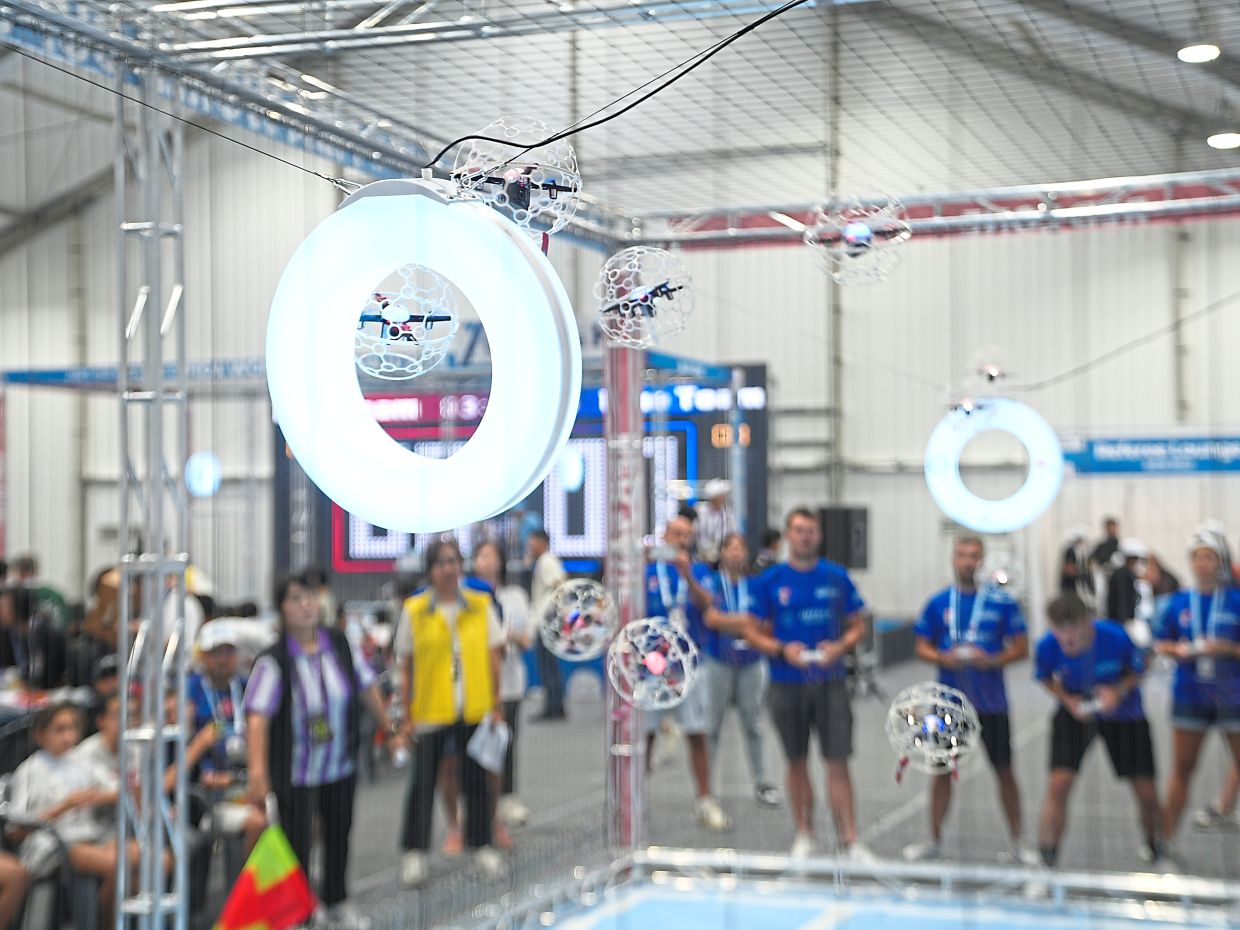
At the end of September, Cybersphere Malaysia sent a contingent of players to represent the country in the Federation International DroneSoccer Association (Fida) World Cup held in Jeonju, South Korea.
The Malaysian contingent managed to snag a second runner-up finish in the Class 20 category, placing behind only Japan and Korea among 24 participating countries.
What made the team’s win more remarkable was the fact that the team was made up of four primary school students, one secondary school student, and two university students, who managed to hold their own against teams of fully grown adults, without feeling intimidated.
Despite the team’s success, Yong says that it is still early days for drone soccer in Malaysia, with only about 400 players nationwide.
“We were very pleasantly surprised that we got number three,” he says.
Yong hopes that the team’s performance at the World Cup will lead to more visibility for drone soccer among potential players, while also attracting more funding and support to grow the community.
“I think the big draw is that this is a spectator sport. The excitement really comes when there is a close match and the scores are close to each other. That’s where the adrenaline just builds up,” he says.
Teams in drone soccer consist of five players at a time and up to two additional players in reserve. Yong adds that the sport is “open to almost everybody”, with no restrictions on age or gender.
At the World Cup in South Korea there were teams with players in their 50s and 60s, and even one player who was a wheelchair user.
Techie thrills
While Yong says that learning to play drone soccer is relatively simple and straightforward, the challenge comes in players polishing their piloting skills and learning strategies due to the game’s high skill ceiling.
“If you haven’t played the game, it’s easy to think that it’s just about scoring, but there’s a lot of tactics involved.
“The goal ring is just 30cm wide – if two defenders are right next to each other in front of it, it can seem nearly impossible to get past them, but the really good players can spin their drones around them to score,” he says.
Teamwork makes the dream work
Each of the five players on the field plays a specific position: the striker, who goes for the hoop to score; the guide, who assists the striker and takes over scoring if the striker crashes; the libero, who acts as the front defender; the sweeper, who covers the rear; and the keeper, who defends the goal hoop.
These clearly outlined roles means that no single player can win a match by themselves, making teamwork especially crucial in order to close out a win.
From Cybersphere Malaysia advisor Mohamad Zamani Razali’s perspective, a key part of drone soccer is the ability to make snap decisions during critical moments in a match.
“One of the things I like most is how important fast decision-making is for the students or whoever is playing.
“They’ll be in a situation where they cannot get through somewhere and need to find another way around, how to divert the attention of these defenders or whatnot.
“So this is the creativity and innovative mindset we need in players. This is what we saw in our striker – she has the skill to create opportunities to score goals,” he says. He adds that with the wider acceptance of esports, he hopes for similar support for drone soccer.
Yong even notes that some teams used headsets during matches for communication – something that he hopes that Malaysian players can replicate with enough funding.
“Many new players think, ‘hey, I’m a striker, I play by myself and just take care of scoring’ and the defenders think ‘okay, I play in isolation’. But those kids who went to South Korea realised that there’s a lot of communication at play.
“When you look at drone racing, it’s very individual, it’s ‘me against the clock’, but for drone soccer, it’s a team game. If the striker is strong but the defenders are weak, you will still lose,” he says.
According to Yong, it costs around RM850 to get started with a 20cm drone meant for Class 20, but it can get significantly pricier with the 40cm drones meant for Class 40 ranging from RM2,500 to RM6,000, which use more specialised parts and feature more in-depth tuning.
The speed of the game also varies significantly between drone classes, with the smaller Class 20 drones generally flying at around 30kph, while Class 40 drones can reach well over 100kph.
While Class 20 competitions use a standardised drone model that can be tuned in software with tweaks on manoeuvrability and flight parameters, Class 40 participants have more freedom to play around on the hardware side of things as well.
This includes swapping out different parts like the propellers, along with materials such as carbon fibre being used in the drone, so long as the proper weight requirements of 1.1kg or lighter are met.
Mohamad Zamani adds the such modifications and maintenance of drones can even further develop technical skills among the participants.
“The best thing about this, the student, whether they’re still young, or on the secondary school or university level, whenever they are playing this, they are doing repairing, doing the adjusting and all those things by themselves.”
He explains that after every game, the players get to make modifications to their drones to adapt to the game’s needs on the fly.
According to Yong, some Class 40 teams even adjust the weight on their drones depending on the specific role they are being played in. For instance, a striker drone’s weight could be lowered to 1kg for greater speed, while a defender drone might be maintained at 1.1kg for more stability and sturdiness when blocking while sacrificing speed.
He hopes that Malaysia can rise to become a central player in drone soccer for the Asean region, with Cybersphere Malaysia hoping to organise a yearly drone soccer festival in Johor from next year.
He adds that this festival would be held in conjunction with the 2026 Visit Malaysia Year and Visit Johor Year.