
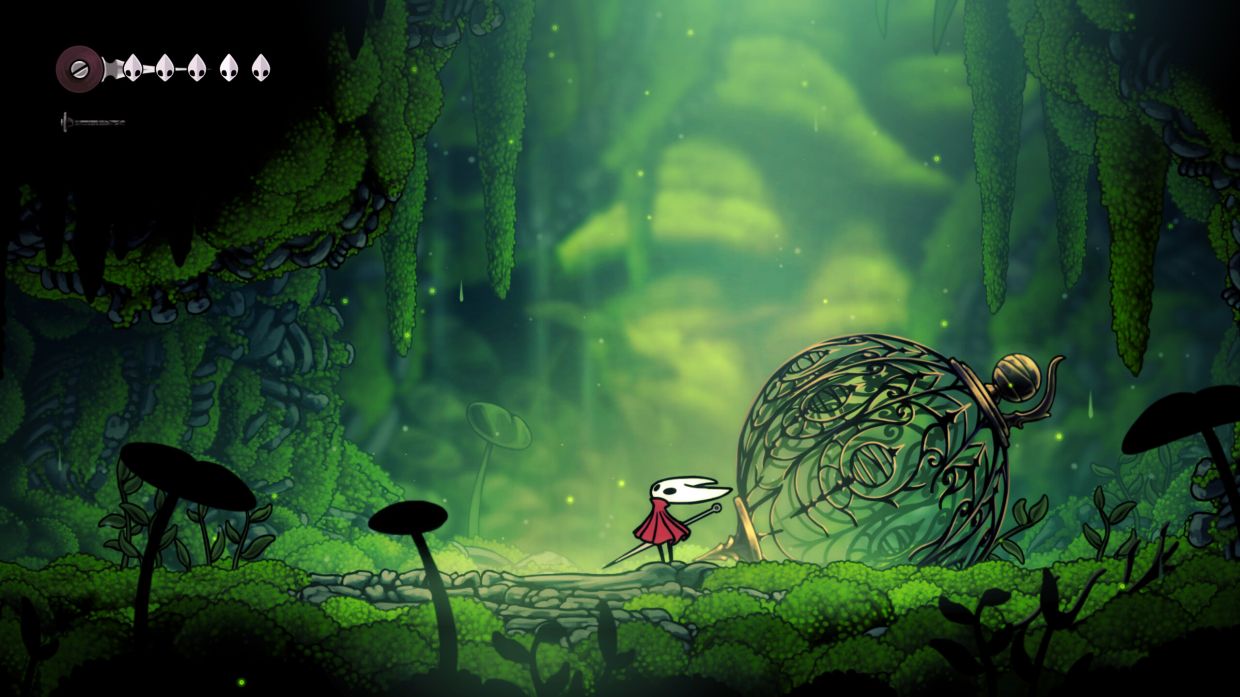
Pharloom, the mysterious realm in Hollow Knight: Silksong, is ruled from above by detached and distant figures in a gleaming and tightly sealed citadel. After the lithe and balletic Hornet, reprising her role as gifted royal progeny, is brought to Pharloom under armed guard, she makes a quick escape into this strange and unfamiliar land where she must leap, dash and slash her way to victory.
Along her journey, Hornet meets many self-described pilgrims, other bugs who have come to seek an audience with Pharloom’s cloistered deities. There’s a bell-clanging zealot, various merchants and thieves, even a mapmaking mantis. Hornet and those fellow pilgrims must overcome many layers of obstacles – towering bosses, spike-ridden corridors and dangerous, wind-swept precipices – to gain entry to the citadel’s supposed sanctuary, where even tougher trials await.
The original Hollow Knight, released seven years ago, quickly built a devoted fan base because of the cartoony aesthetic and satisfying 2D gameplay, all underpinned by an evocative narrative and rich characters.
Silksong was originally meant to be an expansion released a year or so later, but the small Australian studio Team Cherry then disappeared from sight, buttoning themselves up within their own impervious fortress. For years, fans would ruin every awards show and trailer announcement with fervent requests for news from the elusive Silksong.
Well, the wait is over.
The gleaming doors of Silksong’s citadel have flung open, and everyone has been let in out of the cold. The gods continue, however, to maintain their distance. Players must display their willingness to submit to Silksong’s endless challenges, to overcome the game’s many punishing boss fights, in order to establish that they, the faithful, deserve this object that has been held just out of reach for so long.
Beating Silksong, even the first of its several endings, requires more than just time – it requires mastery. There’s no brute forcing this game. The most leveled-up player, bristling with upgraded weapons and tools, must still practice and grow familiar with Hornet’s every move, which vary widely depending on how she has been customised.
Different tools affect how brutally Hornet attacks, how high she jumps and how quickly she dashes. One approach allows you to regain health by aggressively attacking enemies, in contrast to the delicate game of keep-away employed elsewhere. Silksong deepens and complicates the relatively simple systems of the previous game, and learning its intricate new structure is an intriguing challenge.
Yet all these trials tend to obscure Silksong’s narrative and atmosphere. The game’s numerous bosses stand out more for their mechanical challenges than the stories they tell. The Savage Beastfly and Sister Splinter were incredible pains who taught me all about timing and positioning, but I have no idea why I fought them or who they really were.
When bosses do have compelling stories, like a windup clockwork dancer going through the lonely motions after you kill its partner, or a misbegotten sibling locked away in a deep underground cell, they offer glimpses of a much richer experience. Imagine an emphasis on discovery and mystery rather than the masochistic stubbornness required to bang one’s head against a wall until one or the other cracks.
The idea of a judge standing at the gates of the citadel, violently rebuffing hopeful pilgrims like some Kafkaesque joke, is incredibly compelling. But soon the only information I can store in my head is the best route from my save point back to the boss room, where to dash, where to jump, which enemies to avoid, and so on. Momentum in Silksong is frequently tripped up in this manner. Pharloom is a world I want to explore, but I am constantly getting waylaid by enemies large and small. The flying foes that dash around and bait me into disastrous mistakes are the bane of both my health bar and spirit.
This all frustrates any potential wanderlust in spite of Pharloom’s rich bounty of sights. Silksong has a much broader footprint than Hollow Knight, soaring into the heavens and plunging deep within the earth. The map is packed with secrets, false dead ends and hidden shortcuts. It’s easy to get deliciously lost here, to wander through dim caves and dank tunnels, growing more and more desperate without a map merchant or save point in sight, and with your precious health getting inexorably chipped away.
Hornet manages to make this oppressive, atmospheric world her own. She forms alliances with its residents, with Silksong introducing semipermanent settlements that can be strengthened through side missions and donations. Though many of these side missions are trite collectathons, there are occasional enlivening hunts that require following the ghostly trail of an elusive boss.
Exploring this world thoroughly is necessary to see all of the game’s endings. It sheds more light on what went down in Pharloom – how it fell victim to the same cycles of accumulation and greed that made Hollow Knight’s kingdom susceptible to outside influence and corruption.
Actually achieving these endings requires a monumental degree of effort. Players must invest dozens of hours familiarising themselves with Silksong’s many regions, fast-travel points and important characters. They must solve the challenging quandaries of pilgrims and track down the hidden castaways of an itinerant flea circus who are wedged into every far-flung corner of Pharloom.
This is a world meant to be lived in, to be run through again and again, until that weird pattern of rocks starts to look like a breakable door, until that specific tangent of wall edges ultimately reveal a potential hidden passage. But the act of moving through Pharloom is so dreadfully cursed with teeth and claws and jagged shell that it becomes difficult to want to exist in this world at all. Which is ironic considering how long fans begged to be let in.
After years of waiting, we’ve finally been allowed into Team Cherry’s ornate creation. But I am finding far less magic than pain. It’s a bristly world, left too long in the oven, now hardened over. – ©2025 The New York Times Company
(Hollow Knight: Silksong was reviewed on the Switch 2. It is also available on the PC, PlayStation 4, PlayStation 5, Switch, Xbox One and Xbox Series X|S.)
This article originally appeared in The New York Times.