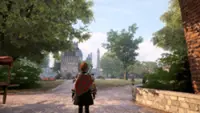
The battlefield reeks of “dusty mustard”. A fanged, freckled character threatens to bite off someone’s face. Coat racks talk, and you’re called a thief when you purchase something from a store. Such is the topsy-turvy world of Deltarune.
This stunningly imaginative role-playing adventure is perhaps the most lo-fi of the earliest releases for the Nintendo Switch 2. But through four expansive and generous episodes – two of them newly published, the others from 2018 and 2021 – Deltarune proves to be the most surprisingly wonderful of those games.
Very early on, as a group of lovable misfits tread through the darkness to bring balance back to their world, the question one could ask is, How could these “prophesied heroes” save anything, even themselves? Perhaps that feeling of doubt surfaces because the pixel artwork is reminiscent of 1980s Atari visuals instead of the assertively modern graphics of, say, Mario Kart World.
But Deltarune’s art style is a trick. Simplicity makes these sprites more endearing, more seemingly real. This merry merging of computer dots transforms into beings who are edgy, flirty and multifaceted. The lovably punky human-monster Susie, the one who threatens to bite faces, ultimately opens their heart to another character. Kris, their face partly hidden by strands of hair, is the silent, introverted teen hero who leads the way. But Kris has something of a dark side, too.
In groups of three, they set forth to explore a universe spun off from Undertale, the 2015 game that sold millions – making its young creator, Toby Fox, wealthy – because fans found so many things to see and do. That variety continues to hit home in Deltarune (an anagram of Undertale). Yes, a sword can kill enemies during turn-based battle. But putting foes to sleep and pacifying them is not only less cruel. It’s much more satisfying.
Deltarune spans the ages of animation past. While it’s clear that The Legend Of Zelda and Pokémon are influences, another inspiration is decades older. When Kris dutifully leads their party members through a church past ghostly, praying angels with antlers, they move in single file with short, dutiful steps, like Linuses or Lucys from a “Peanuts” cartoon.
Some of the game’s writing could be pared down to be clearer and, especially, grammatically correct. But it’s the riffing, improvisation and satire that allow for a deeper attachment to the characters.
Take the complex slide puzzle in a library-themed maze that involves playing pianos and moving shelves. At one point among the tomes, you’ll read perfectly nerdy puns about the Dewey Decimal System. Elsewhere, Carol Holiday, Kris’ reindeer-inspired childhood friend, lives in a mansion that’s a twisted homage to Christmas.
The soundtrack, more than 150 pieces composed by Fox, is remarkably diverse. A slightly unsettling, upbeat theme plays as the trio competes in a game show. At another point, a samba inspires real-life toe-tapping. On the game save screen, three repeated notes are spot on. They sound like the foreboding groaning in Einstürzende Neubauten’s classic “Stahlmusik.”
Speeding through Deltarune to a quick ending is not the point. It’s meant to be enjoyed gradually, a trip along startling roads less traveled with your virtual friends. Moving through life with Susie and Kris recalls teenage adventures. They’re full of abandon and occasional recklessness, if not supernatural moments of dread. To absorb the experience with each of the five senses is to satisfy every part of the mind.
It took Fox nearly 10 years to make four of the seven episodes he has promised. It may take another decade to complete the series. But spending a full week with this masterpiece is nothing short of a blessing. – ©2025 The New York Times Company
(Deltarune was reviewed on the Switch 2. It is also available on the PC, PlayStation 4, PlayStation 5 and Switch.)
This article originally appeared in The New York Times.