Hey everyone! As I’m writing this, I’ve already spent two weeks engrossed with my Nintendo Switch 2, playing Mario Kart World (MKW), the new Rune Factory, and various Switch 1 favourites.
The fact that I’m enjoying Mario Kart so much is actually pretty amazing, because in real life, I find driving waaay too stressful. (I used to drive in KL, and let me tell ya, Malaysian drivers are maniacs.) (Editor’s note: Eh, speak for yourself ah.)
Anyway, there’s a lot I want to talk about in regards to Nintendo’s new game console and its flagship launch title, but if you’re just reading this article for a recommendation on whether the Switch 2 is right for you, here’s my quick review:
The Nintendo Switch 2 is a bigger, beefier Switch 1. This means that, like its predecessor, this game console is an excellent investment if you want to play games with family and friends, or if you just want to enjoy Nintendo’s wholesome, well-designed library of games.
If you already own a Switch 1, then consider the Switch 2 a major upgrade that’s reeeaaally nice to have, but not something you need to rush to get. At the moment, its only exclusive game is Mario Kart World, so there’s no harm waiting for Nintendo to release more titles. (That said, MKW is awesome.)
One good thing about the Switch 2: I can run almost every single Switch 1 game I have on it, save for some weird outliers like the Nintendo Labo, so there’s already plenty to play. One bad thing about the Switch 2: the new price point makes it more of a premium purchase. In the UK, the Switch 2 is £395.99 (prices start at RM2,488 in Malaysia), compared to the Switch 1’s £259.99 (RM1,288 in Malaysia) or the Switch 1 OLED’s £309.99 (RM1,588 in Malaysia). (Yipes!)
Alright, now that review’s out of the way, I can now ramble about every single thought I have on my Switch 2 experience! So, in my best Mario voice: Let’s a-gooo! Wa-hoo!
Like Switch, but Switchier
My biggest surprise with the Switch 2 is that it is, in fact, pretty much a bigger (literally) and better Switch 1. If you’re used to, say, Sony PlayStations, where each successive console basically just had better graphics and processing power, this shouldn’t come as much of a surprise.
But, as a long-time Nintendo nerd who went oooh as the 3DS introduced touchscreen gameplay and aaahhh when the Wii introduced intuitive motion controls, I was expecting something crazy new and wildly inventive from Nintendo’s new console, like a console that, uh, could fold into an origami crane or something.
Hypotheticals aside, the new Switch 2 did feel comfortable and familiar in my hands even as I took it out of the box. It was significantly larger (about 30% more) and a bit heavier (about 22.37% more, and why yes, I did use a kitchen scale for this) than my Switch 1 OLED, but the control layout’s pretty much the same save for the addition of a “C” (“Chat”) button on the right Joy-Con 2. (More on GameChat later.)
Like its predecessor, the Switch 2 can be played in its handheld mode, tabletop mode (i.e. it has its own kickstand so you can prop it on a table), and TV mode (i.e. docked). 95% of the time I’m playing it in handheld mode, and I have good things to say about its bigger and brighter 7.9in screen (compared to 7in on my Switch 1 OLED) and battery life (I regularly got three-plus hours playing Guardians Of Azuma).
So hardware-wise, the Switch 2 is already just a solid upgrade to the Switch 1 – so what’s actually “new” new?
What’s new?
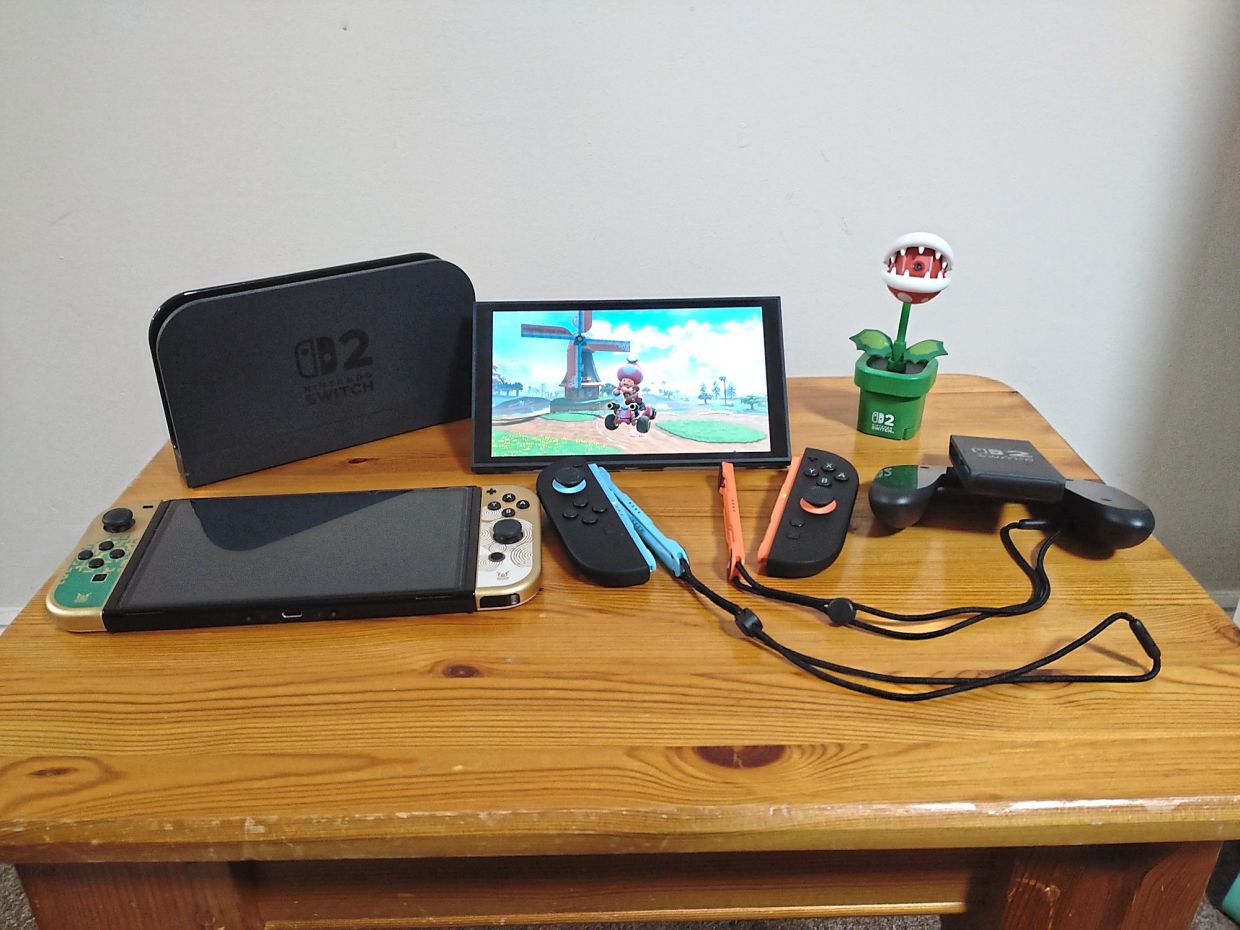
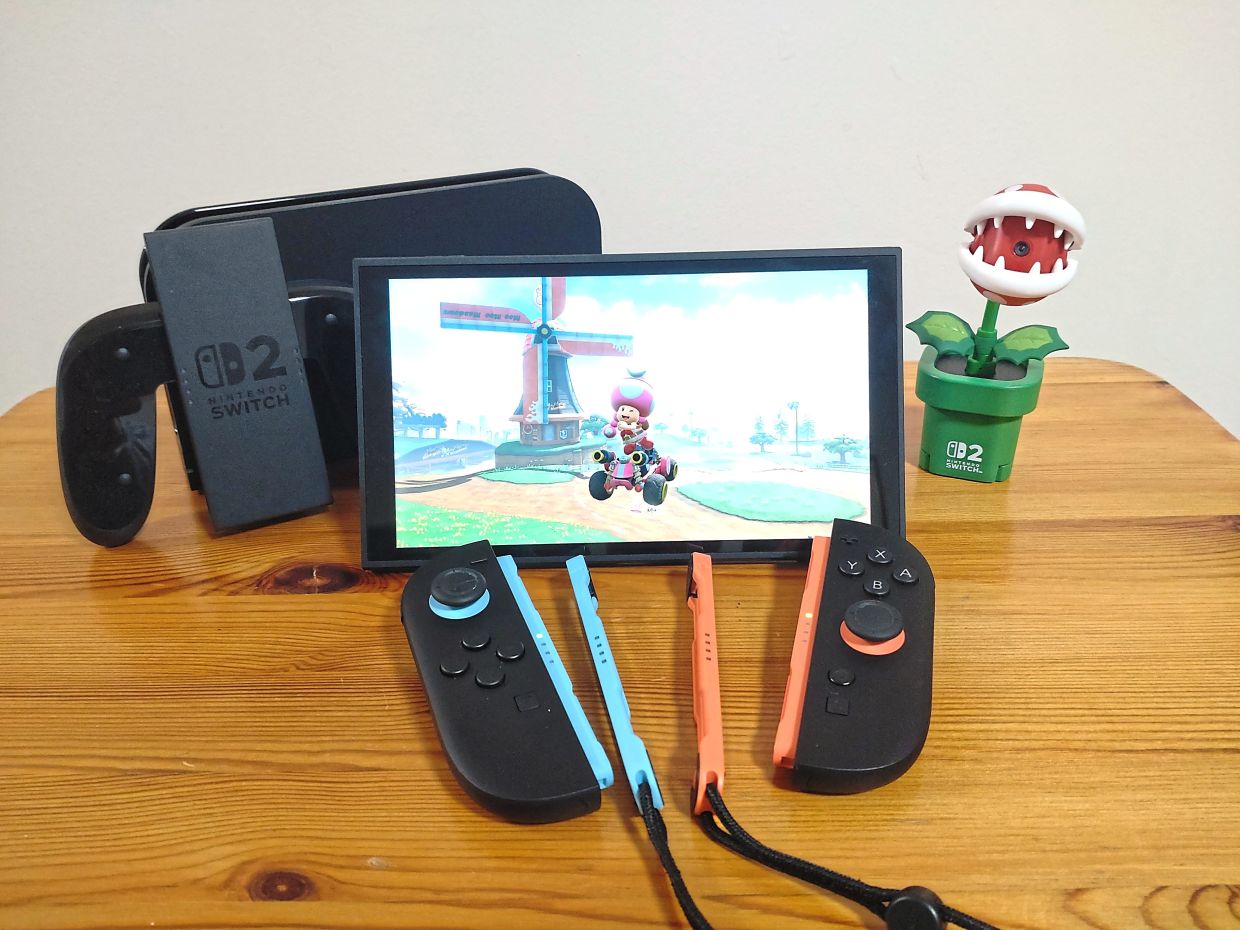
For one, the new Joy-Con 2 controllers now attach to the console via magnets (with a very satisfying tactile “snap”), instead of using the Switch 1’s slide & latch mechanism.
The magnetic connection felt really solid too, so I quickly lost any earlier apprehension I had about the controllers potentially being wobbly, or coming unattached because I accidentally pulled really, really hard. (Either the magnets are really strong, or this video game reviewer doesn’t have the super strength he believes he has. You decide!)
The Joy-Con 2 controllers can also be used as mouse input, and the mouse tracking works really well even when I use it on random surfaces (like my couch, because I’m too lazy to get a mousepad). But that said, I haven’t really played a game where mouse input really mattered yet. I’ll report back when someone ports StarCraft to the console, so I can really test my mouse APM.
Ooh, and the new GameChat feature is something I really, really wish I had when I was playing Animal Crossing (ACNH) with friends all over the world! (Ah, such happy pandemic-era memories.)
That new “C” button lets you start a voice/video call session with your friends, assuming y’all have Nintendo Switch Online subscriptions. Not only does it make it super easy to talk with your friends while you’re playing together online, you also get to see each other’s screens.
That said, you’ll need to purchase a separate USB video camera if you want your friends to see your face. I recommend the official (and officially cuuute) Piranha Plant camera, which adds a splash of cartoonish joy to the surprisingly reserved colour scheme of the Switch 2. (Special thanks to mum for surprising me with one!)
And if you’re looking for a game to play while chatting with friends, then MKW is perfect for you!
What a (Mario Kart) world
Mario Kart World is the Switch 2’s flagship launch title, and just like how I described the Switch 2 as “the Switch 1, but better”, I can also describe MKW as “Mario Kart, but even more better-er”.
I mean, at its most basic level, MKW remains the same fun, chaotic racing game that’s meant to be played with friends. (Or soon-to-be-former-friends, if you jerks keep using the Blue Shell on me!!)
There are obvious graphical improvements (the character animations for one are just absolutely delightful) but dig a little past the surface, and you’ll start to see Nintendo’s zany inventiveness shining through – now this is the kind of weirdness I like to see.
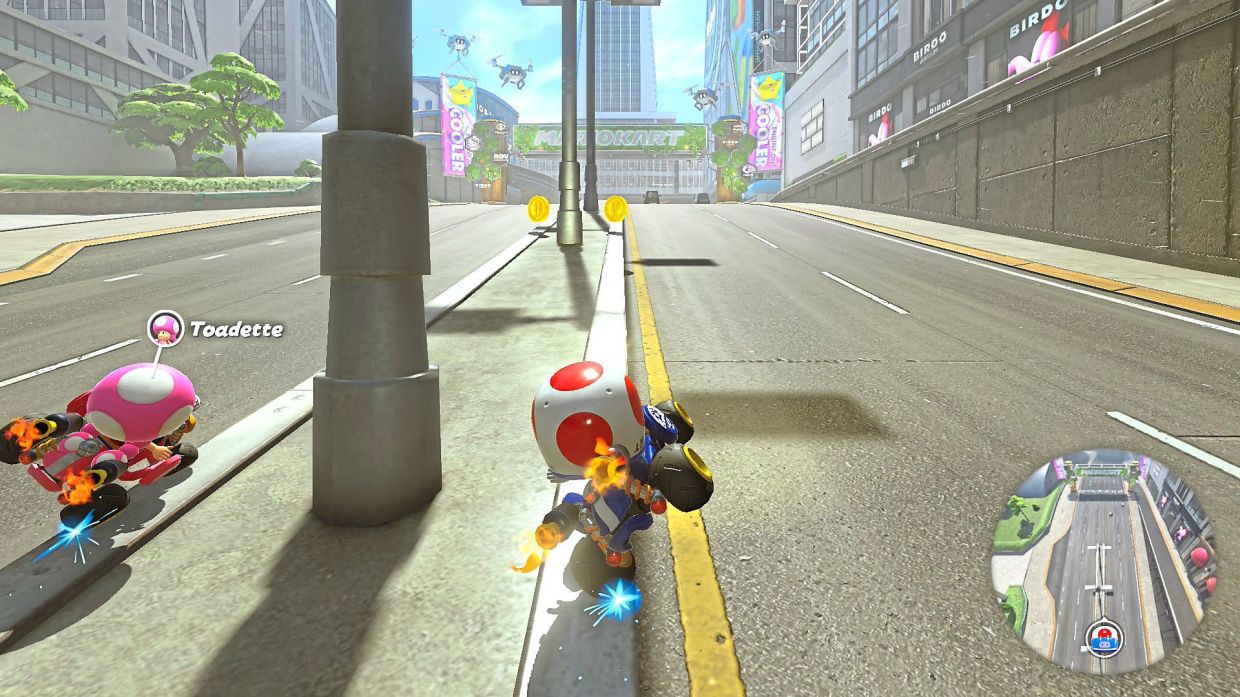
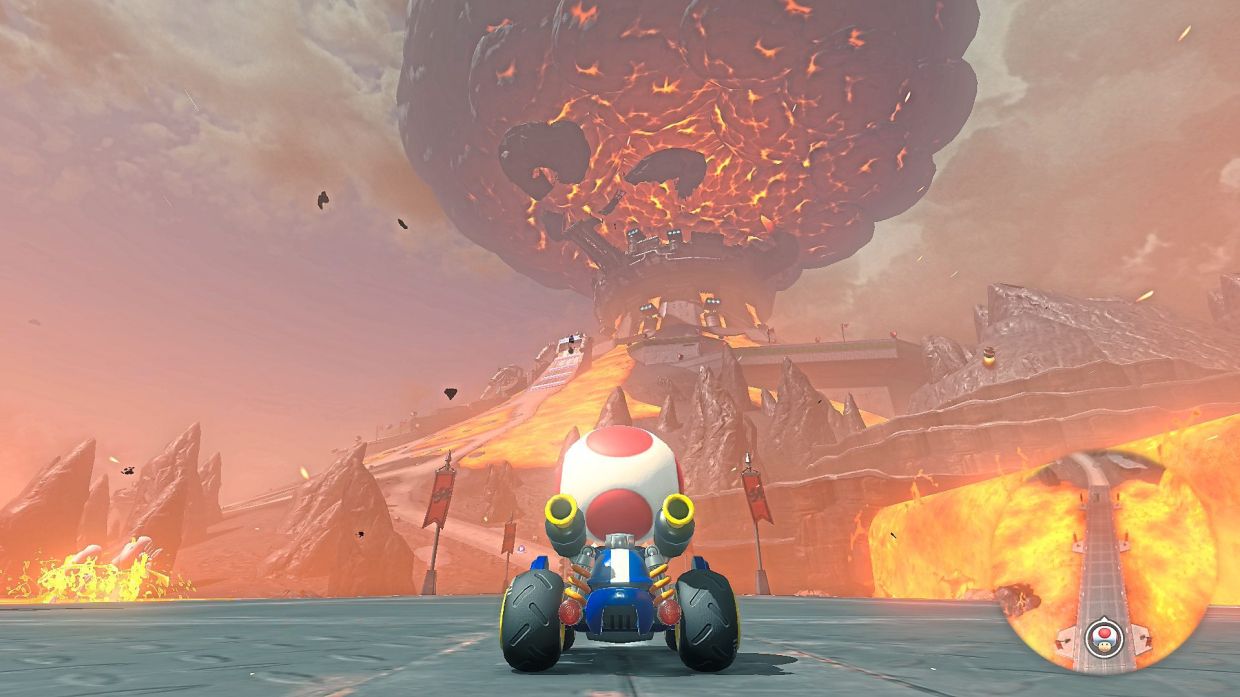
The central premise of MKW is that the whole game and all its races take place in one contiguous open world, populated with NPCs ambling about their own business. In the standard four-race Grand Prix mode, not only will you be doing laps around a race track, you’ll also be racing from one race track to another.
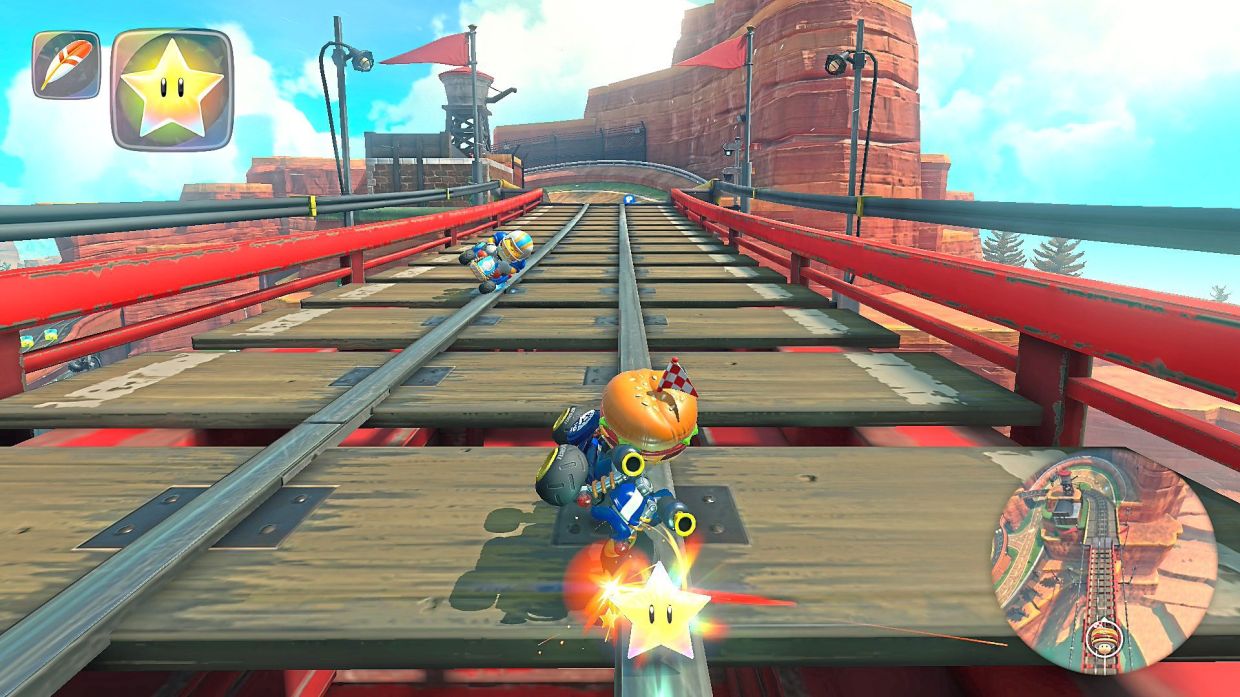
This is like having your first race at the Sepang International, then your next race has you zoom out of Sepang and hurtling down incoming traffic on the North-South Expressway to reach another race in Singapore. It’s madness, it’s chaos! It’s also incredibly, wildly, fun!
The new Knockout Tour mode refines this concept even further – you have 24 (!!) racers going from one point of the map to another, racing continuously across city streets, country roads, desert roads, dessert roads (made of ice cream!), and several poor schmucks’ backyards. At each leg of the race, the slowest racers are knocked out, until only the best (and/or luckiest) four remain to compete for the cup.
There’s so much variety and character beyond the races themselves that I actually spent more hours in Free Roam mode, just exploring the world, tackling optional challenges, finding hidden collectibles, and/or terrorising innocent pedestrians like I’m playing a family-friendly version of Grand Theft Auto. Who knew that just driving around would be so much fun?
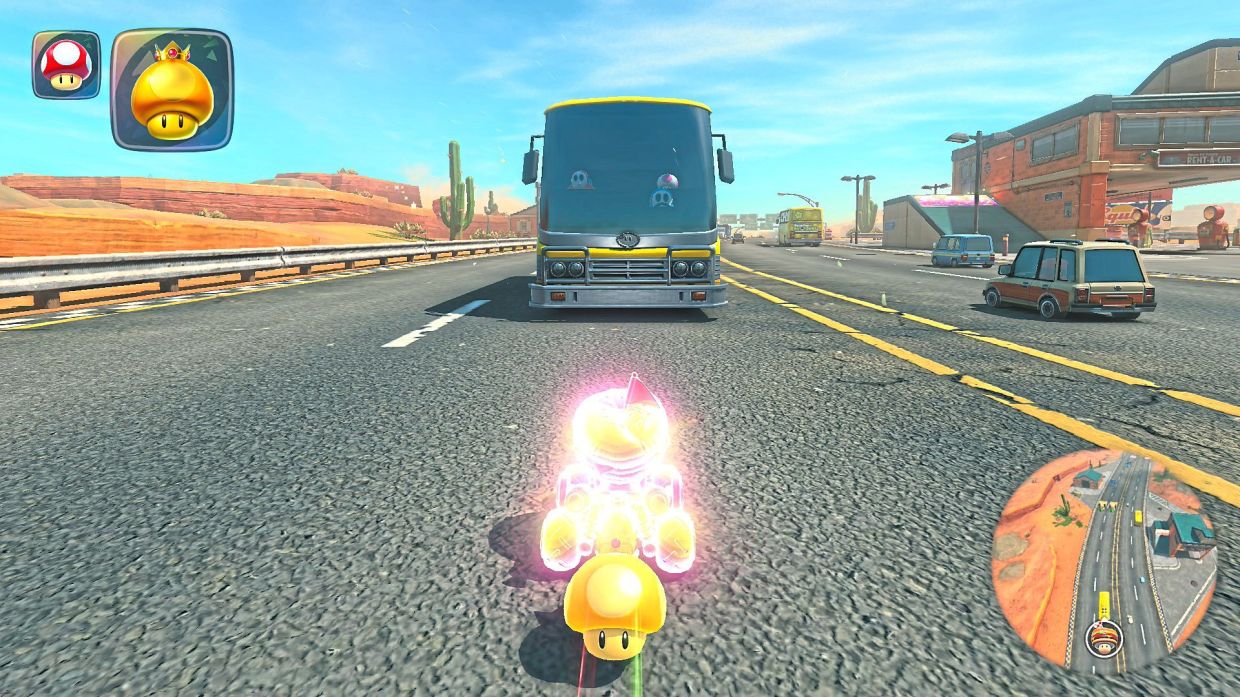
That said, as someone with a Malaysian driving licence, I take issue with how everyone’s driving on the wrong side of the road all the time. (No, bus full of screaming Toads whom I’m driving directly towards – YOU get out of my way!)
Switching over
OK, MKW is good on the Switch 2, but what about other games? I still have a large Switch 1 game library, and I wanted to see how they looked & played on the new console.
First off, when I booted up my Switch 2, I was given the option to transfer data from my Switch 1. Know that the easy option is there (which is great if you have a pandemic-era ACNH island you want to maintain), but as for myself, I opted to start the new console from scratch, logged into my Nintendo Online account, then downloaded my Switch 1 games plus their save files – just to see if the cloud sync feature works.
Short answer: it worked perfectly, and I now have my favourite Switch 1 games running on my Switch 2. Better yet, many of these games appeared to be running better – I measured how long it took to start various levels in The Rise Of The Golden Idol, and I can confirm that the Switch 2 cuts down loading times by half. (One level’s loading screen went from 23.38 seconds to 10.69.)
Additionally, I tried an experiment with the new Rune Factory: Guardians Of Azuma, to see what’s the difference between a Switch 1 game running on a Switch 2, and a game optimised for a Switch 2. I bought the Switch 1 version (Limited Edition, because I wanted that keychain that came with it) and played it for a week, before buying its “Switch 2 upgrade” (an extra £10/RM57).
I shouldn’t have been surprised, but oh boy there was a big improvement in the graphics. Notably, the upgraded Switch 2 version had better LOD (level of detail) management, so NPCs didn’t magically transform into stuttering mannequins when viewed from a distance.
What all my tests tell me is that the Switch 2 will flat out improve the experience of playing any Switch 1 game, although paying for a dedicated Switch 2 optimisation upgrade (e.g. for Tears Of The Kingdom) can still be worth it, if you want prettier visuals.
Software makes the hardware
While I’m really happy to see that the Switch 2 acts like a super-charged Switch 1 plus plus, and I love the fact that I can keep playing my Switch 1 games, what I really want to see from Nintendo now are new games specific for the Switch 2.
As always, it’ll be the software that determines whether this new hardware will be worth it in the long run.
In the meantime, I’m going to continue playing Mario Kart World and just see what chaos ensues. I mean, sure, that bus full of innocent Toads coming directly towards me may have the right of way, but I have the invincibility of a Super Star.
I’m sorry, you poor, helpless citizens of the Mushroom Kingdom, but we Malaysian drivers are maniacs.