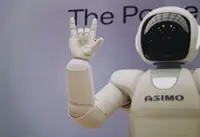
Apple’s one of the most influential big tech names ever, so when industry insiders release rumours about the technology Apple engineers are researching, it’s worth paying attention. That’s because Apple’s got vast cash piles to pour into R&D, and where Apple goes, others tend to follow. So rumours that Apple is looking into robotics tech are deeply interesting, especially when you remember that Elon Musk has bumptiously asserted that the future of Tesla is all about robots, not cars, and he’s slapped a US$10-trillion (RM44.3 trillion) valuation on the endeavour.
Tech industry analyst and long term Apple expert Ming-Chi Kuo released a new scoop on the topic of robots, news site TechCrunch notes. Kuo’s report comes only days after Apple released information on its research into what it very deliberately labeled “non-anthropomorphic” (i.e., not human-form) robots, which featured a robot a lot like the delightful Pixar lamp, famous from the movie maker’s title card.
Information has reached Kuo that Apple is also exploring humanoid robot form factors – but perhaps not in exactly the same way that rival robot makers like Tesla or Figure, with its impressive “01” machine – have designed. Kuo notes that as the robot industry “debates the merits of humanoid vs. non-humanoid designs,” Apple actually “cares more about how users build perception with robots than their physical appearance.” So, a future Apple android may not have a head or two arms and legs, but it could still seem human-like.
Kuo was careful to note that Apple’s work is in the very early “proof of concept” phase, which he describes as being all about “verifying whether product ideas and core technologies are viable before formal kick-off.” Apple’s foldable-screen phone is in this development phase, Kuo explains, and the famously cancelled Apple car was researched at this level too – to the tune of billions of dollars. This places any actual human-inspired Apple robot as a product that’s years away from actually going on sale – if it ever does.
Why should we care about this hypothetical piece of tech, then, when manufacturers like Tesla are promising their own human-form robots will go on sale in just a year or so, ready to transform all sorts of workplaces, from warehouses to hotels?
It’s all because of the giant status of Apple, which was the world’s first company to hit a trillion-dollar valuation, and which has at least one of its products in around 1.5 billion people’s pockets right now. The idea that Apple is researching humanoid robots, and is years away from actually making one – if it ever does – may easily tempt other smaller players to press ahead with their own robots (think of the way the Mac totally changed the computer industry, and the iPhone totally changed the cellphone industry).
Case in point: Startup Apptronik, a spin-out company from the Human Centered Robotics Lab at the University of Texas at Austin, has just raised US$350mil (RM1.55bil) in Series A funding. The money includes backing from Google, and will help further the company’s work on what it calls a “groundbreaking” humanoid robot, Apollo. This machine is destined for industrial workplaces, CNBC reports – a plan that vibes with the work of other robot makers who have also concluded that human-shaped robots are ideal to work alongside people in dangerous or complex work areas. CEO Jeff Cardenas explained that the plan is for Apollo to work in areas like manufacturing or health care, and the robots will be trained “separately from humans” on repetitive tasks before they’re integrated into real workplaces.
Humanoid robots have long been predicted as the next big thing in tech, but their development has been frustrated by numerous scientific sticking points. It’s only thanks to recent battery chemistry, motor, and AI technology advances that these sorts of androids may finally be viable as commercial products, rather than research curiosities.
Apple has benefitted from all of these innovations, and has recently shifted some of the experts who were working on its car project onto AI tasks – which squares with Kuo’s rumour.
The only question is: Will we feel differently if the command “Hey, Siri?” elicits a nod from an actual robot in our homes and offices? – Inc./Tribune News Service