




ORGANISATIONS must pursue digital strategies to remain competitive in a rapidly evolving landscape. Malaysian companies need to accelerate digital transformation to keep up with cutting-edge developments. However, what isn’t well known is exactly where Malaysian organisations stand vis-a-vis other South-East Asian and global companies. It also isn’t clear what are the factors dragging down Malaysian enterprises’ digital progress.
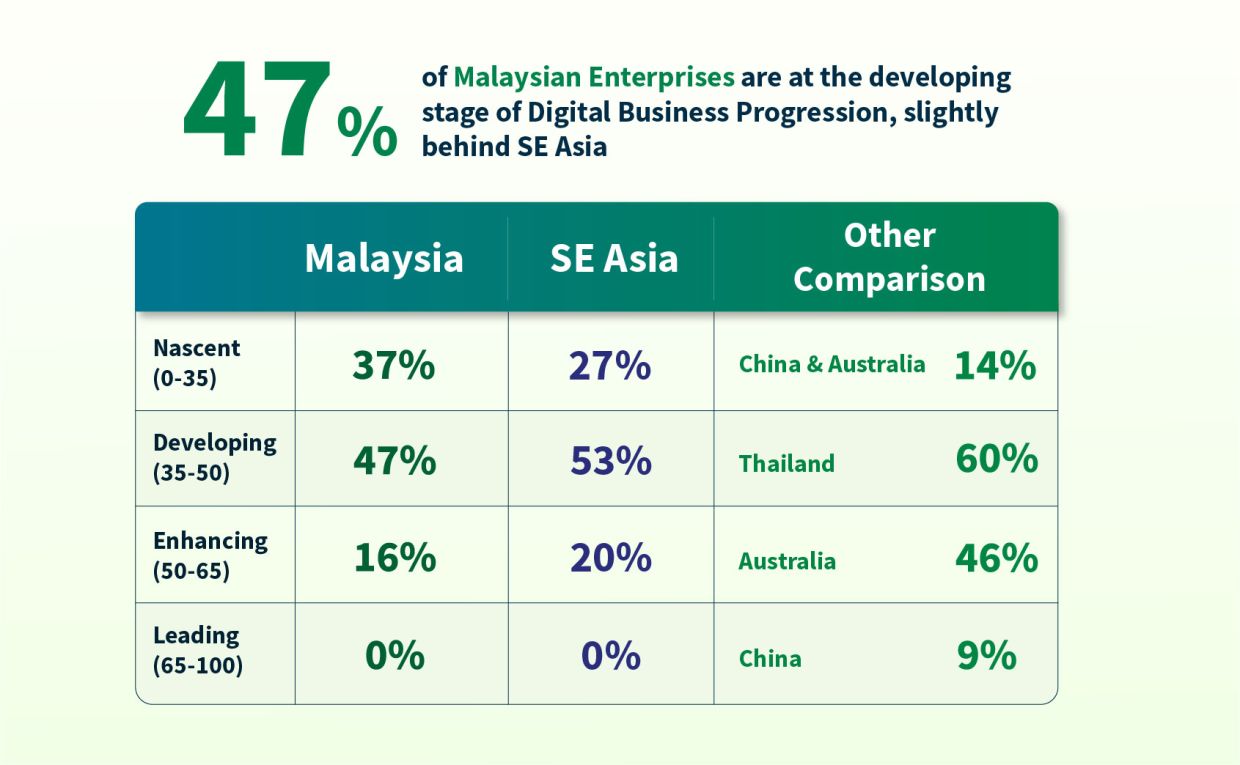
But recent research conducted by IDC called the IDC 2025 CEO Outlook, which was sponsored by Maxis Business – the B2B arm of integrated telecommunications provider Maxis - reveals valuable and actionable insights. It breaks down the digital business progression of companies into four levels – nascent, developing, enhancing and leading. The nascent stage is where companies are missing out on business opportunities and lagging industry norms in many areas.
The developing stage is where companies are making progress but are hobbled by significant capability gaps, while the enhancing stage is where the company has a mix of good capabilities and has identified areas for improved business outcomes. Those in the leading segment have achieved success from their digital business investments.
The study shows that Malaysia’s digital evolution lags regional and global peers. For example, 47% of Malaysian enterprises are still only at the developing stage compared with 17% for Thailand and 27% in general for the whole of South-East Asia. The research also shows that only 17% are at the ‘enhancing’ stage, compared with Thailand (23%) and South-East Asia (20%).
According to IDC, examination of the issues showed a confluence of factors dragging Malaysian enterprises' digital progress. One issue is the lack of leadership in guiding the organisation through its digital transformation. In this context, the report points out that top chief executive officers (CEOs) around the world who have successfully used technology to strengthen their businesses have done a few things differently. These CEOs have focused on using technology to compete and reskill their labour force. They have also come up with ways to encourage a customer-centric culture within their organisations as well as focused on ‘data-driven’ decision making.
Other issues holding back Malaysian organisations in their digital transformation include the lack of capability to harness their data, which is linked to having a shortage of skills. These organisations are also sometimes stuck with legacy technology systems, which become a challenge for any kind of innovation to take place.
In terms of company spend on IT, Malaysia also lags behind. The IDC report indicates that for 2025, the Malaysian IT spend is falling behind the worldwide expected spend, which is growing more than two times gross domestic product or GDP growth.
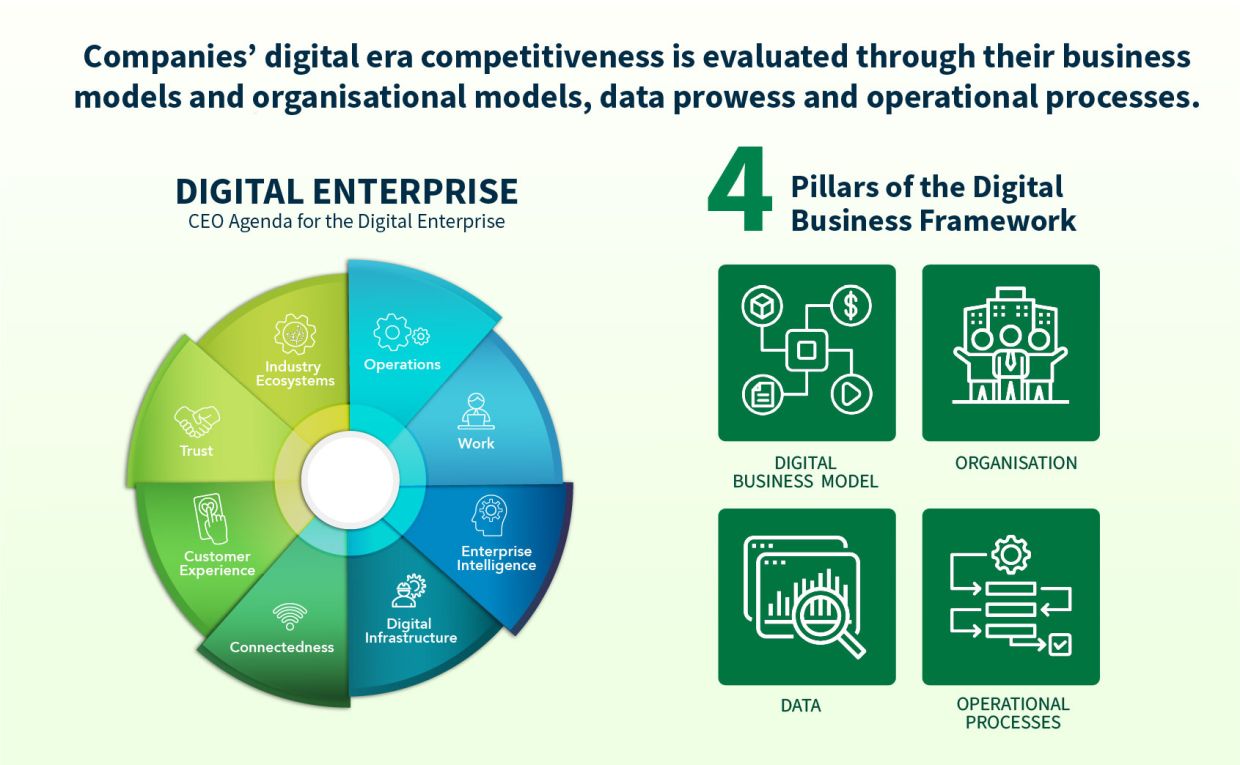
The study identified critical gaps when compared to global leading digital businesses. These include the lack of digital business model innovation, tactical use of data, inefficient operational processes, and the lack of tools to streamline workflows.
The report recommended that business and technology leaders rethink legacy approaches, assess current capabilities, and benchmark against leading enterprises to implement a roadmap that positions Malaysia as a future digital powerhouse.
The AI conundrum
And then there is artificial intelligence (AI). This, of course, makes the digital journey even more complex but necessary.
According to IDC, within Asia-Pacific excluding Japan, Al is expected to generate an economic impact of over US$1.2 trillion over the next three years.
This impact will be in the form of operational efficiency and growth with Al-powered automation and products and services.
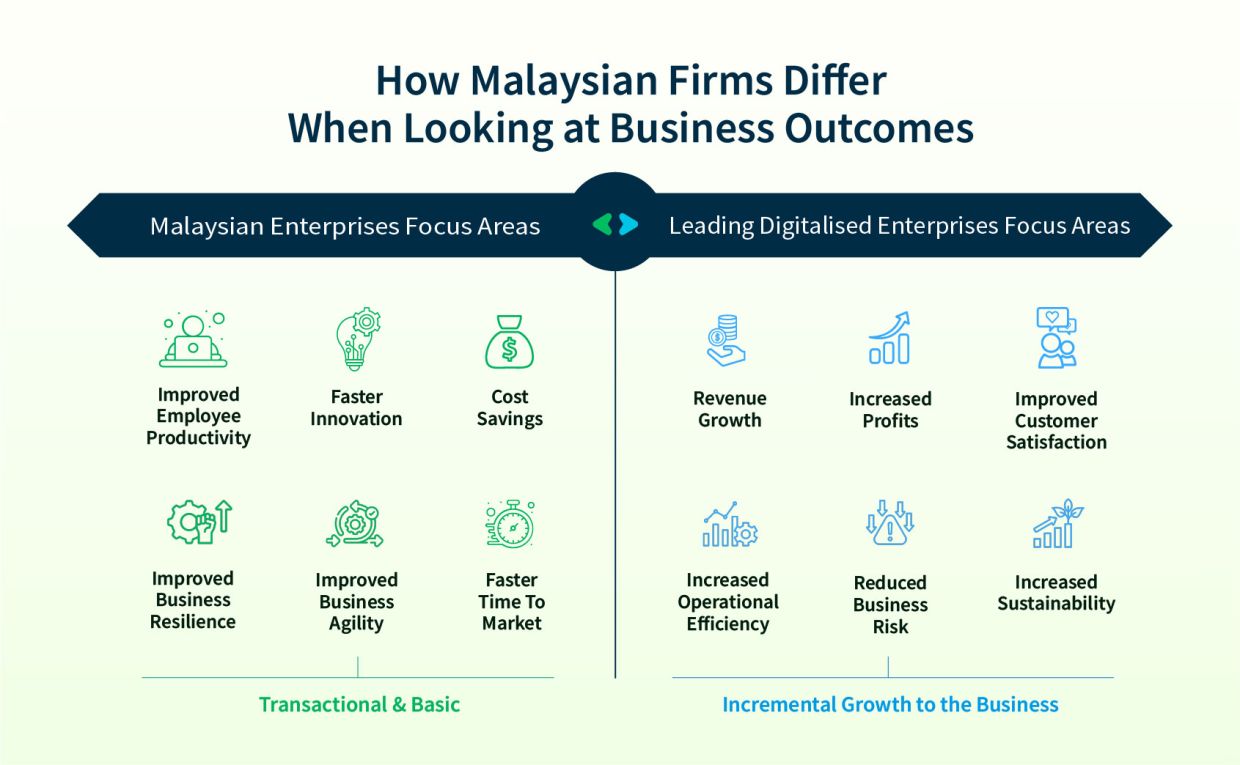
Yet, the study shows that 50% of Malaysian organisations have focused on implementing productivity use cases.
The IDC report, however, points out that while these use cases are quick to implement, they lack the full transformative impact that Al can bring about.
Instead, a broader approach incorporating a variety of use cases comprising productivity gains, operational efficiency and growth is needed to sustain and maximise Al's transformative potential, IDC reckons.
The report also states that the limited use of digital tools hampers Al adoption.
“Agile work models require digital collaboration tools and adaptive training solutions to reskill and upskill employees. Without these, there is a gap in building the necessary digital and Al literacy and enable agile development teams that accelerate innovation,” the report states.
Another factor that needs to be considered is having consistent and streamlined processes. Without these, implementing Al-driven efficiencies in workflows becomes challenging. This, in turn, can lead to “siloed Al initiatives” that drive inconsistent security practices and expose sensitive data to cyber threats, IDC says.
Additionally, non-standardised processes complicate compliance with regulatory requirements.
When it comes to dealing with data capabilities, organisations are still in the early stages of building advanced data infrastructure like data warehouses and data lakes. This restricts the ability to harness Al's full potential, IDC points out.
Meanwhile, with digital business models still in their infancy, companies in Malaysia are struggling to generate meaningful digital revenue streams. “The absence of mature digital strategies limits the opportunities to integrate Al into customer-facing and revenue-generating initiatives, limiting a strong business return on investment and making investments unattractive,” IDC points out.
To find out more, visit Maxis Business's AI-fuelled business transformation.


