To: Datuk Seri Anwar Ibrahim, Prime Minister
THIS letter is written to Prime Minister Datuk Seri Anwar Ibrahim with respect for your office and with a deep sense of national responsibility regarding the Malaysia-US "Reciprocal" Trade Agreement (ART).
Malaysia’s relationship with the United States has long been grounded in engagement without subordination, cooperation without the erosion of principle. It is precisely because this relationship matters — and because Malaysia has historically navigated great-power relations with care and dignity — that the ART Agreement signed on Oct 26, 2025 merits urgent and careful reconsideration.
The Agreement, while framed as “reciprocal”, extends far beyond conventional trade facilitation. Its provisions reach deeply into Malaysia’s regulatory, fiscal, digital, industrial,
and security architecture.
Clause by clause, the Agreement introduces obligations that, if left unamended, risk constraining Parliament’s constitutional authority and Malaysia’s freedom to shape policy in accordance with its own laws, institutions, and development priorities.
The most troubling elements arise where trade commitments intersect with national security.
Article 5.1 binds Malaysia, upon notification, to adopt “equivalent” restrictive measures taken by the United States against third countries. Article 5.2 further entrenches this alignment by
extending cooperation into security-sensitive technologies, unilateral export controls, and restrictions linked to foreign sanctions lists. Taken together, these clauses risk subordinating Malaysia’s foreign-economic policy to decisions taken outside our constitutional and institutional framework, replacing independent strategic judgement with compliance by default.
Such alignment, even if unintended, sits uneasily with Malaysia’s long-standing doctrine of active neutrality and Asean centrality. It also raises serious constitutional concerns.
Decisions on sanctions, export controls, and national security posture fall squarely within Malaysia’s sovereign jurisdiction and must remain subject to domestic law, parliamentary
oversight, and multilateral legitimacy — particularly where United Nations mandates are concerned.
Malaysia’s economic and industrial sovereignty is also materially affected. Articles 6.1 to 6.3 require Malaysia to promote US investment in strategic sectors such as energy, telecommunications, and infrastructure, while simultaneously committing Malaysia to facilitate approximately US$70bil of outbound investment into the United States over the next decade.
For a capital-importing economy still focused on industrial upgrading and domestic innovation, this represents an inversion of developmental logic.
Compounding this, the Agreement allows for scrutiny of Malaysian subsidies and the possibility of “corrective” action if they are deemed distortive.
These provisions weaken Malaysia’s ability to pursue state-led industrial policy — a tool historically used by every successful late industrialiser — and risk crowding out domestic investment and credit essential for innovation, resilience, and value-chain upgrading. Over time, this shifts development strategy away from national priorities toward external validation.
In the technological and digital domain, the erosion of policy space is even more pronounced. Articles 3.1 to 3.5 prohibit Malaysia from imposing a digital-services tax on US firms, constraining a fiscal instrument established under our own domestic law. They also restrict Malaysia’s ability to regulate cross-border data flows, require consultations before entering new digital trade agreements, and prohibit technology-transfer or localisation requirements under Article 3.4.
Collectively, these provisions remove essential tools for building national digital capability at a time when technological sovereignty is becoming a core determinant of competitiveness.
Fiscal and trade policy flexibility is further curtailed under Article 2.12, which obliges Malaysia to coordinate and endeavour to align its border measures with future US border-adjusted taxes, while prohibiting tax distinctions that disadvantage American firms.
When combined with a pledge not to challenge certain U.S. export rebates at the WTO, these clauses narrow Malaysia’s ability to deploy tariffs, incentives, and counter-cyclical tools responsive to local economic conditions.
Beyond substance, the manner in which the Agreement was concluded raises legitimate governance concerns. Agreements of this magnitude and permanence demand the highest level of inter-ministerial coordination, legal scrutiny, economic impact assessment, and parliamentary oversight.
The very fact that these issues are now being examined underscores the need for a structured and transparent corrective process.
None of this should be read as a rejection of cooperation with the United States. Nor is it an argument for confrontation or withdrawal. Termination of the Agreement would neither be prudent nor constructive when engaging a major power. The issue is not whether Malaysia should engage, but on what terms, and with what safeguards.
Crucially, the Agreement itself provides a lawful and time-bound remedy. Clause 7.3 allows for amendments through written notification within a defined period following signature. With the Agreement signed on Oct 26, Malaysia is now approaching the outer edge of that window.
This is not an abstract concern. It is a matter of timing, legality, and institutional responsibility.
Invoking Clause 7.3 to introduce sovereign safeguards — affirming the primacy of the Federal Constitution, domestic law, parliamentary authority, and Malaysia’s independent foreign-policy doctrine — would not weaken Malaysia’s partnership with the United States.
On the contrary, it would strengthen that partnership by placing it on clearer, more sustainable foundations. Durable cooperation is built not on asymmetry, but on mutual confidence in each other’s institutional integrity. This is about recognising, in time, that agreements of this scope require recalibration where national interests are at risk. Acting now would demonstrate foresight and institutional maturity, not retreat.
Above all, this matter must remain above politics. It concerns Malaysia’s long-term sovereignty, development trajectory, and strategic posture — issues that transcend electoral
cycles and partisan lines.
Attached herewith are our suggested amendments and/or modifications for your urgent consideration and attention.
These are presented in a structured and practical format:
• The relevant Article and/or Clause as it appears in the current Agreement;
• The issues and consequences arising from retaining or maintaining such provisions in their present form, with specific reference to implications for the nation;
• Suggested amendments, modifications and/or additions, formulated in accordance with Article 7.3 of the Agreement; and
• The anticipated impact and outcomes of such amendments, including the protections and safeguards they would afford Malaysia.
These proposals are intended to serve as a constructive tool for engagement and negotiation following the invocation of Article 7.3. To reiterate, this exercise is not driven by political positioning, nor by semantic or procedural contention. It is undertaken solely in the national interest, with the objective of protecting and preserving Malaysia’s sovereignty,
constitutional integrity, and long-term policy space.
Prime Minister, Malaysia’s credibility has always rested on its ability to engage the world without surrendering its centre of gravity. The opportunity before us is to amend what can be amended, protect what must be protected, and ensure that cooperation with all partners, including the United States, remains consistent with our Constitution, our laws, and our national interest.
With respect, and with urgency, we therefore urge that Clause 7.3 be invoked without delay, and that structured negotiations be undertaken to realign this Agreement with Malaysia’s sovereign and developmental priorities.
This is a moment for decisive stewardship — one that future Malaysians will recognise not as a rupture, but as a correction made in time.
Thank you.
DR RAIS HUSSIN
President/CEO
EMIR Research
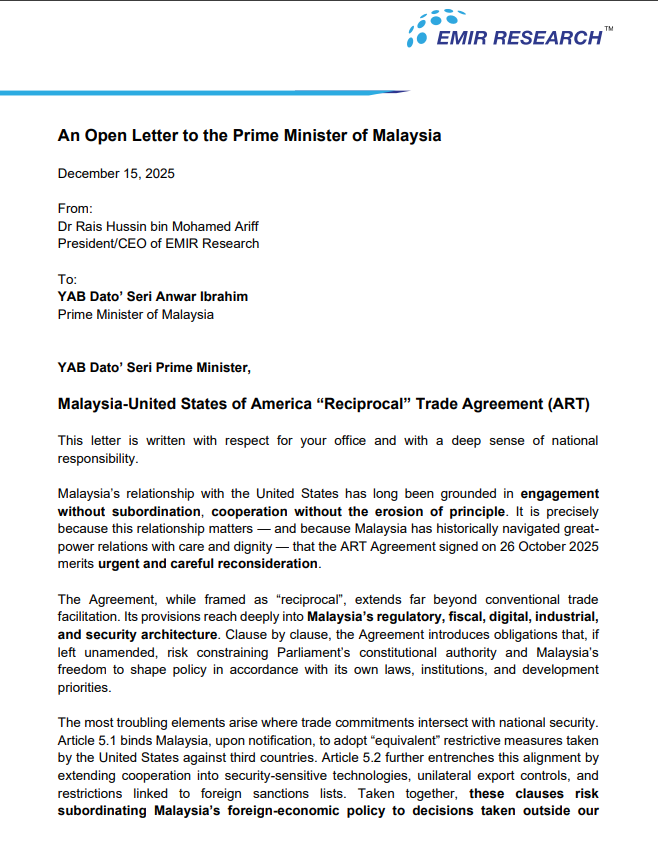
The full text of the letter and the Proposed Amendment Sheet can be read below: