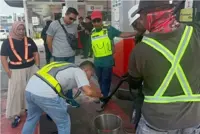
Attendants moving through traffic to warn foreign-registered vehicle owners against pumping subsidised RON95 has become a common sight at petrol stations near the two land checkpoints in Johor Baru.
One station has even resorted to blaring the message around the clock that foreign-registered cars are restricted to the RON97 grade.
Despite these efforts, cases of Singaporeans or Malaysians in Singapore-registered vehicles attempting to fill up on subsidised petrol remain a problem.
The latest uproar occurred earlier this month when a 64-year-old Singapore permanent resident was caught on video concealing certain letters on his number plate to make it look local and illegally pumping RON95 at a petrol station in Kulai.
The video, filmed on Jan 2, went viral and sparked outrage among online users over the lengths some will go to for subsidised fuel.
Police tracked down the man in question, and he was charged and fined RM9,000 on Jan 14.
The retiree paid the fine for number plate tampering, but the case also raised a pertinent question – why was he not charged for the act of purchasing the subsidised fuel also?
A quick check revealed a vast difference in petrol prices between Malaysia and the island republic, with Malaysia’s RON97 priced at RM3.10 per litre, while Singapore’s lowest-grade petrol, 92-octane, is priced at S$2.84 (RM8.89) per litre (see graphic).
Under Singaporean law, all vehicles exiting the country are required to have at least three-quarters of a tank of fuel or risk a S$500 (RM1,561) fine.
Random checks are carried out by local authorities at the Woodlands and Tuas checkpoints.
However, this latest tampering case has brought to light some loopholes in the system that need to be plugged.
Lawyer Norman Fernandez pointed out that under the Control of Supplies Act 1961, the Domestic Trade and Cost of Living Ministry (KPDN) usually takes action against petrol station operators for selling subsidised petrol, while buyers often walk away unscathed.
He lamented that there were currently no specific laws to prosecute foreigners who fill foreign-registered vehicles with subsidised fuel.
“This issue has been going on for years,” said Fernandez.
“Recent viral cases further highlight the need to take action against those committing the act,” he said.
He added that under present law, petrol station operators face fines of up to RM1mil or three years’ imprisonment.
Fernandez suggested that, as a temporary measure, authorities could use Sections 415 and 420 of the Penal Code to charge buyers for cheating and obtaining fuel through deception.
However, the next question would be whether the police or KPDN should enforce this law.
The issue has also reached Parliament, with Tebrau MP Jimmy Puah Wee Tse urging for existing laws to be amended and proposing that such offenders be blacklisted from entering Malaysia for up to two years.
He also suggested installing LED signage at all checkpoints nationwide to inform drivers of foreign-registered vehicles that they are only allowed to pump RON97 in Malaysia.
The issue of foreign-registered vehicles filling up on subsidised petrol is not just limited to the south, but also occurring in the northern border states with Thailand and states bordering Indonesia.
For Singaporeans, Johor is a cheap weekend or holiday getaway to shop for groceries, enjoy a good meal and obtain cheap fuel.
The government needs to act quickly and decisively to curb this leakage, which likely costs the country tens of millions of ringgit.
Once the relevant laws are amended, the agencies concerned should strictly enforce them.
Malaysia needs to review and update its laws, especially those governing the sale and purchase of subsidised fuel, so that when a law is broken, both the seller and buyer can be held accountable.