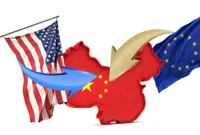
The current wave of economic fragmentation, characterised by geopolitical uncertainties, regionalised trade blocs, localised supply chains, and tariff wars, challenges the future of global trade and economic integration. Underscoring this challenge, the World Bank has forecast a subdued global growth rate of just 2.3% for 2025, significantly below the pre-pandemic average of 3.7%.
Against this backdrop, the recent US trade policy, involving increased tariffs on imports and targeted barriers against China, poses a dual threat to Asean. Firstly, it reduces Asean exports to the US. Secondly, it could exacerbate China's overcapacity, which potentially overflows to Asean markets.
Concurrently, regulations such as the European Union’s Carbon Border Adjustment Mechanism (CBAM) and the European Union Deforestation Regulation (EUDR) necessitate a rapid shift toward sustainable practices for Asean producers. To address the challenges, Asean requires a comprehensive strategic approach through enhanced trade and investment linkages.
Yet, despite the headwinds, Asean remained China’s largest trading partner in the first quarter of 2025, with total trade reaching $234.17bil marking an annual increase of 7.1% and accounting for 16.6% of China’s total trade, according to China’s General Administration of Customs (GAC).
In terms of composition, imports from Asean consist of components for data processing equipment, printed circuits, and textile raw materials. Alongside these industrial goods, agricultural products are a cornerstone of Asean's exports to China; for the past eight years, Asean has been China's largest source of agricultural imports. Meanwhile, Chinese exports to Asean include flat panel display modules, automotive parts, and lithium batteries.
Thereby, Asean–China trade is underpinned by complementarity. China exports technology goods while importing key electronic components and various agricultural products. This trade symbiosis has intensified under the frameworks of Asean-China Free Trade Area (ACFTA) and later the Regional Comprehensive Economic Partnership (RCEP), technically an inclusion of all Asean+1 FTAs except with India. The frameworks have slashed tariffs, streamlined customs procedures, and fostered supply chain integration across the region.
For China, this has meant securing the supply of essential electronic components for its tech industry from countries such as Malaysia and Vietnam, mitigating global supply chain risks. Conversely, China’s export of lithium batteries to Asean supports the regional push towards electric vehicle (EV) sectors, particularly in Indonesia and Thailand.
The economic partnership between Asean and China has been developed progressively. The formal launch of ACFTA 1.0 in 2010 marked a turning point, granting businesses across the region preferential access. By 2018, ACFTA 2.0 further deepened integration, eliminating tariffs on over 90% of traded goods.
While this framework has undeniably boosted trade volumes, particularly in electronics, automotive parts, and agricultural products, its benefits have not been evenly distributed across Asean. A case in point, Indonesia gained from commodity exports (palm oil, nickel) but faces competition from cheaper Chinese imports, hurting local labour-intensive industries such as textiles, and small and medium-sized enterprises (SME).
The upcoming ACFTA 3.0, currently under negotiation, aims to modernise the agreement by incorporating digital trade, green supply chains, and deeper investment cooperation. For Asean, this presents both opportunities and risks. While the digital economy and renewable energy sectors could attract investments, there are concerns about Chinese dominance in critical industries and whether local firms, particularly SMEs, will be able to compete. Hence, ensuring that ACFTA 3.0 includes strong safeguards for domestic industries and technology transfer mechanisms will be crucial for Asean.
Establishing Factory Asia 2.0
ACFTA has underpinned the emergence of “Factory Asia”, a regional production network pivotal to the economic rise of Asean countries. Countries such as Indonesia, Vietnam, Thailand, and Malaysia have thrived in electronics, automotive production, and commodity processing, respectively.
To build on a stronger foundation amid ongoing global challenges, Asean and China now seek to transition towards a more inclusive and sustainable industrial ecosystem known as “Factory Asia 2.0”. However, the shift toward Factory Asia 2.0, which emphasises digitalisation, green technology, and high-value manufacturing, raises critical questions about whether Asean can transition equitably or if it will deepen existing disparities.
For developing member countries such as Indonesia, the transition can be challenging. While the country has made strides in nickel downstreaming to promote its domestic EV battery production, its broader industrial base remains reliant on low-cost labour and resource extraction.
Hence, if Factory Asia 2.0 is to succeed, Asean must ensure that the benefits are inclusive, supporting not just tech-savvy economies such as Singapore but also emerging industrialisers such as Indonesia and Vietnam. Otherwise, the region risks fragmenting further along technological and economic lines.
Furthermore, the next advancement resides in digital commerce. Asean and China are two of the globe's most rapidly expanding e-commerce markets. The ACFTA 3.0 frameworks necessitate the establishment of comprehensive bilateral regulations on digital commerce that guarantee mutual access, data interoperability, consumer protection, and equitable competition. Key regulatory considerations include establishing interoperable e-payment systems, harmonising data protection standards, and implementing consumer dispute resolution mechanisms.
Forging Ahead Together
Looking ahead, ACFTA 3.0 must be more than a tariff deal. It should lay the groundwork for Factory Asia 2.0, a new regional production and innovation ecosystem. Moreover, Asean and China can jointly promote initiatives in sustainable agriculture, renewable energy, and clean manufacturing that will help achieve the climate transition goals in the region.
As the world grapples with a rise in protectionism, the Asean–China cooperation offers a compelling, albeit complex, counter-narrative. While it has built a regional economy more insulated from external tariff pressures, this interdependence is not without its risks.
From an Asean perspective, the relationship's asymmetry creates a significant risk of economic dependency. Therefore, while the model showcases resilience through consistent trade growth, its long-term success as a truly equitable partnership will depend on whether future frameworks of ACFTA 3.0 can address imbalances and promote genuine co-development.
Dr. Wahyudi Wibowo is a full-time faculty staff at the Faculty of Business, Universitas Katolik Widya Mandala Surabaya, Indonesia. He is also a senior researcher at the Center for International Trade and Supply Chain Management (CITSCM). The views expressed here are entirely the author’s own.
The SEARCH Scholar Series is a socially responsible programme jointly organised by the Southeast Asia Research Center Humanities (SEARCH) and Tunku Abdul Rahman University of Management and Technology (TAR UMT).
Already a subscriber? Log in
Get 20% OFF The Star Digital Access
Cancel anytime. Ad-free. Unlimited access with perks.