



THE global economic order largely has already undergone a silent but profound transformation that most policymakers in Malaysia and across the Global South have yet to fully grasp.
It manifests as a decisive shift from an era where sovereignty was defined primarily by territorial control (land and labour) to one increasingly determined by architectural sovereignty, which can be defined as a nation's capacity to design, govern and derive value from the digital platforms that now coordinate global commerce, automate decisions and shape cognition itself.
This shift is not just technological evolution but a fundamental rewiring of how power and prosperity are generated in the 21st century. Those who fail to recognise it risk becoming permanent tenants on platforms designed by others, ceding not just economic advantage but strategic autonomy in the process.
The next phase of global competition is not about markets versus states, or capitalism versus alternatives. It is about who designs, owns and governs the platforms that record value, coordinate activity and make decisions at scale. Malaysia's struggle with the 5G saga offers a very illustrative cautionary tale we must not repeat in other strategic domains particularly those that constitute or related to sovereign triangulation framework – financial platform, cognitive platform and strategic state.
The financial platform trap: Beyond currency substitution
Just as we became entangled in a monopolistic infrastructure model that compromised our telecom industry's competitiveness, many nations now seek to escape dollar dependency, although at times through equally flawed approaches: either elevating another national currency (like the yuan) to reserve status or creating supranational baskets modelled on the IMF's Special Drawing Rights.
These solutions replicate the core flaw of the existing system – they remain trapped in a 20th-century mercantilist paradigm that treats money as a commodity to be accumulated rather than understanding it as a record of value already produced within a community of trust.
Emir Research advocates a qualitatively different path: a mutual credit clearance (MCC) system built on distributed ledger technology ("BRICS' Currency Dilemma: A Necessary Quality Leap Beyond the Dollar", from Sept 16, 2024). Within a trusted community like BRICS+, participants would record debits and credits in trade using a common unit of account, with algorithms automatically netting positions over defined periods. Crucially, a participant's ability to run a debit (to purchase) would be inherently bound by the community's demand for goods and services that participant can reliably produce.
The structural advantages are profound:
1. Endogenous money creation tied directly to real economic transactions – not political decisions by a foreign central bank
2. Preservation of monetary sovereignty – no surrender of domestic policy tools to external actors
3. Built-in incentive for productive diversification – "to spend, you must produce" becomes the engine of intra-bloc industrial development
4. SME empowerment through credit creation based on productive capacity rather than collateral.
This isn't theoretical. Historical MCC systems have proven exceptionally effective at energising networks of small and medium enterprises (SME) often starved of traditional credit. For Malaysia, where SMEs constitute 98.5% of businesses but struggle with financing, such a platform could unlock transformative entrepreneurial energy while reducing vulnerability to external financial shocks.
The cognitive platform imperative: Beyond chatbots to world models
While our policymakers obsess over 5G coverage percentages, a more consequential battle is unfolding in the artificial intelligence (AI) space. The current global fixation on large language models represents a dangerous distraction. These systems are brilliant statistical imitators of human prose but poor at grounded, causal reasoning about the physical world. They inherit the biases, abstractions and epistemic assumptions of their training data, primarily western Internet content.
To build AI that serves sovereign, sustainable development, we must pivot decisively toward three architectural imperatives:
First, from text-centric to sensor-centric AI development. The next generation of foundation models must be trained on multimodal streams of real-world sensor data – video, audio, hyperspectral imaging and IoT telemetry. The data density in a single minute of high-fidelity sensor fusion from a Malaysian palm oil plantation or port facility dwarfs millions of text tokens. This sensor-first approach allows AI to learn the actual dynamics of our physical environments, not just human commentary about them.
Second, from autoregressive chatbots to predictive world models. We need AI systems with persistent memory that can simulate how complex systems behave over time – essential for managing smart grids, optimising logistics, or diagnosing crop diseases. Language becomes a disciplined interface atop cognitive systems that genuinely understand causality.
Third, from centralised data monarchies to federated learning ecosystems. The prevailing model – extracting data from the Global South to fuel innovation in the Global North – must be replaced by architectures where sensitive data remains under sovereign jurisdiction while anonymised algorithmic insights are shared across trusted consortia. This preserves data sovereignty while enabling collective cognitive progress.
Malaysia's Technology Innovation Park Malaysia (TiPM) and similar institutions must pivot from being mere technology adopters to becoming thriving "living labs" – real-world, sensor-rich testbeds where next-generation AI is trained on local challenges (Figure 1). This ensures the AI governing our economies is energy-aware, culturally attuned and reliable under our specific socio-technical conditions.
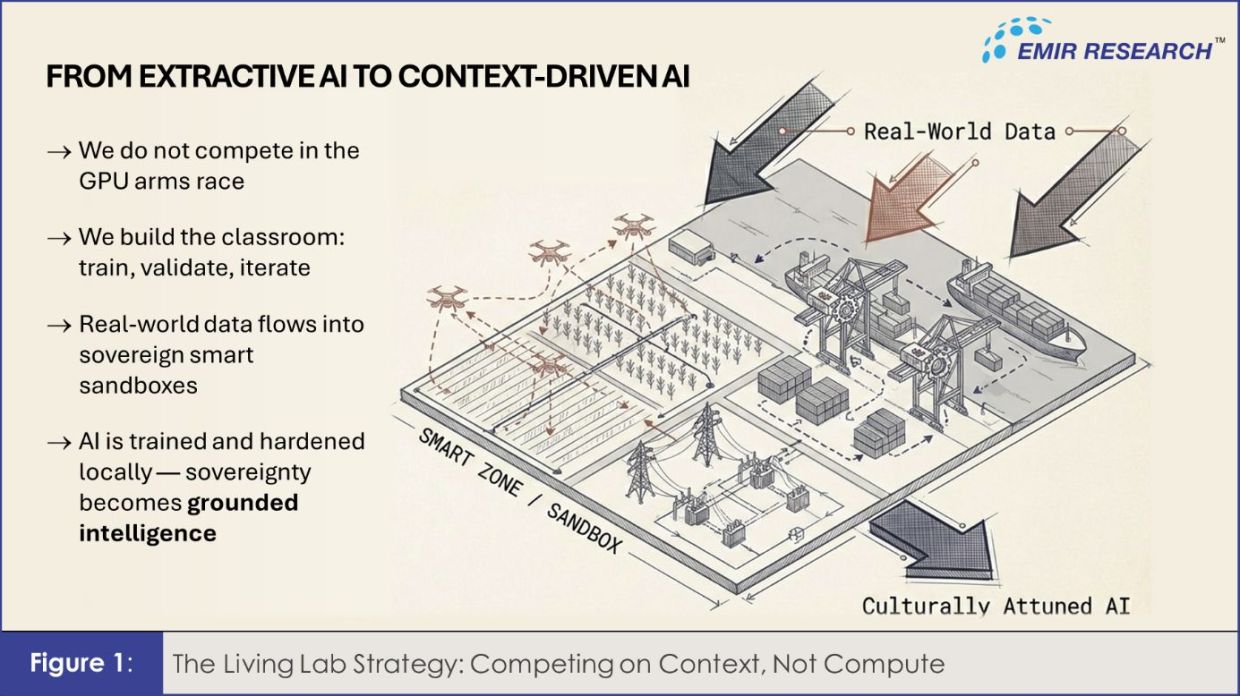
Critically, AI influencing public policy or critical infrastructure cannot be black-box oracles licensed from foreign vendors. Sovereignty in the cognitive realm demands inspectability, auditability and the capacity to verify or replace algorithmic tools upon which our societies increasingly depend.
The state's new role: From regulator to platform architect
This convergence of sovereign financial platforms, cognitive platforms and emerging platforms for logistics and energy grids constitutes the nascent architecture of 21st-century prosperity. In this landscape, the nation-state must evolve beyond its traditional roles as mere regulator or service provider into a strategic platform architect guided by what Emir Research terms the "Sovereign Triad":
1. Analytical foresight to identify which platform layers constitute strategic public goods essential for national resilience – separating technological hype from foundational leverage points through first-principles analysis
2. Catalytic capacity to de-risk platform creation through innovative public-private-platform partnerships: setting interoperable standards, providing anchor demand through strategic procurement, creating regulatory sandboxes and funding pre-competitive R&D in foundational technologies
3. Executional agility to orchestrate diverse stakeholders around shared platform goals – aligning incentives across corporations, start-ups, academia and civil society to ensure sovereign platforms deliver tangible value to SMEs, farmers and manufacturers rather than becoming white elephant projects
A new grammar of growth
The nations of the Global South should not be merely aspirants to a future designed by others. Often less encumbered by legacy industrial silos and possessing hard-won understanding of dependency's costs, we are uniquely positioned to pioneer a new grammar of global growth – one that is:
• Open by design, with protocols ensuring interoperability between sovereign architectures
• Equitable in structure, with built-in mechanisms to narrow asymmetries between early adopters and followers
• Sustainable by default, where efficiency per watt and per unit of embedded carbon is hardwired into platform design
• Centred on human agency, where technology enlarges rather than diminishes cognitive depth and creative capacity
This is not a call for autarky, but redesigning globalisation from a hub-and-spoke model centred on dominant foreign platforms to a multi-polar network of interconnected sovereign platforms. In this model, sovereignty is not isolation's end goal but the starting condition for meaningful, balanced cooperation.
Of course, Malaysia can continue treating platforms as mere commercial products or IT projects, repeating the DNB mistake across financial and cognitive domains. But we can also start finally seeing platforms as the foundational political and economic institutions of our century and begin architecting our sovereign participation in this new order, rather than becoming permanent tenants in a digital world designed without our interests in mind.
Dr Rais Hussin is the president/CEO of Emir Research, a think tank focused on strategic policy recommendations based on rigorous research.

