THE night was warm and lovely as the Abu Samra family gathered outside their home in the northern Gaza Strip in September 2023, the smell of mint from the garden filling the air.
As always, the family patriarch recounted how, as a 10-year-old in 1948, he was forced from his village in what is now Israel, one of hundreds of thousands of Palestinians displaced in what they call the Nakba – “the catastrophe.”
The patriarch, Abdallah Abu Samra, had told the story often, each time focusing on different details to ensure his family would remember them. One day, he hoped, they would all return.
Within weeks, that prospect seemed more distant than ever.
Hamas waged its surprise attack on Israel, storming across the border on Oct 7, 2023, killing about 1,200 people and seizing about 250 others as hostages. Israel retaliated by launching its war in Gaza, killing tens of thousands and leaving generations of Palestinians to experience displacement and hunger, and the fear that they would never see their homes again.
The Abu Samra family and many other Palestinians say they have always lived in the shadow of the Nakba. And from the first moments of the war, as Israeli warplanes started dropping bombs and flyers ordering mass evacuations, their worries of another Nakba rose.
Since then, around two million people – about 90% of the population – have been driven from their homes and displaced within Gaza, many of them repeatedly, according to the United Nations.
Israel has stepped up efforts since last week to empty Gaza City of civilians, which it said would enable it to confront Hamas. Legal experts warn it would violate international law by displacing hundreds of thousands of people indefinitely.
“We are in a bigger Nakba now,” said Abdallah, who is a retired teacher.
Zionist denial
Israelis have long objected to the characterisation of the 1948 conflict as a catastrophe. For them, it was a war of survival.
The mass displacement nearly 80 years ago – and the rival narratives about it – are among the most intractable issues in the long conflict between the two sides, with Palestinians and their descendants demanding, and Israel rejecting, the right to return to the land they fled in 1948.
Israel’s displacement of civilians and destruction of neighbourhoods in the current genocidal war on Gaza,“appears to be a push for a permanent demographic shift in Gaza that is in defiance of international law and is tantamount to ethnic cleansing,” said the UN’s human rights chief, Volker Türk.
Israel is also encouraging what it calls “voluntary” emigration for people to leave Gaza entirely but has not found countries willing to take them in large numbers.
Human rights experts have constituted it as a kind of ethnic cleansing.
The Abu Samra family, about 20 in all, said they began fleeing on the first day of the war, when Israeli bombs struck so close to their home that the walls shook. It was the start of a cycle of displacements, until they eventually split up to find shelter.
Some relatives died in Israeli strikes, the family said. Others fled to neighbouring Egypt and now wonder if they will ever return home, or if there will be anything left to return to.
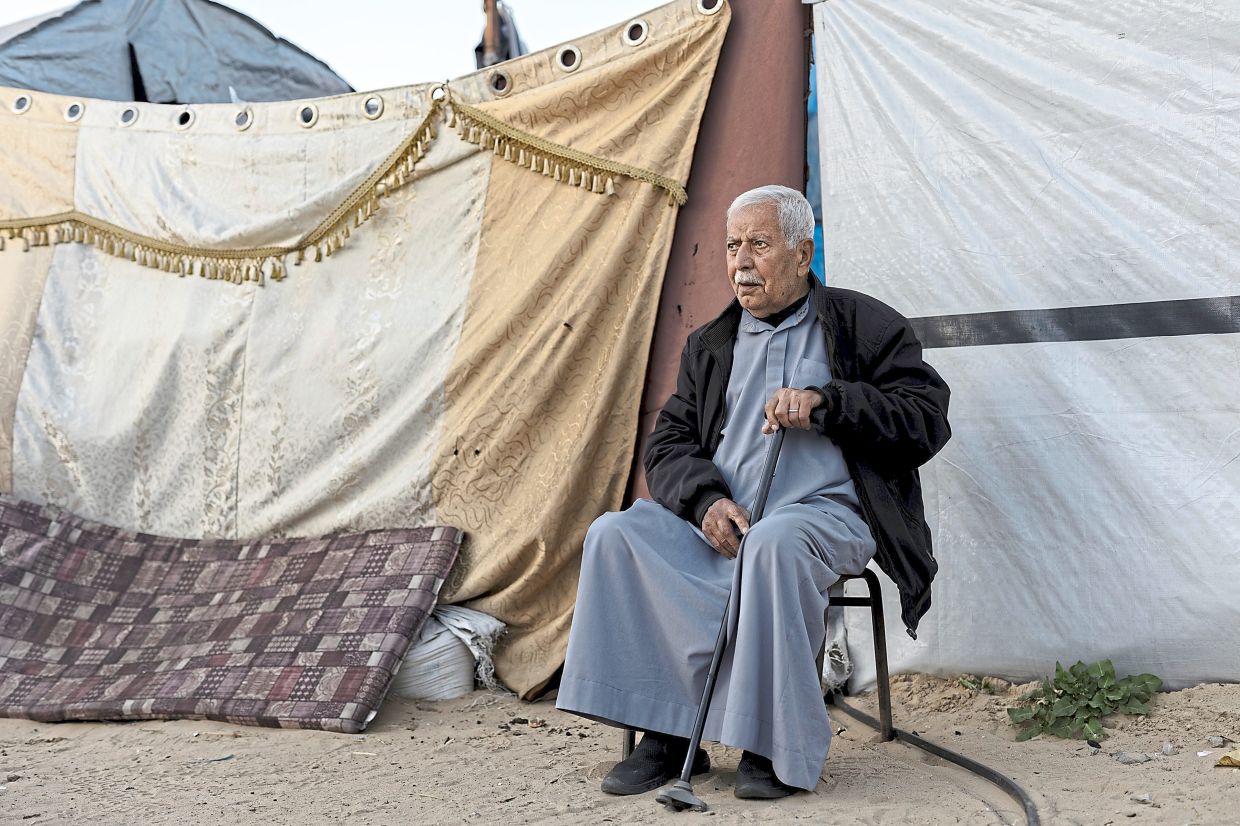
Abdallah, now 87 and frail, has been stuck in southern Gaza, in a tent of tarps, a curtain and blankets. Once again, he is scared, hungry and separated from most of his family, just as he was as a boy.
“I always think, talk and dream” of going home, he said.
Mass destruction
Nearly 80% of buildings in Gaza have been damaged or destroyed, with more being cleared as Israel now expands its military campaign. The World Bank estimated that it could take 80 years to rebuild the homes that have been destroyed.
“With the news and what is happening, we are losing hope that we’ll ever be able to return,” said Ghada Abu Samra, 25, Abdallah’s granddaughter.
For many Palestinians, the Nakba is not only a traumatic memory but also a matter of identity. About 1.7 million of the 2.2 million people in Gaza are either refugees from the war surrounding the establishment of Israel in 1948 or their descendants, according to the UN.
And while most have never lived outside Gaza, many consider themselves refugees from the lands their families fled – including villages nearly wiped off the map.
In the current war in Gaza, incendiary comments by Israeli leaders raised Palestinians’ fears that history was about to repeat itself.
“We are now rolling out the Gaza Nakba,” Israel’s agriculture minister Avi Dichter, for one, had said a few weeks into the war.
Human rights groups say the war has rendered so much of Gaza uninhabitable that it is leading to permanent displacement, a potential war crime.
Some, like Human Rights Watch, call the displacement an intentional part of Israeli policy that amounts to a crime against humanity.
An independent United Nations inquiry, commissioned by the UN Human Rights Council, concluded last week that Israel has committed genocide against Palestinians in Gaza, incited by the country’s top leaders.
This followed the International Association of Genocide Scholars’ recent resolution that Israel is committing genocide in Gaza.
Two prominent Israeli groups have joined these international organisations in accusing the government of committing genocide for killing tens of thousands of Palestinians, razing huge areas, displacing nearly all of Gaza’s population and restricting food.
Israel has rejected the accusations as deliberate misrepresentations.
Still hoping
In January, when Israel and Hamas struck a brief ceasefire deal, members of the Abu Samra family cried tears of joy, thinking it might offer a chance to go back home.
Survivors of the 1948 war remember how hundreds of thousands of Palestinians were told at the time that they would be allowed to return to their villages in what is now Israel after a few days or weeks.
Believing they would return within days, people left with very few belongings – some clothes, blankets and a bit of food – and the keys to their front doors.
“The most important thing is the key to the house,” Abdallah recalled. “Everyone locked their door and took the key in the hopes that they would be gone only a short period.”
They were not allowed back.
The key to a house, often called the key of return, is such a powerful symbol for Palestinians that many families hold onto theirs, even for homes inside Israel that no longer exist.
Abdallah’s daughter Abeer said she never fully understood the stories until Israeli bombs began falling near the family home in Gaza after the attack Oct 7, 2023, shaking the walls, followed by the Israeli orders to leave.
“We always used to say, ‘Why did they leave?
“‘Why did they leave their homes?’ But then,” said Abeer, 52, trailing off for a moment, “then we went through the same trial.”
Like those who fled in 1948, many in 2023 thought they would leave their homes for just a few days. Many took only a few changes of clothes. And their keys.
Everywhere Ghada goes now, she always carries with her the key to her home in northern Gaza, which has long since been reduced to rubble, she said.
“It’s my only reminder of home,” she said of the key.
Her aunt Abeer carries the key to her home as well.
“It often occurs to me, will these keys become like the 1948 keys of return?” she said.
“I don’t expect to return,” she started, then stopped herself.
“No, we’ll return, we’ll return,” trying to convince herself. — ©2025 The New York Times Company