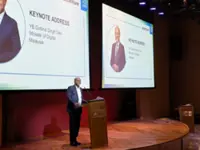
NANJING, Dec. 8 (Xinhua) -- An international cooperation mechanism linking universities in major canal regions around the world was on Monday launched in Yangzhou, east China's Jiangsu Province -- the southern starting point of China's Grand Canal.
Unveiled at a symposium in Yangzhou, the Canal-city University Cooperation Mechanism seeks to harness academic expertise to promote cross-cultural exchange and tackle shared challenges.
A total of 23 universities in 10 countries along major waterways, including China's Grand Canal, Egypt's Suez Canal, and canals in Portugal's Aveiro and Brazil's Rio de Janeiro, have joined the cooperation mechanism.
Ding Jianning, Party secretary of Yangzhou University, which is one of the initiative's founding institutions, said that the mechanism will prioritize youth engagement through cross-border seminars, academic exchange and collaborative research to infuse new vitality into ancient canal regions.
Xi Yanchun, vice president of Xinhua News Agency, highlighted the mechanism's importance in fostering high-quality cooperation in the field of higher education, in empowering the development of canal cities, and in enhancing dialogue among civilizations.
She said that Xinhua will leverage its global role in news-gathering, reporting and research, as well as its global reach, to support the mechanism actively through its journalistic and think-tank insights.
University representatives at the symposium said they are committed to building the mechanism into a dynamic and forward-looking platform, contributing academic strength to the prosperity of canal cities and the improvement of global governance.
The establishment of the mechanism will advance international research collaboration, bringing together university expertise to address shared global challenges such as ecological protection and urban development, said Jose Fernando Fragalli, rector of Brazil's Santa Catarina State University.
"As we look ahead, Keele stands ready to collaborate with partners to translate education and enterprise into shared vitality for canal cities," said Mirna Mourtada-Maarabouni, dean of internationalisation and partnerships at Keele University's Faculty of Natural Sciences in the U.K.
According to the symposium, more than 520 canals in over 50 countries connect some 3,000 cities worldwide, serving as corridors of trade, culture and international cooperation.
Also released at the event was a five-year action plan outlining priorities in the fields of joint talent development, faculty training, and collaborative research and innovation.