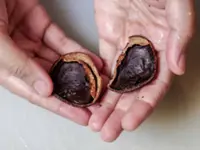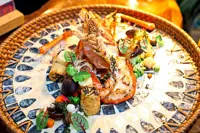
FROM the kitchens and dining rooms of stately homes in Melaka and Penang to Peranakan restaurants all over Malaysia, buah keluak – or pangium edule to use its scientific name – is either a traditional celebratory classic or a popular fixture on the menu.
Having said that, it has also been claimed that buah keluak contains hydrogen cyanide in its raw unprocessed form.
Is this true?
VERDICT:

TRUE
Yes, there is truth to this as hydrogen cyanide is present in all parts of the tree in the form of hydrocyanic acid.
Indeed, as mentioned in an entry on Singapore’s National Library website; “young buah keluak seeds contain more of the poison than ripe seeds.”
This is in turn supported by the entry on buah keluak in the Plant Resources of Southeast Asia database, which states that an overdose can result in “sleepiness, headache and a sort of intoxication or attack of delirium, which may result in death.”
It then goes on to say that this is most common in improperly processed seeds, adding that the toxin can be removed through extensive washing, soaking, roasting or fermenting.
And as for what constitutes safe processing, this was in turn definitively identified in research published in a research paper by Nur Abdi Aminullah, Baharuddin and Syahidah of the Faculty of Forestry of Universitas Hasanuddin, Indonesia.
In their paper, the researchers cited a study conducted in which buah keluak were buried at different depths of 15, 30, and 45cm for three periods, 20, 40, and 60 days.
“The results showed that a depth of 45 cm and a length of 60 days resulted in the greatest reduction in cyanide levels of up to 95%,” said the researchers.
So yes, buah keluak does contain a deadly toxin – but it is ultimately safe to eat, as long as it is given the proper treatment before it hits your plate.
SOURCES:
https://iopscience.iop.org/
https://iopscience.iop.org/
https://www.myfoodresearch.
https://prosea.prota4u.org/
https://www.nlb.gov.sg/main/