
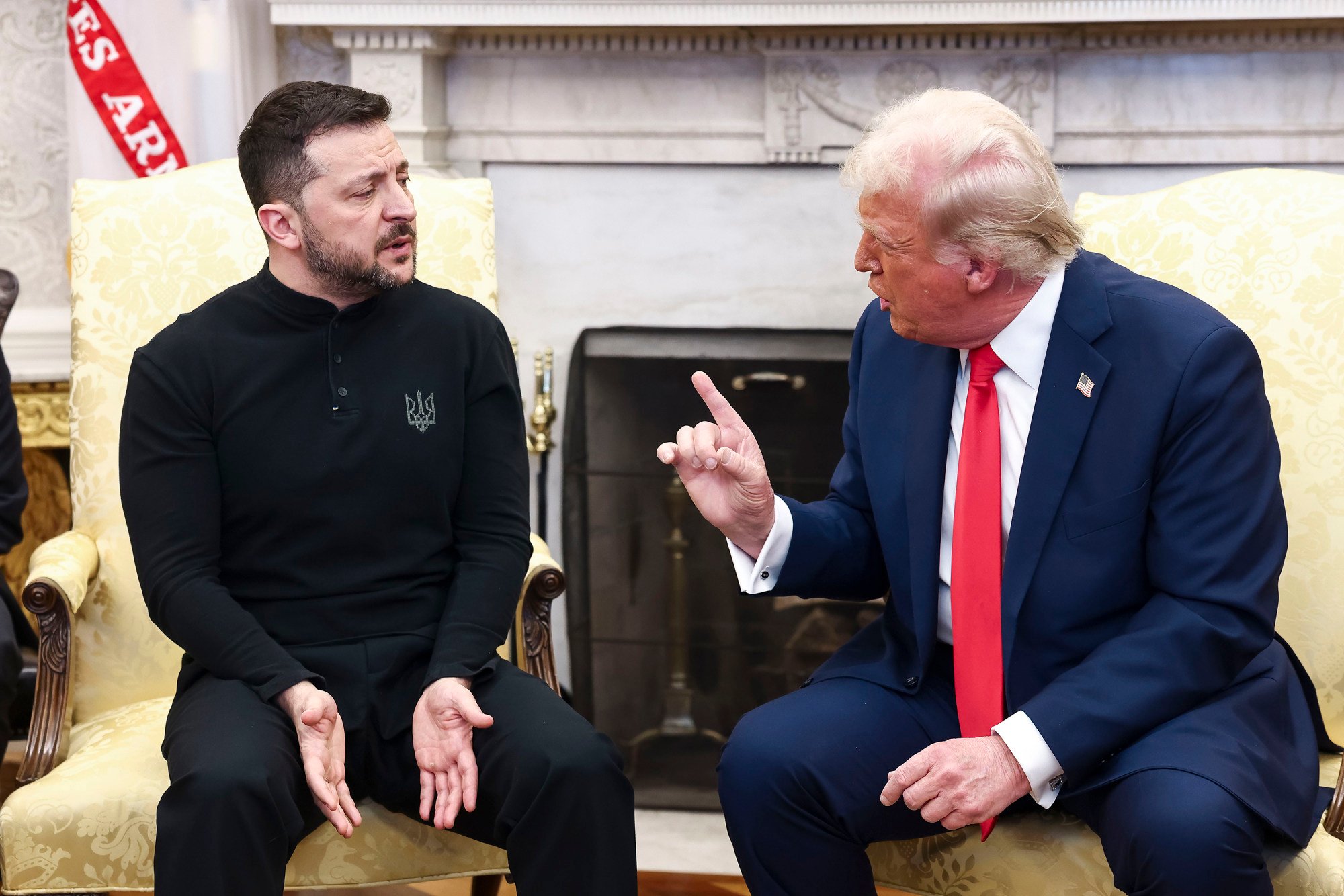
Weeks after a tense and widely televised spat with Ukraine’s leader during a meeting expected to lead to a critical minerals deal, Donald Trump announced that the long-awaited agreement would be signed next week.
“We have a minerals deal which I guess is going to be signed on Thursday,” the US president said during an Oval Office meeting with Italian Prime Minister Giorgia Meloni on Thursday. “And I assume they’re going to live up to the deal.”
Shortly after Trump’s remarks, Ukraine’s deputy prime minister and economy minister, Yulia Svyrydenko, posted on social media that the two countries had virtually signed a memorandum as a first step towards the agreement.
Do you have questions about the biggest topics and trends from around the world? Get the answers with SCMP Knowledge, our new platform of curated content with explainers, FAQs, analyses and infographics brought to you by our award-winning team.
“We are happy to announce the signing, with our American partners, of a memorandum of intent, which paves the way for an economic partnership agreement and the establishment of the investment fund for the reconstruction of Ukraine,” Svyrydenko wrote.
We are happy to announce the signing, with our American partners, of a Memorandum of Intent, which paves the way for an Economic Partnership Agreement and the establishment of the Investment Fund for the Reconstruction of Ukraine. pic.twitter.com/AQsHPkWh5X— Yulia Svyrydenko (@Svyrydenko_Y) April 17, 2025
The joint US-Ukraine development deal grants American companies access to Ukraine’s vast mineral reserves and authorises them to take part in rebuilding the war-torn country’s infrastructure.
It comes as Trump pushes Kyiv for compensation in return for the military aid and support provided by his predecessor, Joe Biden.
The US spent US $119.7 billion on aid between January 2022 and December 2024, according to the Kiel Institute, a German-based think tank tracking support going to Ukraine.
However, Trump has claimed that the US has given Ukraine more than US$300 billion over the same time frame.
The pact coincides with worsening US-China relations, fuelled by escalating trade disputes, tit-for-tat tariffs and Beijing’s tightening grip on critical mineral exports.
Critical minerals are essential to the US economy, national security, and clean energy. Many are imported and prone to supply disruptions.
Though details of the deal are not known, Ukraine holds about 5 per cent of the world’s critical raw materials, according to a 2024 report by the World Economic Forum.
These include graphite, titanium, beryllium, and uranium as well as rare earth metals used in weapons, wind turbines and electronics.
China dominates the global rare earths market, both in mining and refining. It produces about 61 per cent of the world’s rare earths and handles 92 per cent of the global refining process, according to the International Energy Agency.
In response to Beijing’s export restrictions on six essential minerals imposed on April 4, Trump ordered a review of potential new tariffs on critical minerals imported to the US.
Last week, the US and Ukraine met in Washington to negotiate the deal. The meeting was “antagonistic”, according to a Reuters report, which said the new draft deal was more “expansive” than the one Kyiv rejected in February after a falling-out between Trump and Ukrainian President Volodymyr Zelensky.
Trump has been ambivalent about the bigger issue of Ukraine’s security.
During his meeting with Trump in February, Zelensky asked for US security guarantees, like Western peacekeeping forces on the ground and protection against future attacks from Moscow.
But it has been reported that this key request will not be included in the final deal.
Russia, having launched its invasion in February 2022, now occupies 20 per cent of Ukrainian territory.
In recent weeks, Zelensky has accused China of supplying weapons and soldiers to Russia. Beijing has rejected the claims as “totally unfounded”.
On Thursday, US State Department spokesperson Tammy Bruce, who earlier this month called China an “enabler” in the war and said it provided “80 per cent of [Russia’s] dual-use items”, declined to comment further on the issue.
“I’m not going to get into the specifics of what sectors that is in, but I think we’ve been very clear about our concern regarding China”, said Bruce when asked about Kviy’s allegations that Beijing was directly supporting Moscow’s war effort.
The new minerals deal would arrive at a pivotal time as the Trump administration intensifies efforts to broker a ceasefire with the Kremlin.
Asked about a peace plan to resolve the Ukraine war and the imposition of US sanctions on Russia, which Trump seeks to involve in the plan, the president on Thursday said “we’re going to be hearing from them this week ... very shortly, actually, and we’ll see”.
“We want the death and the killing to stop,” Trump added.
The US leader’s muted remarks on Thursday followed a sharper critique he gave on Monday, when he blasted Moscow and Kyiv for failing to end the war.
“That’s a war that should have never been allowed to start and Biden could have stopped it and Zelensky could have stopped it and Putin should have never started it,” Trump said. “Everybody is to blame.”
Last week, Trump’s special envoy to the Middle East, Steve Witkoff, met with Russian President Vladimir Putin. In an interview with Fox News on Monday, Witkoff described his five-hour meeting with Putin as “compelling,” saying he believed a peace deal was “emerging”.
More from South China Morning Post:
- Ukraine has evidence of China supplying Russia with weapons, Zelensky says
- Trump administration reduces Ukraine aid estimate in minerals deal: report
- US envoy claims ‘on the verge’ of Ukraine peace deal after Putin meeting
- Trump blames Biden and Zelensky for failing to prevent war in Ukraine
- Trump on Russia-Ukraine peace deal: there is a time ‘to put up or shut up’
For the latest news from the South China Morning Post download our mobile app. Copyright 2025.