
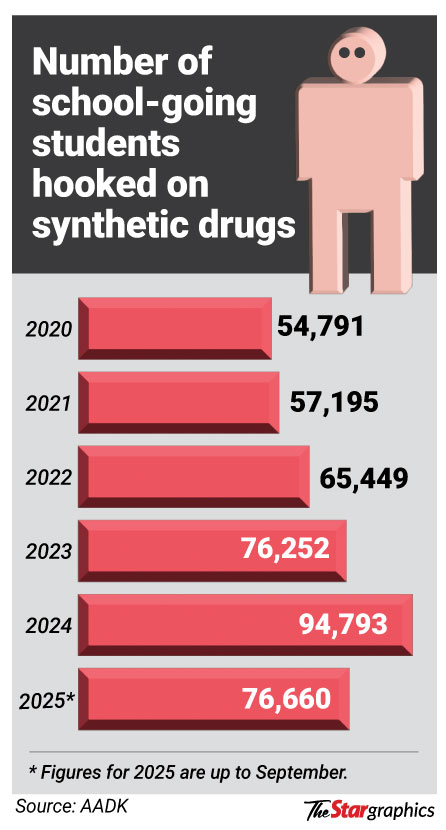
KUALA LUMPUR: Students as young as 13 have fallen into the trap of synthetic drugs, with cases of abuse among school-going youths showing a sharp increase over the past five years.

The number went up by 73% to 94,793 individuals in 2024.
From January to September 2025, 76,660 youths were recorded as being involved in synthetic drug use.
“Since 2020, the majority of youths involved in synthetic drug abuse cases were those aged 16 and 17 (Form Four and Form Five students).
“As of September last year, 41,615 of those involved were from that age group.
“The second-highest group comprised lower secondary students aged 13 to 15 (Form One to Form Three), with 25,484,” AADK director-general Datuk Ruslin Jusoh told The Star.
ALSO READ: Brain damage risk soars among teen users
He said the data reflected a worrying pattern of synthetic drug exposure among school-going youths, necessitating early intervention and targeted rehabilitation efforts.
“We have identified several categories of synthetic drugs under the Amphetamine-Type Stimulants (ATS) group, including crystalline methamphetamine known locally as syabu or ice, methamphetamine tablets such as pil kuda, yaba, yama and pil bom, as well as ecstasy and amphetamine.
“Psychotropic pills such as benzodiazepine, Erimin 5, APO 5 and Dormicum were also listed among substances of concern,” he added.
Ruslin said that the abuse of synthetic drugs poses a significantly higher risk of severe mental health complications, including psychosis and aggressive behaviour, compared with traditional opioids.
“The direct impact of certain synthetic substances on the central nervous system can trigger serious psychiatric conditions, making treatment and rehabilitation more complex.
“Mental health specialists revealed that synthetic drug use is strongly associated with hallucinations, paranoia, depression and violent or aggressive behaviour.
“In many cases, the psychotic symptoms can be severe because these substances act directly on the brain’s chemistry,” he said, adding that the long-term impact on cognitive and emotional functioning can be profound.
Unlike opioid addiction, which has established pharmacological treatments, Ruslin said that there are currently no widely effective substitute medications for synthetic drug dependency.
“For opioid addiction, therapies such as methadone and buprenorphine under Opioid Replacement Therapy (ORT) programmes are available to help manage physical withdrawal symptoms and reduce cravings.
“However, for synthetic drug addiction, treatment relies heavily on intensive psychosocial therapy. Without a substitute medication, recovery depends greatly on structured therapy, counselling and continuous monitoring,” he added.
Another major challenge is the intensity of psychological addiction associated with synthetic drugs, he said.
“Prolonged and persistent cravings are common, making recovery particularly difficult. While opioid addiction also involves strong psychological dependence, initial treatment often focuses on addressing severe physical withdrawal symptoms,” he said.
In contrast, Ruslin said synthetic drug treatment centres focus more on managing behavioural and mental health complications from the outset.
“The long-term cognitive and emotional damage linked to synthetic drug abuse can also hinder rehabilitation efforts,” he added.
Affected individuals may struggle to reintegrate into society and maintain focus during rehabilitation programmes.
“In comparison, traditional opioids such as heroin or morphine are more recognisable in form, although they may still be injected or inhaled.
“Greater awareness of the distinct dangers posed by synthetic drugs is needed, as well as enhanced mental health support and rehabilitation resources to address the growing challenge,” he said.