



PETALING JAYA: Chinese New Year is a season of abundance, reunion and generosity, but prosperity does not belong in the fridge indefinitely.
As dining tables overflow and refrigerators are packed to the brim with festive fare, experts warn that improper storage of leftovers may pose a hidden health risk long after the last firecracker fades.
The real challenge begins once the guests have left and the dishes are packed away.
Here, ensuring that leftovers remain safe to eat is crucial to preventing foodborne illnesses that can quickly turn festive joy into medical distress, and the trick lies in how leftovers are stored.
Registered dietitian Ng Kar Foo said preparing food in abundance during the festive season symbolises prosperity, togetherness and blessings for the year ahead.
“Leftovers are therefore common and traditionally reused in dishes like asam mustard greens, reflecting thrift and wisdom passed down through generations,” he said.
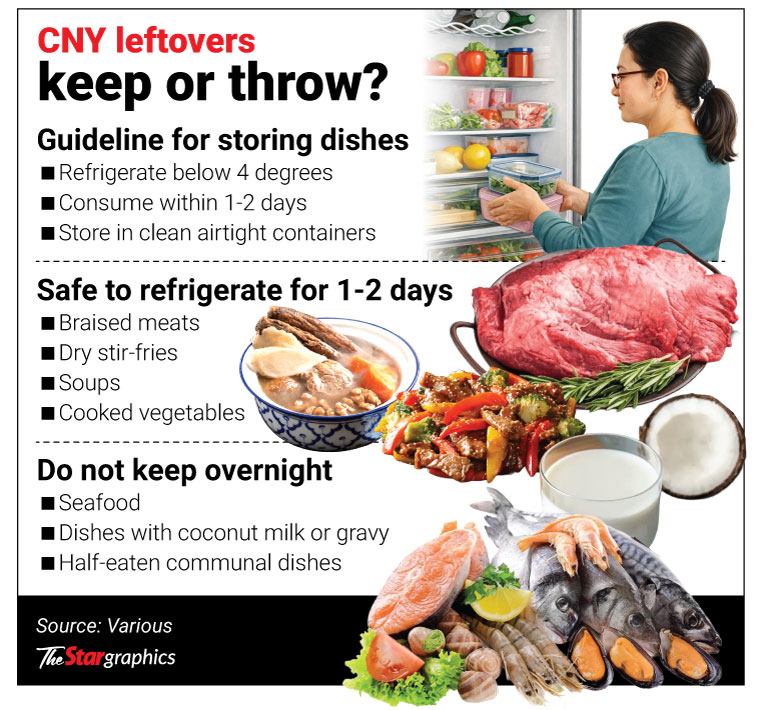
From a food safety perspective, he said dry dishes, braised meats, soups and cooked vegetables can generally be kept within two hours after cooking and cooled quickly, stored in clean airtight containers, refrigerated below 4°C, and consumed within one or two days.
“If you like to keep these foods longer, deep freeze them,” he said, adding that frozen food can be kept for three months in a standard home freezer.
“That said, it is not advisable for high-risk food such as seafood, dishes with coconut milk, gravy-soaked stir-fries, or half-eaten communal dishes to be kept overnight, especially for older adults, young children, pregnant women, or those with chronic illnesses.
“Improper storage may lead to food poisoning, bacterial growth, and toxin formation that reheating cannot fix,” he said.
In the same vein, he said proper planning is the more important goal, adding that Chinese scholars have long taught that moderation and avoiding waste reflect wisdom.
“Planning portions wisely and finishing food safely honours both tradition and sustainability; true prosperity benefits health, family, and the environment,” he added.
Public health expert Prof Dr Sharifa Ezat Wan Puteh of Universiti Kebangsaan Malaysia recommended that food should be refrigerated within two hours of cooking to prevent bacteria growth.
“Keeping it exposed and at room temperature increases the risk of bacterial growth,” she said.
“When in doubt or it has been kept a long time, discard such food, as they can spoil even if they look or smell fine,” she added.
Prof Dr Sharifa said raw and half-cooked food and those cooked with milk or coconut milk tend to turn bad quickly.
“Food preparation must also be done in a clean manner. There should not be cross-contamination when we prepare food. For example, having raw meat and blood next to cooked food,” she said.
She said food borne illnesses are generally caused by pathogens, namely bacteria, viruses, and parasites, as well as toxins that contaminate food.
“The common culprits include Salmonella, Bacillus, norovirus, hepatitis A virus, Campylobacter, E. coli, Listeria, and Clostridium perfringens,” she said.
These organisms typically cause clinical symptoms like diarrhoea, vomiting, fever and abdominal cramps.
“Untreated cases may cause kidney failure and can be fatal,” she added.
