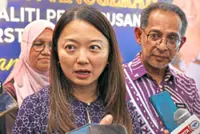
PETALING JAYA: A feasibility study to hold an election for the Kuala Lumpur Mayor will be conducted, says Hannah Yeoh.
According to Sinar Harian, the Minister in the Prime Minister’s Department (Federal Territories) said that such an election was seen as more practical than electing many city council members through local government elections.
She explained the existing administrative structure involved too many units, with the capital city currently being administered simultaneously by a mayor, MPs and Kuala Lumpur City Hall (DBKL) advisory board.
“If I were the mayor, whose advice should I listen to? Do I need to listen to elected members of Parliament, DBKL advisors or city council members?” she said as quoted in an interview with China Press.
She said that if local government elections were revived, direct elections would only be held for either the position of Kuala Lumpur Mayor or city council members, but not both simultaneously.
She added that mayoral and local government elections also require different procedures than general elections, including separate considerations regarding costs, laws, voter eligibility and voter registration.
“In a general election, anyone aged 18 and above can vote. However, in the mayoral election, we need to clarify whether eligibility is based on home ownership, tenant status or individuals working in Kuala Lumpur,” she said.
Yeoh added that an amendment to the Federal Capitol Act 1960 would be needed if such an election was to be implemented, and new legislation may be considered if the amendment was too far-reaching.
She added that a separate study on local government elections would be conducted by the International Islamic University Malaysia (IIUM), with the findings expected to be announced in March and made public.
Additionally, she said research and preparatory work were still needed regardless of whether the mayoral election was eventually implemented, while assuring that MPs and the public would be informed and given a clearer explanation in the future.
Hannah also said five new monitoring committees of the Kuala Lumpur City Hall (DBKL) chaired by MPs would strengthen monitoring of development projects and provide advisory input to the mayor.
“This is because previously MPs did not have access to DBKL’s internal processes and are often only informed about development plans after approval has been given.
“When development plans are still at the One Stop Centre, MPs will know that they can also advise the mayor before decisions are made,” he said.
On Jan 19, Hannah announced that the committee would also oversee the DBKL 2026 budget, evaluate the city’s key policies and help improve the administration of the capital.
The committee is chaired by Batu MP P. Prabakaran (sustainable business); Bandar Tun Razak MP Datuk Seri Dr Wan Azizah Wan Ismail (public housing projects and community welfare); Wangsa Maju MP Zahir Hassan (flood mitigation, road maintenance, slope management and maintenance); Kepong MP Lim Lip Eng (systems and traffic Management); and Seputeh MP Teresa Kok (clean, green city and sustainable Development).
Calls to restore local government elections in Kuala Lumpur came in November last year following the sudden termination of former mayor Datuk Seri Dr Maimunah Mohd Sharif’s term.
She was later replaced by Datuk Fadlun Mak Ujud after receiving approval from the Yang di-Pertuan Agong.
Meanwhile, Setiawangsa MP Nik Nazmi Nik Ahmad said the people of Kuala Lumpur had no say in how the city was governed, while calling for long-overdue reforms to curb the concentration of power in the mayor's office.
He also referred to Pakatan Harapan's 2022 General Election manifesto, which promised to strengthen democratic participation at the local level.
Nik Nazmi was joined by six other Kuala Lumpur MPs who submitted a Private Member's Bill to Parliament to amend the Federal Capital Act 1960 and called for a councillor-based system of administration for the capital.