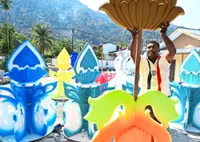
GEORGE TOWN: Keeping his designs simple and traditional, kavadi maker K. Pragalathen uses neon ombre colours to make his creations stand out.
The 45-year-old wants his kavadi to be affordable and accessible to devotees, with prices ranging from RM1,000 to RM1,200 depending on design, with basic ones priced at RM800.
“I usually say that a single colour is cheaper, and nicer too. Kavadi is likely to be used only once, and I tell them not to choose elaborate decorations as the pricing varies.
“My design is simple and inspired by God, which is why it features the spear and peacocks. Sometimes I choose the colours for the devotees, or they send me something they like and we work on the design together.
“I stick to traditional designs as kavadi is carried to fulfil vows,” he said when met at the Paya Terubong Community Management Council (MPKK) hall on Wednesday.
Pragalathen, a Penang Island City Council worker, has made 22 kavadi this year, his most in over 21 years.
He started working on them from last November.
“It is an arduous task requiring physical and spiritual commitment. When I work on a kavadi, I have to be vegetarian throughout the process,” he said.
He said kavadi were made from polystyrene, reinforced with plywood and steel at the base which rests on the bearer’s shoulders.
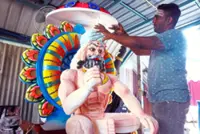
“Crafting a single kavadi, from drawing the designs to cutting, carving with a knife and painting, takes about a week and is done at my store in Sungai Pinang.
“Assembly takes up to two days and requires plenty of space, as the kavadi are about 1.8m tall and weigh up to 7kg.
“I do the design, cutting and painting, while my friends and family help put them together,” he said, adding that orders have come from as far as Johor and Kedah. The self-taught kavadi maker has been teaching his daughter P. Subhiksha, 10, the basics of designing and making kavadi.
“She helps me with the painting and wants to learn more,” he added.
Paya Terubong assemblyman Wong Hon Wai, who helped provide space for Pragalathen to assemble his kavadi at the Paya Terubong MPKK hall, said it was important to support traditional artisans.
“His work is a form of Indian craftsmanship. He approached us a few years ago because he needed a larger area to assemble the kavadi,” he said.