KUALA LUMPUR: Malaysia’s trade with Asean saw an increase of 6.1% in 2024 compared to the previous year, surpassing RM765.03bil, the Dewan Rakyat was told.
Investment, Trade and Industry Minister Datuk Seri Johari Abdul Ghani said this amount accounted for 29% of Malaysia’s total trade for that year, which stood at RM2.879tril.
“During the same period, exports to Asean rose by 4.1% to RM438bil, while imports from the region increased by 8.9% to RM327.12bil,” said Johari in a parliamentary written reply on Wednesday (Jan 21).
Johari was responding to Tan Kok Wai (PH-Cheras), who asked about the comparison of Malaysia’s trade with Asean and non-Asean nations.
According to Johari, Malaysia’s trade structure remained heavily focused on Asean countries, which continue to be the nation’s largest export destination. Malaysia’s top three trading partners in Asean were Singapore, Thailand and Indonesia.
“Exports to Asean member states were dominated by electronic and electronics (E&E) products, petroleum produce, and chemicals,” said Johari, adding that this pattern reflected the increasingly complex and interdependent nature of regional supply chains.
For the period of Jan to Nov last year, Johari said Malaysia’s trade with Asean grew by another 1.7% to RM709.08bil compared to the same period in 2024. Exports for this 11-month period in 2025 rose 4.8% to RM418.78bil, supported by higher demand for E&E, machinery, as well as optical and scientific items.
However, Johari said imports contracted by 2.6% to RM290.30bil during that period.
“This decrease was due to a significant drop in domestic demand for petroleum products, chemicals and transport equipment. It was also influenced by the fall in crude oil prices, which dropped from around US$80 per barrel in 2024 to US$60 per barrel last year,” he said.
Meanwhile, Johari said the combined GDP of all 11 Asean member states, including Timor-Leste, had risen to US$3.9tril last year, maintaining the bloc’s position as the world’s fifth largest economy.
Despite 98.6% of tariffs being eliminated among member states, Johari said intra-Asean trade still hovered around 21% to 22% of the region's total trade. To address this, Johari said Malaysia as the Asean Chair last year had prioritised the upgrading of the Asean Trade in Goods Agreement (Atiga).
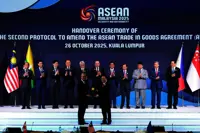
The Second Protocol to Amend the Atiga was signed by the Asean Economic Ministers during the 47th Asean Summit in Kuala Lumpur in October last year.
“All member states are now undergoing their respective domestic processes to ratify this Protocol within 18 months,” said Johari.
Johari also added that Asean is currently finalising the Asean Digital Economy Framework Agreement (Defa), which aims to double the region’s digital economy from US$1 trillion to US$2 trillion by 2030.