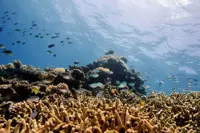
KUALA LUMPUR: Malaysia has lost about 20% of its coral reefs, equivalent to 47,250 football fields, over the last three years since 2022, with reef conditions continuing to deteriorate nationwide, according to Reef Check Malaysia’s Annual Survey Report 2025.
The report, which assessed 297 reef sites across the country using the internationally recognised Reef Check survey method, found that average live coral coverage fell to 39.94% in 2025, down from 44.65% in 2024.
Reef Check Malaysia chief executive officer Julian Hyde said the five-percentage-point drop translated to about an unsustainable 10% of coral cover lost annually.
"Live coral cover (the national average) reduced from about 45% in 2024 to 40% in 2025. That’s a loss of five percentage points, or 10% of coral cover in one year.
"Back in 2022, live coral cover was about 50%. Looked at one way, you could say we lost 10 percentage points, or 20% of coral reefs since 2022.
"Imagine if someone told you that one-fifth of Malaysia’s forests were cut down in a few years. Or, to use a different measure, that’s about 47,250 football fields gone,” he said in a statement on Jan 14.
Reef Check Malaysia attributed the ongoing decline to multiple stressors, including the fourth Global Coral Bleaching Event in 2024, alongside unsustainable tourism activities, pollution, coastal development and destructive fishing practices.
Its survey results also showed that populations of key indicator fish and invertebrates remained low, even in marine protected areas, where recovery would normally be expected.
In a statement accompanying the report, it also reported that signs of reef disturbance were widespread, with 82.5% of sites affected by trash, 80% by abandoned fishing gear, and 57.5% by boat or anchor damage.
Coral bleaching was observed at 67.5% of surveyed locations.
Meanwhile in Sabah, damage linked to dynamite fishing was recorded at 33.33% of surveyed sites, highlighting ongoing enforcement challenges.
“These findings are significant because coral reefs underpin livelihoods and food security for coastal communities,” Hyde said, noting that reefs, together with mangroves and seagrass meadows, serve as vital nursery habitats for fish stocks.
In light of these findings, Reef Check Malaysia called for stronger reef protection measures, particularly by reducing local stressors and expanding the role of coastal communities in conservation efforts.
They urged the government to adopt immediate co-management approaches to formally involve local communities in managing marine protected areas, while simultaneously strengthening ecological and economic resilience.
“Reducing local impacts gives reefs a better chance of surviving broader pressures such as climate change,” Hyde said, adding that diversifying livelihoods could also ease pressure from tourism.
Reef Check Malaysia also stressed the need for a shift away from mass tourism towards more sustainable practices.
“We are not anti-tourism — we are pro-sustainable tourism,” Hyde said.