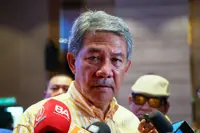
Malaysia has not finalised the Agreement on Reciprocal Trade (ART) with the United States, and it has to redefine certain matters before it is ratified, said Investment, Trade and Industry Minister Datuk Seri Johari Abdul Ghani.
Johari said it is crucial to iron out any issues that could potentially raise misunderstandings before ART is ratified.
“We must redefine certain matters, including sovereignty and national interest, prior to ratification.
“Before I was involved, discussions centred on economics, and there was no clear definition.
“The ratification process will be used as an opportunity to discuss and redefine what the terms actually mean,” said Johari during Question Time in Parliament yesterday.
Johari was responding to Datuk Seri Hamzah Zainudin (PN-Larut), who asked about Malaysia’s commitment in ART, as other countries in Asean have yet to ratify that document.
Johari also explained the significance of not discriminating against existing investors when welcoming new ones into Malaysia.
“For example, Penang is home to many American investments. If we bring in another country and give better incentives, they (the United States) will feel affected. So, if we can accommodate everyone, why can’t we sit down and negotiate with the world’s leading economy?” he said.
Johari said Malaysia has signed 17 free-trade agreements (FTAs); nine of them are multilateral FTAs, while eight are bilateral FTAs.
According to him, four regional countries are currently negotiating ART with the US – Malaysia, Indonesia, the Philippines and Thailand.
“Malaysia’s involvement in ART is to ensure stable and consistent market access to the US, which is the main trading partner and the main investment destination for Malaysians.”
Johari said the United States imposed higher tariffs on countries that did not negotiate ART, such as Myanmar (40%), Laos (40%), and Brunei (25%).
He said ART was crucial for securing the future of the Malaysian semiconductor industry, with the United States being the primary destination for exports.
Johari highlighted that in 2024, Malaysia’s semiconductor exports to the United States were about RM60bil (US$13bil), representing the highest value compared to other exporting nations.
“Other countries that export semiconductors to the US are South Korea (US$3.2bil), China (US$2.1bil), Japan (US$2bil), and Germany (US$2bil), among others.
“If our semiconductors are expensive, investors will move to other sources; they will go to other countries because of higher tariffs.
“It (ART) has nothing to do with politics,” said Johari.
ART was signed between Malaysia and the United States on Oct 26 last year by Prime Minister Datuk Seri Anwar Ibrahim and US President Donald Trump.
Under ART, tariffs on Malaysian exports were reduced from 25% to 19%, one of the lowest among Asean countries.