PETALING JAYA: A surge in Prasarana’s rail and bus ridership suggests that public faith in the nation’s transport network is on the mend, said a leading transport expert.
Associate Professor Law Teik Hua, who heads the Road Safety Research Centre at Universiti Putra Malaysia, said the record-breaking figures for 2025 are a positive sign for the country’s congestion and emission reduction goals.
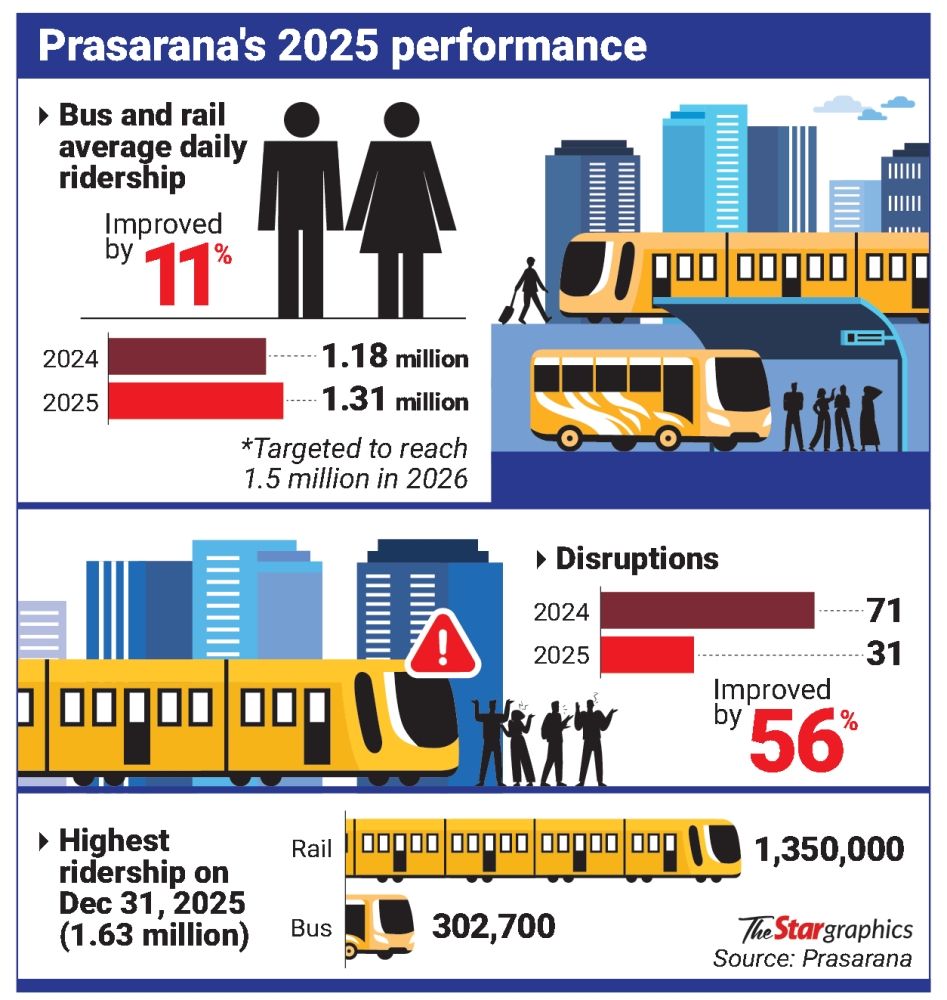
Prasarana Malaysia Bhd reported yesterday a daily average of 1.31 million passengers across its networks last year, representing an 11% increase from the 1.18 million recorded in 2024.
Describing the development as “worth cheering about”, Assoc Prof Law said it validates the effectiveness of recent operational improvements.
ALSO READ : Shah Alam LRT line faces more delays
However, he warned that urban ridership growth this year was likely to be dampened owing to delays in the Shah Alam LRT line’s launch.
The 37km line from Bandar Utama in Petaling Jaya to Johan Setia in Klang, was supposed to begin operations last September.
Transport Minister Anthony Loke said yesterday that a commencement date for the line’s Fault-Free Run (FFR) has not yet been set due to technical hurdles.
The FFR is a critical safety and reliability test where the system must operate without failure for a set period.
Assoc Prof Law backed the government’s decision to prioritise safety and dismissed the idea of bypassing these checks to meet public expectations.
“Delays in large-scale projects tend to be met with frustration. However, the FFR is a vital safety and reliability qualification test.
“Forgoing the process for the sake of a deadline is irresponsible and possibly poses a danger to not only the passengers but the eventual functionality of the facility itself,” he said.
However, he added that the delay was unlikely to cause long-term stagnation as rail demand in the Klang Valley was structurally driven, and “typically rebounds once service begins”.
Assoc Prof Law also noted that the Shah Alam LRT line gives commuters a reliable alternative to the Klang Valley KTM Komuter line, which is currently undergoing a major double track rehabilitation project project.
“While double tracking serves longer-distance trips, the Shah Alam LRT line supports frequent urban travel.
“This reduces reliance on a single system and improves overall resilience.”
The academic also highlighted systemic issues in how public infrastructure projects are managed in Malaysia.
He suggested that deadlines are often communicated to the public before technical issues have been fully resolved, leading to inevitable disappointment.
To remedy this, he proposed a staggered approach to public updates.
He suggested that authorities should focus on informing the public about the necessity and progress of testing phases instead of fixating on a completion date.
“This ensures the public is kept informed of the reason for the need of such processes and its progress rather than the date of completion.”