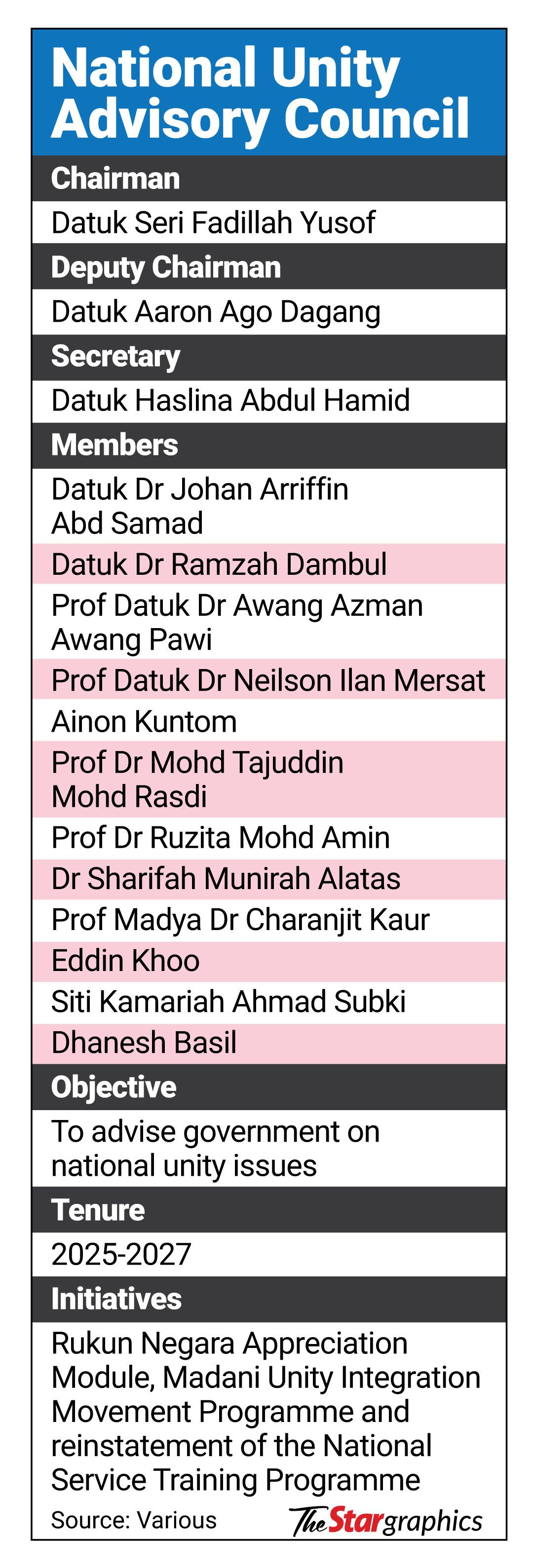
PETALING JAYA: While multiracial volunteerism and listening without bias are essential for social cohesion, the National Unity Advisory Council emphasises that true unity begins at home.
These are some of the views newly appointed council members are articulating as Malaysia enters the new year with national unity in mind, as the National Unity Ministry works to celebrate diversity and togetherness.
The council members, who were announced two months ago for the 2025-2027 term, stated that everyday Malaysians continue to practise unity far more naturally than public discourse often suggests.
Professor Datuk Dr Awang Azman Awang Pawi pointed to multiracial volunteerism during disasters and communities supporting one another during festive seasons as examples of unity built through shared experience.
“These are the moments that reflect who we really are as a society,” he said.
Another council member, Assoc Prof Dr Charanjit Kaur Darshan Singh, highlighted the lack of communication and listening skills as a major barrier to unity.
“Listening without bias or judgement is something we rarely cultivate. But it is essential if we want to rebuild trust,” said the Universiti Tunku Abdul Rahman associate professor, who is the first Sikh appointed to the council.
Despite these challenges, she remains cautiously hopeful, pointing to youth initiatives, interfaith dialogue, cultural collaborations and grassroots volunteerism, which demonstrate that Malaysians remain united.
“We must have the courage to unlearn, learn and relearn. We cannot rely on inherited generational fears or outdated narratives to label others.
“Religion, in particular, is often treated as too sensitive to discuss or, worse, weaponised. Yet every religion speaks about humanity, dignity and diversity. Religion is not meant to prove superiority but to improve ourselves. We must also resist the temptation to act as moral judges.
“We have laws, institutions and due process, and they must be respected. Increasingly, we see impatience like people wanting instant answers, instant punishment and instant outrage.
“When outcomes fail to meet expectations, racial narratives are stirred again. This is not how a mature society governed by the rule of law should function.”
Cultural practitioner and historian Eddin Khoo believes unity must be framed as part of Malaysia’s civilisational foundation.
“History is key, especially community and cultural history, not just political history. When everything is reduced to politics, we are in trouble.”
Unity, he stressed, begins at home and within families, not solely in classrooms.
“Public education must reach adults, too. Parents shape values long after schooling ends,” he said.
Khoo believes that although the council does not have executive powers, it can influence national tone and discourse.
“We may not solve everything, but we can open up spaces and help Malaysians become resilient to toxic rhetoric,” he said.
Awang Azman stressed that unity must also be examined through an economic lens.
“Among the T20 and professional classes, unity is strong because Malaysians collaborate naturally across ethnic lines in business and professional settings.
But among the B40 and working class, economic integration remains limited,” he said.
If left unaddressed, Awang Azman warned, economic segregation could harden into social and political division.
His focus within the council is on promoting inclusive entrepreneurship, mixed-ethnicity cooperatives, shared ownership models and equitable access to skills training and financing.
“Unity should not be measured only by the absence of conflict. It should be measured by trust, shared opportunities and mutual respect,” the political expert said.
He described Malaysia’s current state as stable, but in need of recalibration to ensure that no group is left out economically or socially isolated.
On Dec 31, National Unity Minister Datuk Aaron Ago Dagang said 2026 would require the ministry to shoulder significant responsibility, as the country faces emerging challenges such as social fragmentation, digital polarisation, and the erosion of national identity amid globalisation and borderless media.
He said a nation-state was not created overnight but was forged on trust, strengthened by love, and nurtured by the people’s willingness to understand one another despite differences in skin colour, language, and beliefs.
“The key is sharing a national identity. We will not lose our identity when we are united, and we do not become lesser by embracing tolerance.
“Malaysia’s true strength lies in celebrating diversity and making togetherness the foundation for building the future,” he said, welcoming the new year.