PETALING JAYA: While the government’s move to raise the mandatory e-invoicing threshold to an annual turnover of RM1mil offers temporary relief to small and medium enterprises (SMEs), industry players should take advantage of the pause to improve their readiness, say groups.
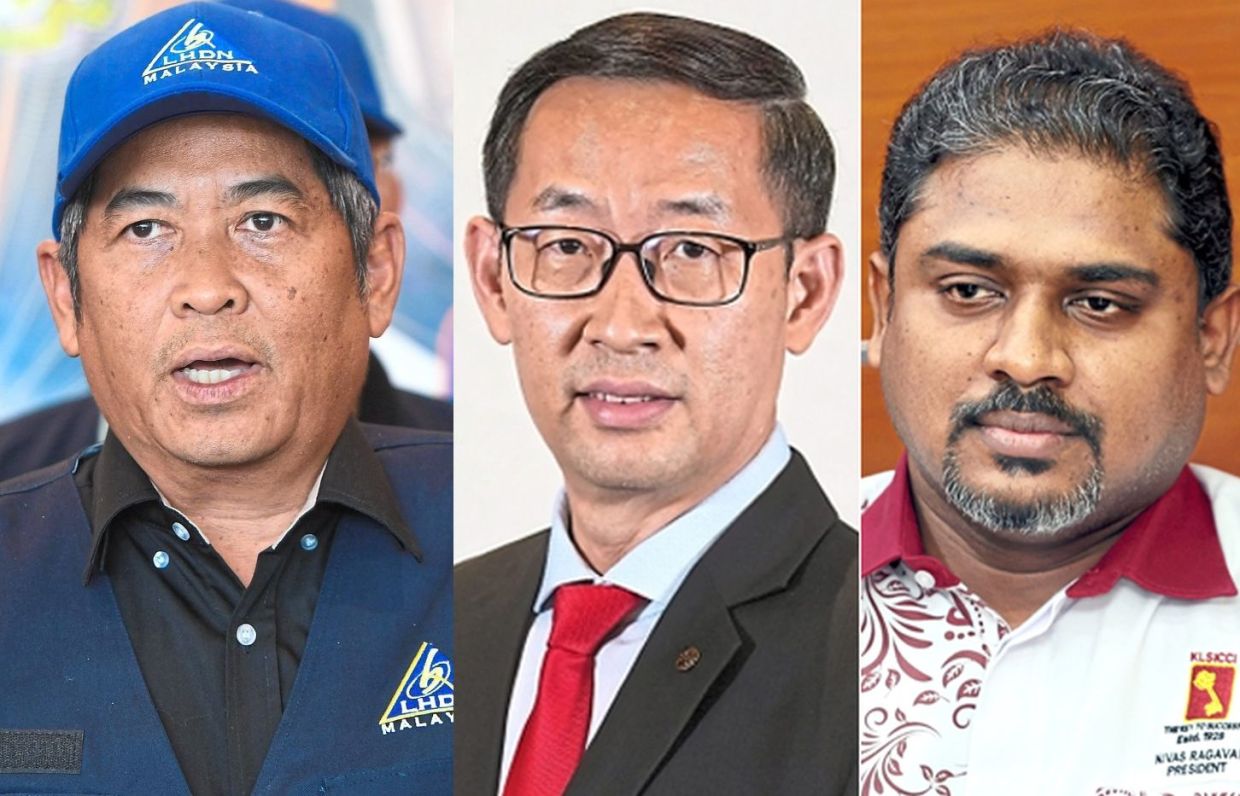
Associated Chinese Chambers of Commerce and Industry of Malaysia (ACCCIM) treasurer-general Datuk Koong Lin Loong said SMEs currently below the threshold should not take the exemption for granted.
“Yes, they do have breathing space but they should not take it for granted. It is better if they voluntarily get started on it,” he said.
Koong acknowledged that ACCCIM has received complaints from SMEs who felt sidelined for not needing to provide e-invoices but he stressed that non-issuance does not mean transactions are illegitimate.
“There is a misunderstanding. SMEs that are not required to issue e-invoices doesn’t mean that the transactions are illegitimate. It is just that they are not mandated to provide it yet,” he said, adding that complications may arise when only one party in a transaction issues e-invoices, creating an apparent one-sided record within the Inland Revenue Board’s (LHDN) system.
He said adopting e-invoicing would ultimately benefit companies by improving organisation and supporting broader digitalisation, urging SMEs to set their own internal deadlines to prepare for future requirements.
Echoing this view, Kuala Lumpur and Selangor Indian Chamber of Commerce and Industry president Nivas Ragavan said e-invoicing is not only about compliance.
“It is part of a broader shift towards formalisation, transparency and digital efficiency,” he said, noting that SMEs that prepare early would face lower transition costs and fewer disruptions as they scale up.
He warned that larger corporations and MNCs are already moving ahead with e-invoicing regardless of exemptions, often due to internal audit, tax compliance and real-time reconciliation needs.
“SMEs that cannot issue proper e-invoices risk delayed payments, administrative friction, reduced order volumes and, in some cases, being dropped from preferred supplier lists,” Nivas said, adding that the risk is particularly acute in structured supply chains such as manufacturing, retail, logistics and professional services.
He advised SMEs to adopt a basic digital accounting software, one that is e-invoice-ready.
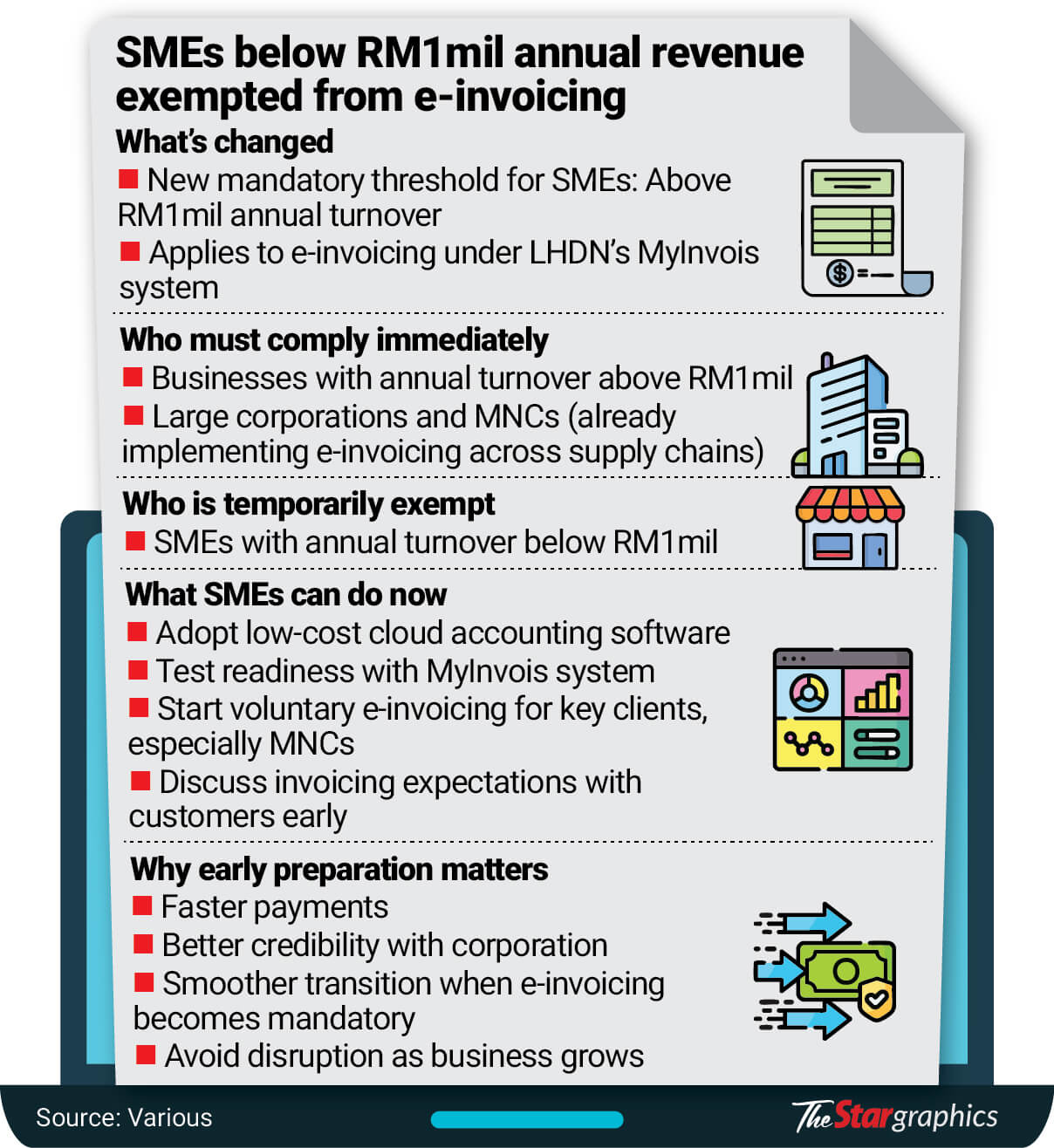
He also encouraged proper record-keeping and data accuracy, train staff on digital invoicing processes and consider voluntary adoption of e-invoicing for key customers, especially large corporations.
“Those who prepare early will enjoy faster payments, stronger credibility and better access to financing and partnerships,” he said.
Newly-appointed Federation of Malaysian Manufacturing (FMM) president Jacob Lee Chor Kok described the higher threshold as a “necessary and pragmatic transitional measure” for micro and small enterprises facing thin margins and cashflow pressures.
However, he cautioned that the raised threshold should not be viewed as a permanent substitute for future adoption.
“E-invoicing is a cornerstone of Malaysia’s broader tax and digitalisation agenda. Over time, it will become an integral part of business-to-business transactions and supply-chain integration,” Lee said.
While FMM has not seen widespread cases of SMEs being rejected solely for being unable to issue e-invoices, he noted that digital compatibility is increasingly becoming a commercial advantage rather than just a regulatory obligation.
“The current risk is not immediate exclusion, but a gradual divergence in operational efficiency,” he said, adding that SMEs that do not embrace digitalisation may face slower payment processing and reduced competitiveness over time.
He also called for continued tax incentives and grants to support a manageable transition.
Meanwhile, SME Association of Malaysia president Dr Chin Chee Seong said many SMEs that had already invested in e-invoicing before the threshold change are continuing to use it, encouraged by its benefits in good record-keeping and account management.
“In general, e-invoicing is good for them to pursue. When you do business with MNCs, you will mostly follow their requirements,” he said, adding that most SMEs in MNC supply chains have already implemented e-invoicing.
Meanwhile, LHDN chief executive officer Datuk Dr Abu Tariq Jamaluddin said e-invoicing participation was currently on a voluntary basis.
“However, LHDN encourages SMEs to accelerate their participation, and will continue to provide support throughout the implementation process,” he said.