PETALING JAYA: Legal experts have urged the government to immediately implement the Parliamentary Special Select Committee (PSSC) recommendations to reform the controversial Security Offences (Special Measures) Act 2012 (Sosma), warning that the law remains vulnerable to abuse.
Human rights lawyer Andrew Khoo said a major overhaul of Sosma is long overdue due to inadequate safeguards against misuse.
He agreed with the PSSC’s findings, stressing the need for stronger judicial oversight.
“There needs to be closer and stricter supervision by the courts, which must take firm action against any attempt to ignore or circumvent legal protections,” he said.
Khoo said Sosma’s scope is overly broad and often applied to offences that do not constitute genuine threats to national security.
“The interpretative threshold used by law enforcement is extremely low, with almost any offence argued to be a threat to national security. The PSSC has highlighted specific cases demonstrating this problem,” he said in an interview on the committee’s recommendations.
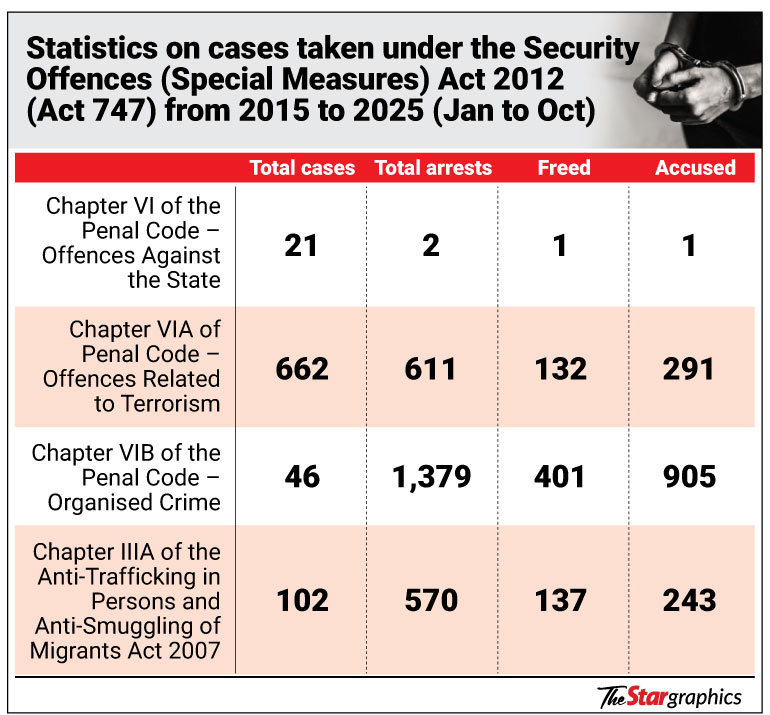
The PSSC made eight recommendations in its Human Rights, Election and Institutional Reform 2025 report, proposing amendments to Sosma, including a review of the 28-day detention period.
The report also noted that since Sosma came into force in 2012, there has been no proposal by deputy public prosecutors to use electronic monitoring devices (EMD), even in cases involving individuals with mental health issues.
On the use of EMDs, Khoo said such measures should be limited to individuals who pose the most serious threats to national security and present a genuine flight risk.
“The use of an EMD is a serious infringement of human rights, including the right to life and freedom of movement, and should only be justified in the rarest circumstances,” he said, adding that the devices are costly to maintain despite allowing limited freedom of movement.
Meanwhile, lawyer Datuk N. Sivananthan also called for the swift implementation of the PSSC’s recommendations, describing Sosma as an ongoing problem affecting not only detainees but also their families.
“Sosma is increasingly used to facilitate arrests and remands without the justifications required under normal remand procedures. The potential for abuse is rampant,” he said.
Sivananthan singled out Section 30 of Sosma, calling for its complete repeal as it allows continued detention even after an accused has been acquitted, pending the final disposal of the prosecution’s appeal in the Federal Court.
“This effectively means someone could succeed at every stage of the trial process and still be detained for up to five years. This provision is unique to Sosma,” he said.
Sivananthan added that in practice, the law allows the police to detain individuals for prolonged periods regardless of trial or appeal outcomes, with no effective recourse available.
He also noted that Sosma is being invoked even when other specific laws are available to address the alleged offences.
“Authorities have realised that by using Sosma, there is almost no judicial supervision.
“Any assertion made is often accepted without question.
“In contrast, other preventive laws have stronger checks and balances,” he said.
Sivananthan urged the government to reintroduce judicial discretion at all stages of the process, particularly in matters of remand and bail.
“The courts should be empowered to dismiss cases where it is clear that the law is being misused,” he said.
On the continued non-use of EMDs, Sivananthan attributed the issue to a lack of functioning devices and an effective monitoring system, adding that bail provisions should be amended to allow courts to consider EMDs in exceptional cases.