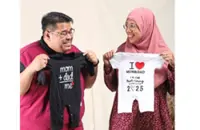
KUALA LUMPUR: Despite being diagnosed with cancer, Juliana Razid did not give up on her dream of having children.
She persevered through a long course of treatment before finally being blessed with a baby girl after nearly 11 years of waiting.
Juliana, 43, was diagnosed with mucinous carcinoma, a rare form of breast cancer that accounts for only one to two percent of cases and typically affects older women or those nearing menopause.
This came after she detected a lump in her right breast in December 2016.
“At that time, I was only 34 years old and had no family history of cancer.
“When people asked why it happened to me, I accepted it as a test given by Allah,” she told Bernama at the Hospital Canselor Tuanku Muhriz (HCTM) Media Day 2025 here.
Juliana, who was a civil servant stationed overseas at the time, took medical leave and underwent surgery at the National Cancer Institute in January 2017.
“Because I acted quickly, the doctor said chemotherapy was not mandatory as the cancer cells had been removed and had not spread.
“However, I chose to proceed as a precaution and underwent six cycles of chemotherapy, with the final treatment on July 7, 2017,” said Juliana, who is from Taiping, Perak.
She added she and her husband Fariq Azwar Salehuddin, 44, continued to hope for a child after more than two years of marriage.
After completing chemotherapy, she underwent follow-up checks including computed tomography scans, which showed favourable results to proceed with fertility treatment.
“The risk can occur early, midway or late in pregnancy. If it happens, only then will doctors consider whether to prioritise treatment or the pregnancy.
“As long as it hasn’t happened, we can’t predict it, so I just prayed that it wouldn’t,” Juliana said.
The couple underwent four cycles of intrauterine insemination treatment at Putrajaya Hospital before being referred to HCTM for in vitro fertilisation (IVF) treatment under the supervision of reproductive and oncofertility specialist Assoc Prof Dr Mohd Faizal Ahmad beginning in May 2020.
She said the first IVF attempt in August 2020 resulted in an early pregnancy that did not progress, followed by several more cycles that had to be postponed or cancelled. At times, the follicles retrieved were empty, with no ova present.
“I underwent surgery twice to remove polyps as they could interfere with embryo implantation.
“Every time a treatment failed, questions arose within me – what else was lacking?” she said, adding that she also sought opinions from several other treatment centres regarding her condition.
After undergoing seven IVF cycles, Juliana was confirmed pregnant in December 2024 and safely delivered a baby girl, Emma Emily Fariq Azwar, on July 24, 2025, at 37 weeks and five days of gestation via elective surgery.
“‘The Magnificent Seven’ – that’s all I can say about this successful attempt.
“It was truly unexpected, since the egg retrieval process for the final cycle had to be extended until day 32, much longer than the usual day 14 to day 17.
“We never gave up. We told the doctor we would keep fighting. But we were also aware that we would have to stop if the doctor said the treatment had reached a point where the harm outweighed the benefit,” she added.
Throughout the pregnancy, Juliana chose to keep the news private, sharing it only within a small circle, while also strictly adhering to the prescribed treatment plan.
To those who are struggling to conceive, the holder of an Executive Master of Administrative Science from Universiti Teknologi Mara stressed the importance of early screening and seeking medical treatment, as well as maintaining physical and emotional well-being.
“If you want a child, even after six months of marriage couples can undergo health checks.
“Don’t be shy about seeing a doctor and don’t take misguided advice from unqualified individuals,” she said.