
PETALING JAYA: Businessmen are calling for faster, lump-sum refunds of excess income tax paid, noting that delays strain their cash flow when they are facing a tough time now.
These delays, in some cases stretching back years, are forcing small businesses to postpone payments, withhold staff bonuses and tap personal savings or bank loans to stay afloat.
Datuk William Ng, president of the Small and Medium Enterprises Association Malaysia, said many SMEs operate on thin margins and limited cash reserves, leaving them highly exposed when refunds are not paid on time.
“When refunds are delayed, businesses are forced to make difficult choices just to keep operations running,” he said, adding that some have had to prioritise payments to suppliers, staff and banks while deferring other commitments.
Ng noted that for many small business owners, business and household finances are closely linked, so prolonged refund delays also affect their families.

“This is not just a business issue. It affects livelihoods and thousands of households,” he said.
SME Association of Malaysia president Dr Chin Chee Seong said SMEs treat tax refunds as part of working capital rather than a windfall.
“When expected refunds do not arrive, businesses struggle to meet higher year-end obligations and prepare for the new year.
ALSO READ: SMEs face a double whammy of ‘unfair rules’
“SMEs are not asking for special treatment. They are asking for clarity and certainty on funds that already belong to them,” he said.
Chin said year-end is typically the period with the heaviest commitments, including staff-related expenses, annual adjustments and preparations for the next business cycle.
When cash flow tightens, owners often step in personally to cover shortfalls, squeezing household budgets.
“Processing legitimate refunds quickly is one of the most effective ways the government can support SMEs without introducing new spending,” he said, adding that faster refunds would improve liquidity and restore confidence.

Both SME leaders welcomed the Prime Minister’s recent announcement to increase the tax refund allocation and updates from the Inland Revenue Board (LHDN) on efforts to expedite processing.
However, Ng cautioned that announcements alone are not enough to convince businesses that have been waiting for extended periods.
“What SMEs want to see now is consistent and transparent execution. Confidence will only return when refunds are processed predictably and within a reasonable time frame,” he said.
Chin echoed this, saying uncertainty over refund timelines is often as damaging as the delay itself.
“When businesses do not know when funds will be returned, they cannot plan responsibly,” he said.
Both associations said faster refunds would help SMEs move beyond survival mode and focus on recovery and growth as they plan for 2026.
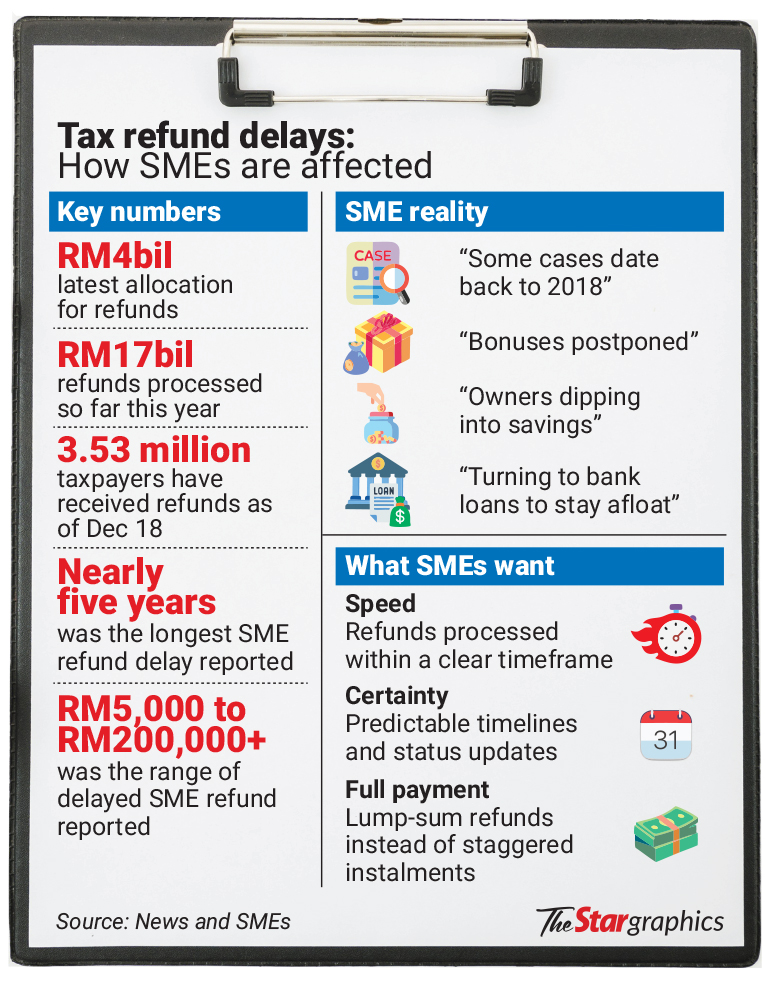
SMEs have recently raised concerns about significant delays in tax refund payments, disrupting their cash flows and creating operational challenges.
It has also drawn attention from leaders, including MCA president Datuk Seri Dr Wee Ka Siong, who has described SMEs as the backbone of the economy and called for outstanding refunds to be paid promptly.
In response, Prime Minister Datuk Seri Anwar Ibrahim announced an increase in the refund allocation from RM2bil to RM4bil to expedite outstanding payments.
LHDN has said it has processed RM17bil in tax refunds this year, covering over 3.5 million cases, and is committed to disbursing the remaining RM2bil before the end of December.