
M’sians enjoy better purchasing power despite marginal rise
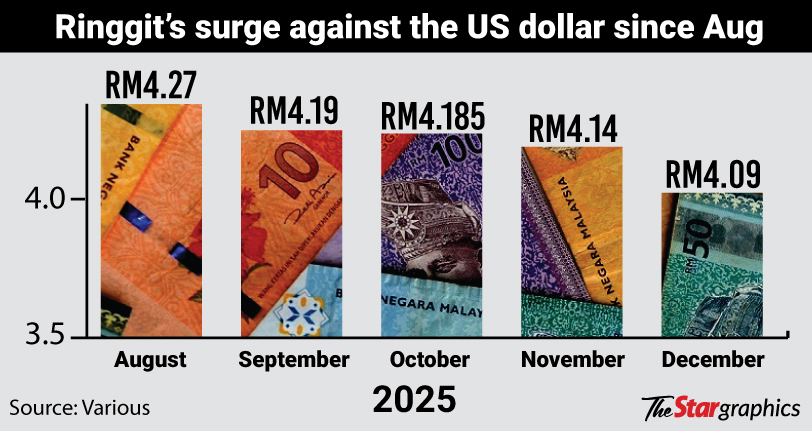
KUALA LUMPUR: The stronger ringgit has become a boon for many Malaysians buying foreign products, travelling or funding their children’s studies abroad.
Terry Tan, 33, who often buys American-made musical instruments, said the stronger ringgit would mean that accessories are now cheaper.
“Maybe this time around I could buy that expensive electric guitar pedal that I have been eyeing since early this year.
“I expect it to be at least 5% cheaper,” he said in an interview.
Similarly, M. Nisha said she would use the opportunity of the higher ringgit to restock on imported beauty products.
“I feel like I have more purchasing power now,” she said.
Sunway University economics professor Dr Yeah Kim Leng said consumers buying goods and going on holidays will benefit from lower imported inflation pressure as the ringgit’s purchasing power rises relative to the dollar.
At the same time, exporters, he said, will see an erosion of international price competitiveness as their goods become more expensive as well as lower export earnings when converted into ringgit.
“Export-reliant sectors like furniture, semiconductors and gloves will receive lower export sales revenue in ringgit terms.
“(But) this disadvantage is somewhat offset by the lower ringgit cost of imported capital and intermediate goods and services, especially for sectors with high import content such as semiconductors,” he added.
Yeah said given the large exchange rate differentials, particularly with respect to the Singaporean dollar and its much higher income level, the impact on Malaysia’s tourism is expected to be muted.
Universiti Malaya economist Prof Dr Mohd Nazari Ismail warned however that domestic tourism sector could lose out because it will cost foreign tourists more to come to Malaysia.
“This depends on the price sensitivity of the foreign tourists as well. If they are wealthy enough, they may still come to Malaysia,” he said.
For Kok Mei Ling, 56, from Ampang, whose daughter is studying in the United States, the higher ringgit has eased her financial burden slightly.
“I send around RM3,000 to RM4,000 to my daughter studying in the United States every month and the stronger ringgit has helped my family a little,” she said.
Nancy Chan, 52, from Cheras, will be travelling to the United States next week to visit her children working there.
“Since the ringgit has gotten stronger, I will exchange more money to spend it there with my family,” she said.
However, Malaysia Retail Chain Association president Datuk Ken Phua said a stronger ringgit has yet to significantly impact the retail industry as most retailers buy and sell in the local currency.
“We have yet to see any major impact on the retail industry as the ringgit strengthening usually benefits importers first,” he said.
Many retailers, he added, also source their products locally, especially in the food and beverage sector.
He pointed out that while some imported specialty products are now about 10% cheaper, this is overshadowed by other rising costs, particularly the expanded 8% service tax (SST) on rental.
He cautioned, however, that a stronger ringgit could lead Malaysians to spend more abroad during the year-end festive season.
“With ringgit strengthening, we may see consumers spending their money overseas rather than in local shops as Malaysians tend to travel during year end,” he said.
Malaysia Retail Association president Datuk Andrew T.K. Lim described the ringgit’s appreciation as “marginal”, rather than transformative.
“It is only a marginal or a small strengthening of our ringgit. It’s more to do with the weakening US dollar.
“We’re not seeing much of a difference in terms of our retail sales,” he said when contacted recently.
Lim added that while a firmer ringgit can ease costs for retailers importing merchandise, it may also slash competitiveness for export-oriented manufacturers.
“When we import consumer goods from China and overseas, a stronger ringgit helps our cost factor.”