Praised for work in bio-medical research
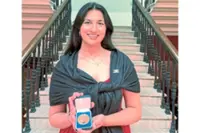
PETALING JAYA: The first call came from Ireland, and Balvinder Dhillon thought it was a mistake.
Sitting thousands of kilometres away from her hometown of Teluk Intan, Perak, the 24-year-old biomedical engineering graduate kept asking the voice on the line to repeat itself — until the reality sank in.
Her research had just won one of the world’s most prestigious undergraduate research awards, the Global Undergraduate Awards (GUA) often dubbed the “Junior Nobel Prize”.
A year later, she won yet another award from GUA.
The daughter of a small estate community had done what few young engineers anywhere have managed – giving hope for breakthroughs in heart and brain research.
Born and raised in Jendarata Estate, Teluk Intan, Balvinder, said these wins were the result of her constant determination and resilience in doing her research paper, which aims to improve medical devices and clinical tools.
“When I first got a call from Ireland for the awards ceremony, I couldn’t believe it, and I kept asking them if it was true,” said Balvinder.
“I was so shocked and immediately called my parents and told them, ‘I won, and I’m going to get a free trip to Dublin!’”
Balvinder, who graduated from Queen Mary University of London, bagged her first award last year in Dublin, Ireland.
The research title was ‘Development of a Bioresorbable Drug-Eluting Stent with Organ-On-A-Chip Validation’ was inspired by her father, who lives with a heart stent and faces the risk of restenosis (the re-narrowing or re-blockage of a coronary artery).
For her second award-winning project, Balvinder wrote a paper on advanced brain tumour analysis using artificial intelligence (AI).
The title was ‘Developing a Multimodal Deep Learning Pipeline for Automated Glioma Subregion Segmentation and 3D Reconstruction with Integrated Spatial Analysis for Clinical Insight’.
“I picked this research because so many people in my community (Teluk Intan) were dying from cancer,” she said.
“It was heartbreaking to hear that from every call I get from my mother, and I wanted to do something to help,” she added.
Focusing on brain tumours, Balvinder developed a computer programme that can analyse MRI scans in a shorter period of time which usually takes doctors hours to do this analysis manually.
This programme identifies different regions of the tumour and extracts important data to guide treatment.
She is now developing it further into a digital twin, so doctors can simulate therapies and see how a tumour might respond over a year.
Balvinder is the only one to achieve this in the engineering category.
Currently studying Human and Biological Robotics at Imperial College London, she said she strongly stayed grounded and focused on her research.
Balvinder told The Star that once her work is properly established, she wants to bring it home to Malaysia.
“I hope the digital twin project grows into a real medical device or startup, and when it’s ready, I want to bring it back to create jobs, build more scientists, and support our healthcare system,” she added while saying she deeply misses Teluk Intan.