




ARTIFICIAL intelligence (AI) in Asia Pacific (Apac) has made remarkable headway over the last 12 months, as AI transitions from a novelty to a norm.
More than three quarters (78%) of employees now use the technology regularly – six percentage points higher than the global average.
Such progress raises an important question: is Apac now at the forefront of the global AI transition? That’s the guiding question underpinning Boston Consulting Group’s (BCG) latest report AI At Work: Is Asia Pacific Leading the Way?
Our findings reveal that Apac benefits from a unique combination of high engagement and strong optimism, creating a valuable foundation to power up AI adoption.
This presents encouraging opportunities for Malaysia as it continues its journey towards further growth.
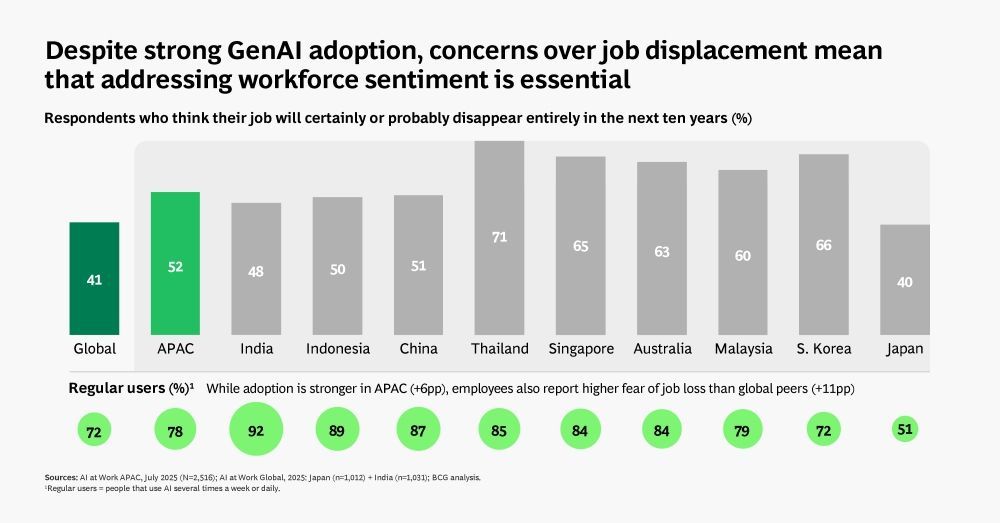
However, smart business strategy must also recognise the disruption that AI will bring. There are persistent fears of AI replacing human workers and uncertainty around redesign of workflows as businesses struggle to adapt to AI capabilities.
Malaysia reflects this dual reality – home to a digitally eager and optimistic workforce with strong AI adoption, but limited by uneven leadership guidance and a focus on tools over transformation.
The next step for Malaysia is turning high adoption into high impact, with a strategic approach to governance, leadership enablement and a stronger focus on redesign and reskilling.
Malaysia demonstrates leading AI optimism
AI adoption in Malaysia is broadly in line with the Apac average, with 79% of Malaysians regularly using AI tools – far above the global average of 72%. It’s the nation’s enthusiasm, however, that really stands out.
Malaysia ranks among the top three Apac markets for AI optimism at 68%, behind only China (70%) and Indonesia (69%).
This is notably higher with the average 60% of Apac users optimistic about the potential of these technologies, and puts Malaysia 16 percentage points higher than the global average (52%).
Malaysia’s optimism is underpinned by strong day-to-day usage. The workforce shows encouraging engagement with AI tools, framing a workforce that is digitally active and eager to apply AI for productivity and innovation.
An encouraging 79% of Malaysian frontline workers – white-collar workers with no managerial responsibilities – are integrating AI into their roles, just above the 78% Apac average.
This is a striking contrast to the global average, where just half (51%) of employees actively use AI weekly.
The benefits of this AI adoption are tangible. Nearly half of regular AI users say the technology saves them more than an hour each day – time they can reinvest in higher-value tasks such as creativity, strategic thinking or learning new skills.
Supported transformation is essential
Despite high comfort with AI tools, 52% of APAC respondents fear job displacement due to AI – a significant 11 points higher than the global average.
These concerns are especially pronounced in Singapore, South Korea and Thailand.

This tension between enthusiasm and fear is echoed in Malaysia, where 60% of employees worry about AI’s impact on their jobs.
This paradox underscores a key tension in adoption – using AI daily does not necessarily translate into confidence about the future of work.
At the organisational level, transformation in Apac has lagged behind enthusiasm.
Only 57% of Apac companies report actively redesigning workflows or decision processes to integrate AI, compared with global leaders that allocate around 70% of their AI investments to business process redesign and reinvention.
Without deeper redesign, adoption risks plateauing before delivering full productivity gains.
Unlocking the next step of AI value
Unlocking the value of Malaysia’s optimism will require a structured approach focusing on four key levers of transformation.
First, set the vision and address barriers driven by top-down leadership. Just a third (32%) of frontline workers in Malaysia report clear guidance from leadership, roughly in line with the Apac average of 31%.
More needs to be done to provide an informed AI journey for workers.
The next lever should focus on going beyond simple adoption of tools to reimagining how we work.
This requires stronger managerial enablement and structured upskilling to turn experimentation into confident execution.
Most Malaysian companies prioritise AI deployment and access to platforms, but few have fully integrated AI into workflows or business models.
Without strategic redesign of processes, the true productivity potential will remain under-realised.
The third lever comes in genuinely empowering workers with the skills to make them AI-ready.
Reskilling and targeted enablement must keep pace with adoption, ensuring Malaysian workers remain adaptive and ready for future AI opportunities.
The fourth lever reflects a key area for that upskilling, as businesses prepare workers for the emerging reality of agentic AI.
So-called “agentic AI” promises a future where AI not only responds to queries, but has the power to make decisions, plan and take action.
Awareness of next-generation AI agents is encouragingly high, with two-thirds (66%) of Malaysian employees recognising their importance to future success.
Yet 43% remain unsure how to use these tools effectively.
The pace and quality of Malaysia’s response here could define the next chapter of its digital competitiveness.
Turning enthusiasm into structured transformation
Malaysia has encouraging foundations and a receptive sentiment towards AI.
The strong digital confidence provides a pathway to transform optimism into true enterprise value.
Important steps to formalise AI governance, upskill leaders and managers, and embed AI programmes into genuine workflow transformation will be key.
Educating and upskilling workers will also be vital, as enterprises deepen awareness of emerging AI opportunities.
This should all be driven by strong leadership from the top, to energise the whole workforce into recognising and capturing the value that AI offers to enterprises.
With the right balance of enablers and safeguards, AI can provide a path to unlock significant value for Malaysia’s business ecosystem.
But we can’t afford to be complacent and lose out on the broad swell of optimism that underpins the landscape.
The next steps will define whether Malaysia can turn enthusiasm into expanding value for its future AI journey.
The authors would like to thank BCG CCI Vantage manager Lilian Cheong and senior analyst Mayank Kalia, as well as BCG X product lead Melissa Lou and global product marketing manager Filipa Ivanova for contributing their insights to this article.


