
PETALING JAYA: Malaysia’s population will undergo a sharp demographic shift over the next four decades, with the median age rising from 29.7 years in 2020 to 40.7 years in 2060, according to United Nations population estimates and projections.
The UN’s “World Population Prospects: The 2024 Revision” report shows this 11-year increase, placing Malaysia among Asean’s faster-ageing countries, although it lags behind nations such as Singapore, Vietnam and the Philippines.
Median age is the midpoint of a population’s age distribution; as it increases, it reflects the combined effects of longer life expectancy and declining birth rates.
Singapore is set to experience the region’s steepest rise in median age, jumping by 21.6 years to reach 56.1 by 2060.
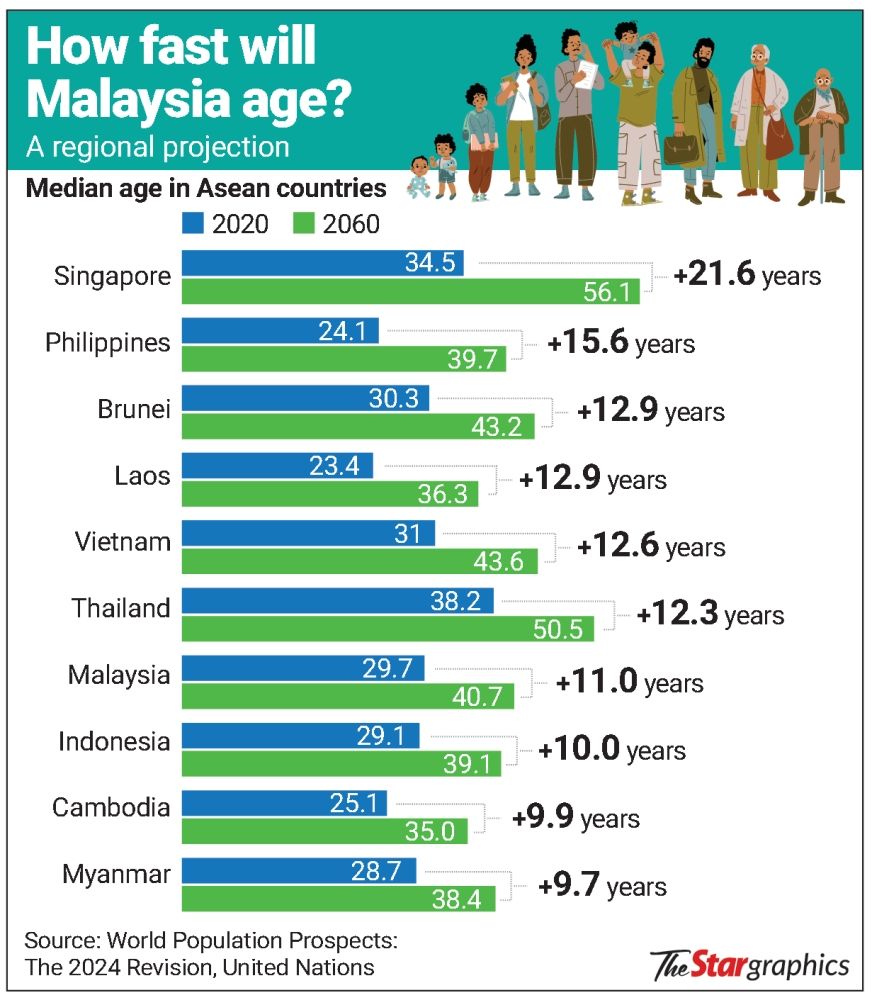
The Philippines, despite being one of Asean’s youngest nations with a median age of 24.1 in 2020, is projected to have the second-highest increase.
The median age is expected to rise sharply to 39.7 years by 2060.
Vietnam, Laos, Brunei and Thailand will see increases of around 12 to 13 years, while Indonesia and Myanmar will age more slowly than Malaysia.
Despite the rapid shift, Malaysia’s overall dependency ratio – the number of children and older persons per 100 working-age adults – is expected to rise modestly from 44.3 in 2020 to 52.3 in 2060.
In contrast, Singapore, Thailand, China and South Korea will face far sharper increases, driven by shrinking workforce and surging elderly populations.
Malaysia is also one of the few countries in the region still expected to grow in population size.
The country will reach its peak population of 42.4 million in 2059, long after Thailand and China have entered population decline.
Peak population refers to the point at which a country reaches its highest number of inhabitants.
After that, the population begins to decline as low fertility and ageing outpace births.
Four countries that have reached their population peak before 2030 are Japan (2010), South Korea (2020), China (2021) and Thailand (2022).
The populations of the United States, Australia and India are expected to continue growing beyond 2060, and the world’s population is projected to reach 9.99 billion by that year.