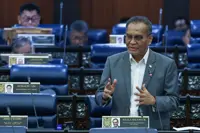
KUALA LUMPUR: Malaysia is tightening security checks at all entry points through a major restructuring of enforcement agencies, upgraded scanning equipment, wider use of artificial intelligence (AI) and stricter screening of frontline officers.
Deputy Home Minister Datuk Seri Dr Shamsul Anuar Nasarah said the Malaysian Border Control and Protection Agency (AKPS) has begun taking over inspection duties in phases under the Malaysian Border Control and Protection Agency Act 2024.
Scanners and personnel were also transferred over from the Royal Malaysian Customs Department beginning Oct 1.
Shamsul Anuar said the move aims to place border control responsibilities under a single agency to reduce overlap and strengthen enforcement.
"Many of the scanners we use are outdated. A full assessment is underway, looking not only at technical performance but also maintenance costs, operational effectiveness and after-sales support.
"Technology from the United States, Germany, China, the United Kingdom and Japan are being evaluated to ensure the country gets the best value," he said in the Dewan Rakyat on Wednesday (Nov 26).
Dr Mohammed Taufiq Johari (PH-Sungai Petani) wanted to know about improvements to baggage screening at international and domestic airports, as well as the monitoring of officers to prevent smuggling.
Shamsul Anuar said high-energy scanners for large containers from US manufacturers, high-resolution CT scanners from Germany and portable scanners from China are among the systems being studied.
Manufacturers from the UK and Japan are also known for their radiation-detection technology, he added.
"To strengthen security, the government is focusing on smart technology and automation, including AI-based scanners capable of automatically analysing images to detect prohibited items such as drugs, weapons and cash.
"We are also looking at electronic declarations and integrating Immigration and Customs data to improve intelligence capabilities," he said.
On concerns about passengers being used by smuggling syndicates, Shamsul Anuar confirmed that one such case has been recorded since AKPS took over.
"In the incident at Penang's Bayan Lepas Airport, four suspects were arrested for attempting to smuggle 86kg of drugs worth RM8.3mil.
"They used methods such as bag-switching, manipulating airport assistance and last-minute baggage handovers," he said.
He said AKPS has since strengthened behavioural detection screening to identify suspicious passengers at an early stage.
"This includes monitoring signs of anxiety, changes in voice tone, eye contact, inconsistent answers and unusual movements.
"Digital risk profiles, travel history and ticket data are also combined to detect anomalies," he said.
Responding to Datuk Awang Solahuddin Hashim (PN-Pendang), who asked about continued smuggling incidents and weaknesses in airport inspections including staff fatigue, outdated technology and officer integrity, Shamsul Anuar said these matters are taken seriously.
"We place strong emphasis on the competence and integrity of officers stationed at the country’s main entry points.
"That is why AKPS is carrying out continuous, comprehensive training programmes, strengthening integrity controls and expanding the use of new technologies, including AI," he said.
He added that integrity audits and profiling systems are in place to detect high-risk officers and identify baggage routes frequently targeted by smugglers.