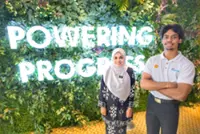
MORE than 200 women leaders and advocates from across Asia-Pacific gathered at Hilton Petaling Jaya on Nov 18, united by one mission: to reshape the future of business through gender equality and innovation.
The region is at a critical turning point, with rising digitalisation, AI adoption and climate pressures reshaping the world of work. However, women’s labour force participation remains at only 46%, compared with 74% for men.
Against this backdrop, the region’s women leaders gathered for the Asia-Pacific 2025 Women’s Empowerment Principles (WEPs) Forum to confront these challenges head-on.
In collaboration with the United Nations Programme for Gender Equality and the Empowerment of Women (UN Women), Talent Corporation Malaysia Bhd (TalentCorp) co-hosted the two-day regional forum which was themed, “Business. Innovation. Impact.”.
It was centred around fostering an inclusive future in emerging sectors such as AI and digital technologies, green innovation and sustainable finance.
Cost of inaction
In her opening address, TalentCorp chairman Wong Shu Qi explained that the forum represents the nation’s commitment to ensuring women are equal partners in economic development.
She said that according to the World Economic Forum’s Global Gender Gap Report 2025, Malaysia ranks 108th out of 146 countries, which is an improvement but still far from where Malaysia wants to be.
“When women are empowered, families and communities grow stronger,” she said.
“The cost of inaction is high: untapped potential, stalled innovation and weakened economic resilience. But, the benefits of action are well-documented, as closing gender gaps contributes to stronger economies, reduced poverty and more stable, inclusive societies.”
Wong also noted that megatrends such as AI, digitalisation and the green transition are reshaping labour markets. But, without targeted investment in upskilling, women are at risk of being left out of emerging high-value roles.
Australian High Commission political-economic counsellor Medina Hajdarevic echoed this sentiment, stating that while progress has been made, much more needs to be done.
“I’m an economist by training, and there’s a statistic that really sticks out to me. Globally, government procurement is worth about US$11 trillion annually. But, of that funding and procurement available in the market, only about 1% of women-owned businesses were engaged,” she said.
Australia’s new gender equality ambassador Michelle O’Byrne reiterated this view via a virtual message, emphasising the crucial role of women’s economic empowerment in the global economy.
“The issues are far from solved, and are increasingly under threat. Which is why it’s more important than ever for us to come together to share experiences and demonstrate practical outcomes,” she said.
“Women’s economic empowerment and gender equality are fundamental to increase business productivity, to cultivate inclusive economic growth, foster social cohesion and realise the human rights of women and girls.”
Closing the action gap
The WEPs, adopted by over 11,000 companies globally, serve as a framework for businesses to champion gender equality across leadership, workplace practices and supply chains.
To mark its 15th anniversary, UN Women APAC regional office women’s economic empowerment head Katja Friewald reflected on the WEPs journey.
“Across Asia, business leaders are showing what real progress looks like, using innovation to advance women’s empowerment and gender equality,” she said.
“This is where the region’s strength lies—turning equality into an engine for inclusive and sustainable growth.”
Friewald noted that while labour markets are being reshaped in this modern era, it’s important not to reproduce the same biases that plagued the previous system, as achieving gender parity could potentially inject US$342 trillion into the global economy.
Meanwhile, LinkedIn South-East Asia’s public policy and economic graph head Trisha Suresh highlighted the gap between in-demand green and digital skills.
She explained that women’s current participation in green talent stands at only 33%, while less than 2% of women have coding skills, despite more graduating in STEM-related fields.
“These factors present us with a clear choice—whether we stand by and watch new forms of inequality emerge, or we actively design a future of parity. It is great to see incremental progress being made, but we need to start working towards a system of parity today,” she said.
Driving action
TalentCorp, as the forum’s strategic co-organiser under the Human Resources Ministry, brought a national perspective to the regional dialogue.
The forum also highlighted the UN Women’s Gender Action Lab and We Rise Together programme in the Mekong subregion.
Another key initiative was the WEPs Corporate Action Lab (WEPsCAL) launched in May, in which Malaysia was the first of four implementing countries to host the programme. Its first cohort will conclude in March 2026.