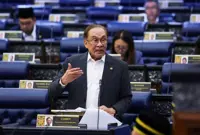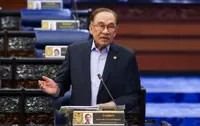
JOHANNESBURG: Economies can manage shocks when policies are aligned and rules are predictable, but the most important lesson is that resilience comes from common preparedness rather than isolation, says Datuk Seri Anwar Ibrahim.
Sharing Malaysia’s experience as Asean chair this year, the Prime Minister said Malaysia had worked with South-East Asia neighbours to manage tariff shocks, supply-chain pressures and rapid technological change.
“This lesson matters because the next disruption will likely be harder to contain. Artificial intelligence will reorganise labour markets at a pace our institutions will struggle to match.
“Without early investment in transitions, workers, especially the young will face these shifts alone,” Anwar said in his intervention at Session 1 of the G20 Leaders’ Summit on Saturday (Nov 22).
“We have seen the consequences before when societies were unprepared for globalisation: stagnant wages, eroded trust and the rise of politics that feed on grievance.
“With AI, destabilisation becomes a real risk if countries enter this transition unprepared. This will be one of the defining challenges of our times,” he added.
The Prime Minister also shared his observations, including the need for countries to equip their people, especially their youth, for the speed of technological change, pointing to the importance of opportunities for training and credible safety nets are essential.
He also touched on the importance of open and predictable trade, where in Southeast Asia, efforts are made to double down on international trade.
“We have seen that connected markets and clear, stable rules strengthen supply chains and give firms the confidence to invest.
“We have therefore moved quickly on the Asean Digital Economy Framework Agreement, which will set common standards for data, payments and digital trade,” he said.
Thirdly, Anwar said that global resilience cannot be built on fiscal exhaustion, sharing his observation that many developing economies now spend more on servicing debt than on education or investment.
“Countries need the capacity to invest ahead of disruption, not after. Multilateral development banks must be ready to deploy more quickly and work closely with countries to support the investments that build resilience.
“Malaysia is ready to work with all partners to meet this common challenge and to help sustain an open, predictable global economy that gives our people a fair chance to thrive,” he said.
The G20 Summit is an intergovernmental forum that was founded in 1999 in response to several world economic crises.
It works to address issues related to the global economy such as international financial stability, climate change mitigation and sustainable development, through annual meetings of heads of state and heads of government.
As of 2023, there are 21 members in the group: Argentina, Australia, Brazil, Canada, China, France, Germany, India, Indonesia, Italy, Japan, Mexico, Russia, Saudi Arabia, South Africa, South Korea, Turkey, the United Kingdom, the United States, the European Union and the African Union.
The Prime Minister’s participation in the G20 Summit as Asean Chair 2025 is upon the invitation of South Africa President Cyril Ramaphosa.