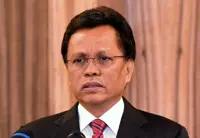
KOTA KINABALU: The Federal Government cannot yet commit to granting Sabah and Sarawak one-third representation in Parliament, though a policy decision to increase their parliamentary seats has already been made, says Prime Minister Datuk Seri Anwar Ibrahim.
“So far, there is no commitment to increasing the number to one-third representation for Sabah and Sarawak,” he said when asked about the long-standing call from the two Borneo states for one-third of all parliamentary seats.
“However, we are committed to increasing the parliamentary seats for Sabah and Sarawak as a matter of policy. The government has agreed to this in principle,” he said, noting that the Election Commission would ultimately determine the number of additional seats.
“For Sabah and Sarawak, I have already made the decision and informed the Cabinet that we will increase the number of seats,” he told reporters during a Santai Media session here yesterday.
Anwar added that the attorneys general of Sabah, Sarawak and the federation have been instructed to study the proposed increase.
The Sabah and Sarawak governments have long argued that their parliamentary representation should be restored to one-third, as originally envisioned under the Malaysia Agreement 1963 (MA63).
After Singapore exited the federation in 1965, many of its former seats were reallocated to Peninsular Malaysia, reducing the Borneo bloc’s share to below one-third.
Sabah currently holds 25 seats and Sarawak 31.
Addressing a separate issue raised by Sabah Journalists Association president Mariah Doksil regarding wages, Anwar expressed concern over reports that senior media practitioners with more than 10 years’ experience continue to earn below RM2,000 a month.
The Prime Minister said he would discuss the issue with Communications Minister Datuk Fahmi Fadzil and request a detailed report on media conditions in Sabah.
“I will ask Fahmi to meet with local media companies and practitioners. We will explore what can be done,” he said.
Anwar said the government may consider targeted incentives for media companies to help them improve salaries and allowances.
“If the minimum wage cannot be directly implemented, we may provide targeted support to help companies raise pay,” he said.
He also urged the local media industry to introduce its own minimum wage scheme to safeguard workers’ welfare and strengthen the journalism profession, particularly amid competition from social media.
“If someone has worked for 10 years, is considered a senior but still earns below RM2,000, it is difficult. I was shocked to hear this. To me, it is simply unacceptable,” he said.
Anwar noted that government-linked companies have been instructed to adopt a minimum wage of RM3,100 in light of rising living costs and expressed hope that the private sector would follow suit.