



PETALING JAYA: All 55-year-old technician Tan wanted after a long day at work was a little peace at home.
But that peace often seemed just out of reach due to his neighbour’s actions.
From afar, he would spot his new neighbour’s car parked haphazardly across his gate. What started as a minor annoyance soon spiralled into daily harassment.
“Every time I asked him to move his car, he would take his sweet time, sometimes nearly half an hour. Then he’d erupt into vulgar tirades, bang on my gate or give me intimidating stares,” Tan recalled.
The situation worsened when his neighbour began leaving rubbish bags and other refuse for collection opposite Tan’s house.
“I admit I snapped and gave him a taste of his own medicine. That only escalated things. We both ended up filing police reports,” he said.
Even after lodging reports, the harassment continued.
Police advised him to take the matter to the local council or resolve it through civil action.
Tan’s story is far from unique as countless Malaysians face similar neighbourly disputes, often feeling they have no effective solution.
Criminologist and retired police commissioner Datuk Seri A. Thaiveegan (pic) pointed to Section 67 of the Criminal Procedure Code as a powerful, yet underused, tool for resolving persistent neighbour disputes.
“This provision allows the police and courts to act early in cases that breach the peace,” Thaiveegan said.
“It empowers the police to compel both parties, especially the aggressor, to sign a bond, usually involving a sum of money to keep the peace.
“If the harassment continues, the bond can be forfeited and the individual may face arrest,” he added.
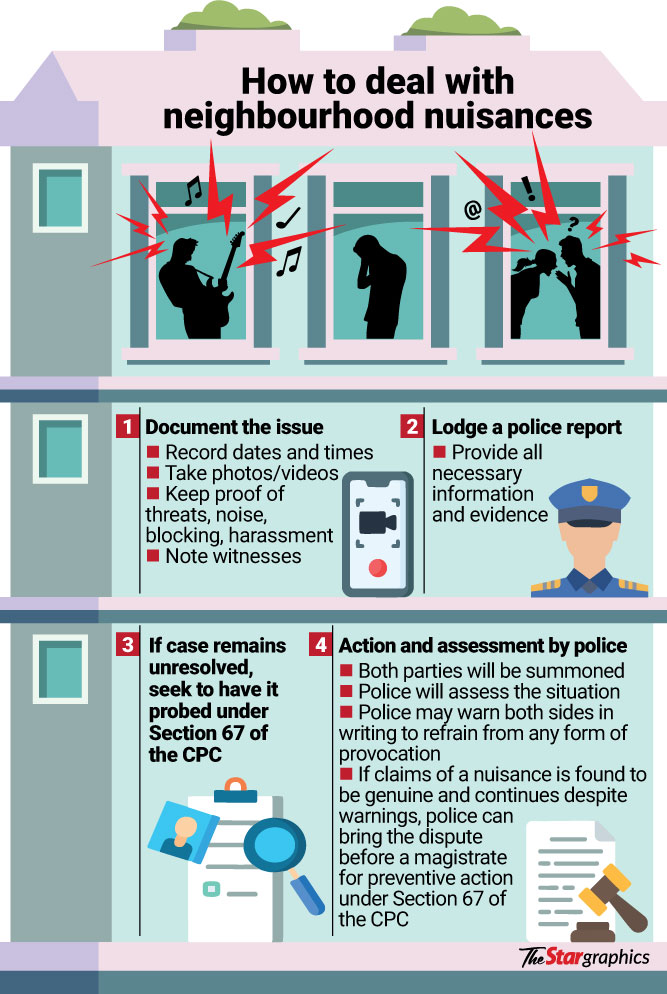
Section 67 of the Criminal Procedure Code, intended for “security for keeping the peace in other cases”, states: “Whenever it appears to a magistrate that any person residing or being within the local limits of his jurisdiction is likely to commit a breach of the peace or to do any wrongful act that may probably occasion a breach of the peace within or beyond such limits, the magistrate may, in the manner hereinafter provided, require that person to show cause why he should not be ordered to execute a bond with or without sureties for keeping the peace for such period not exceeding six months as the magistrate thinks fit to fix.”
Thaiveegan explained that many neighbour disputes escalate because residents feel helpless, believing police can act only in cases of property damage or physical assault.
“Violence is investigated as a crime, yes. But Section 67 can prevent situations from flaring into something more serious or violent,” he said.
He added that the provision applies only to persistent, ongoing conflicts that remain unresolved even after mediation.
He advised that complainants document every incident, including dates, videos, photos and witnesses, before filing a police report, and request that authorities consider action under Section 67.
Lawyer Datuk S. Shanmugamoorthy Chinniah said civil action remains an option to claim damages, but it is often time-consuming.
“Section 67 can be invoked when both parties are repeatedly involved in a neighbourly nuisance case.
“While it’s rarely used, it is an effective tool to resolve disputes before they escalate.
“If a case was previously dismissed as a civil matter, either party can insist that police handle it under Section 67,” said the former principal assistant director of the federal police’s Criminal Investigation Department.
For Tan and others like him, the provision offers a glimmer of hope to restore the peace and prevent minor annoyances from turning into ongoing torment.
