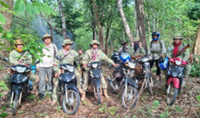
Ranger reveals how animals suffer after getting trapped
IPOH: They are the guardians of the jungle, often witnessing firsthand how wildlife is abused at the hands of man.
Or poachers, to be more precise.
“They would use various methods to trap wildlife, including cable-trigger snares and artificial bamboo salt licks,” said Yahya Charol, who is from the Jahai tribe.
He said the most common – and most cruel – is a wire snare tied to a tree.
“When an animal gets caught, the wire tightens around its leg or neck.
“The more the animal struggles, the tighter it gets, leaving the animals badly injured suffering from broken bones or to die slowly.
“Some animals would even chew off their own legs to escape, but the wounds often get infected and survival on three legs is very difficult. It’s very sad.
“Some animals, such as bears, have been found with severe injuries after being caught in snares,” Yahya told The Star.
He is one of the many rangers on the front lines protecting wildlife when WWF-Malaysia launched Project Stampede in 2018 to protect the Malayan tiger in the Royal Belum State Park.
In the earlier days, there were only about 30 rangers to patrol the vast forest. Today, that number has grown to 150, including women rangers.
About 70 of them patrol Royal Belum while the rest are stationed in Temenggor.
Their patrols are not only about tracking wildlife but also about confronting poachers who come into the forest with snares, ropes and machetes.
“These poachers would do their research. They know exactly which areas hold which type of animals,” said Yahya.
“Some also carry firearms, but we rarely encounter those. Most of the time, what we see are items for setting snares.”
Yahya said most foreign poachers carry these items in white sacks.
Some of these poachers, he said, came from Thailand, Myanmar, Vietnam and Cambodia.
While the rangers are trained to stay calm, encounters with poachers can still be unpredictable.
“Generally, there has never been violence when we meet them in the forest.
“Usually, they either try to strike up a conversation with us or they simply run away,” he said.
Sometimes, poachers attempt to charm or bribe their way out of trouble.
“Besides cigarettes, they also try to offer us food, drinks or money, but we don’t accept them.
“Our duty is to protect the forest and wildlife, not to befriend poachers,” Yahya added.
Instead, the rangers would note the locations and report them to the Perak State Park Corporation and the Wildlife and National Parks Department (Perhilitan).
However, he said face-to-face encounters are rare although their tracks are often spotted.
“We rarely meet them, but more often we see signs like footprints, food packaging or temporary camps. It is rare that we come face to face with them.
“Before the ranger patrol initiative under Project Stampede, we frequently ran into poachers. After more community rangers were appointed as patrol teams, poaching incursions have reduced significantly,” he said.
It was previously reported that active snares in the forest had dropped by almost 90%.
Yahya said that any type of animal can be trapped even if it is not the poachers’ intended target.
And injuries from snares can easily become infected, he said.
Without immediate treatment, he said the likelihood of the animal dying is very high.
Besides tigers being hunted for their body parts, which fetch high prices on the illegal market, he said animals such as elephants, sun bears, wild boars, sambar deer and gaur (seladang) are also targets of poachers.
“If they fail to snare a tiger, they’ll take whatever is trapped to eat or just leave the animal to die.
“If the animal is still alive, we immediately report it to Perhilitan and other authorities. If it is dead, we also report it and remove the snare, so no other animal becomes a victim.
“Our main job is to locate and destroy snares, to protect wildlife from suffering,” he added.