



PETALING JAYA: Concerned over the projected double-digit increase in medical insurance costs next year, some employers are reviewing their healthcare plans to ensure long-term financial sustainability, says the Malaysian Employers Federation (MEF).
Its president Datuk Dr Syed Hussain Syed Husman said employers may eventually be forced to reduce coverage or shift part of the cost burden to employees if systemic reforms are not done by the relevant stakeholders.
He noted that the trend of double-digit increases in medical insurance costs is unsustainable in the long term.
Syed Hussain said employers have reported that insurers are imposing steeper premium renewals for medical insurance and stricter terms, such as higher deductibles and exclusions, especially for high-claim groups.
This, he said, is particularly challenging for micro, small and medium enterprises (MSMEs), considering they lack the bargaining power or risk pool size to negotiate better terms.
He said while most employers remain committed to maintaining medical benefits as part of their total rewards strategy, many, especially MSMEs, are already struggling to balance escalating operational costs, statutory obligations and employee welfare commitments.
“MEF observed that most employers are not slashing benefits outright but rather adopting strategic adjustments,” Syed Hussain said.
This includes reviewing policy limits and introducing co-payment or shared cost schemes to manage overutilisation, as well as shifting towards managed care models or corporate healthcare partnerships that promote preventive care and cost control.
ALSO READ: INTERACTIVE: Malaysia's medical inflation to rise to 16% in 2026, says Aon
Other strategies include exploring flexible benefit structures that allow employees to choose coverage based on their personal needs and priorities.
Syed Hussain said employers have been encouraging employee wellness programmes to reduce long-term claims through healthier lifestyles.
They are also negotiating with insurers for customised plans that better reflect workforce profiles and risk levels.
Syed Hussain acknowledged that drastic cuts to medical benefits will undermine employee morale, retention and employer branding, particularly in an increasingly competitive labour market.
MEF urged insurers, healthcare providers and the government to work collaboratively with employers to curb medical cost escalation through greater transparency and standardisation in healthcare pricing.
It also urged incentives for preventive and primary care usage instead of costly hospitalisation, and policy interventions that promote value-based healthcare, as well as better cost management within the insurance sector.
“While employers are taking prudent steps to manage medical costs, the priority remains on sustaining fair and reasonable healthcare coverage rather than cutting benefits.
“A systematic, multi-stakeholder approach is essential to maintain both cost control and employee protection in the long run.
“Employers are increasingly educating employees on the true cost of healthcare and promoting a culture of shared responsibility to ensure the sustainability of medical benefits.”
Syed Hussain was commenting on the findings of the recently released Mercer Marsh Benefits (MMB) 2026 Health Trends report, which revealed that medical trend rates remained persistently high.
After averaging close to 11% globally in 2024 and 2025, insurers forecast an 11% year-over-year increase in medical plan claims cost per person in 2026.
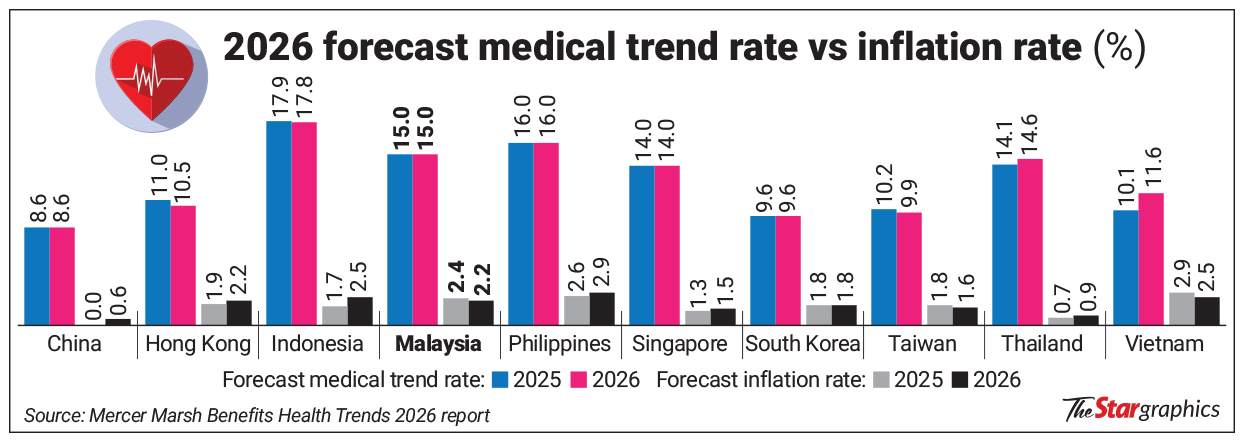
Insurers expect a 12.5% medical trend rate across Asia for 2026 and 15% for Malaysia.
MMB reveals that 63% of insurers in Asia anticipate reductions in coverage to manage cost increases in 2026, up from 43% in 2025.
Steven Yu, Mercer Marsh Benefits Asia Leader, said the findings are a wake-up call.
“Another year of widespread double-digit medical trends across Asia is a wake-up call: cutting benefits may ease budgets now, but it shifts financial risk to employees and undermines retention,” said Yu.
He said employers should partner with insurers on data-driven plan design and targeted funding for high-cost claimants, and tackle inefficiency and waste.
Yu said both sides should also prioritise preventive care and funding innovations for mental health to preserve essential protection and long-term affordability.

