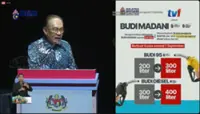
KUALA LUMPUR: The government is ready to increase the Budi95 monthly fuel quota to 800 litres for e-hailing drivers who meet travel distance requirements, says Datuk Seri Anwar Ibrahim (pic).
The Prime Minister said e-hailing drivers are currently eligible for 600 litres a month, an initiative which has benefited some 58,000 drivers.
He said some in the e-hailing sector, however, feel that 600 litres is insufficient.
“We are looking into it. If this information is true and records support it, the government will agree to increase the quota up to 800 litres a month for eligible e-hailing drivers,” he said during the Prime Minister’s Question Time in the Dewan Rakyat yesterday.
“This will cover 5,000km but is subject to terms and conditions.”
Anwar also said the government has agreed to list airport taxis as vehicles eligible for subsidised RON95 fuel under the Subsidised Petrol Control System scheme.
Meanwhile, the Finance Ministry said in a statement that the tiered eligibility scheme under Budi95 for e-hailing drivers will be activated in the middle of each month.
Only e-hailing drivers who exceed 5,000km will be eligible for up to 800 litres.
“Those who drive less than 2,000km will receive the basic 300 litres, while those covering between 2,000km and 5,000km will be eligible for an additional 300 litres (for a total of 600 litres),” it said.
Travel distance data will be verified by the Land Public Transport Agency (Apad) and the Commercial Vehicles Licensing Board (LPKP) in Sabah and Sarawak based on monthly reports from e-hailing operators.
“The new threshold has been lowered from 3,000km to 2,000km, with the addition of a new category for those exceeding 5,000km, following the ministry’s study of e-hailing drivers’ travel patterns and actual subsidy usage,” it said.
As for airport taxi drivers, the ministry said operating companies could apply for a fleet card under the Subsidised Petrol and Diesel Control Scheme, which is managed by the Domestic Trade and Cost of Living Ministry.
With this, they can enjoy up to 800 litres of subsidised RON95 petrol per month.
As for consumers, Anwar said only 0.7% have exceeded the 300-litre quota, with the majority using an average of 98 litres a month, or 33% of their eligible quota.
He said that as of the end of last month, 13.1 million people had utilised the Budi95 scheme.
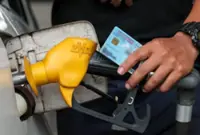
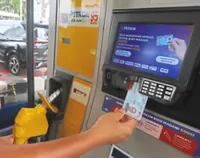
Under Budi95, Malaysians aged 16 and above with a valid driving licence are eligible to buy up to 300 litres of subsidised RON95 per month using their MyKad.
On Oct 31, e-hailing drivers said the current 600-litre monthly RON95 quota under Budi95 is insufficient for their daily operations.
They urged the government to raise the limit to at least 1,000 litres per month.
Anwar was responding to a question from Syerleena Abdul Rashid (PH-Bukit Bendera) about the progress of the first month of the Budi95 programme and the measures taken by the government to resolve emerging issues, particularly regarding the eligibility of airport taxi drivers, e-hailing drivers and riverboat users under Budi95.
Syerleena also asked about the rationale for the provision of subsidised fuel at RM1.99 per litre for 85% of Malaysians, including high-income groups.
“The challenge with implementation arises when we consider T15.
“If we initially set a target of RM13,000 per month and then increase it to RM20,000 per month, it still places pressure on the upper middle class.
“So, we intended to raise it to around RM50,000 per month, but the number of affected individuals is very small. In terms of enforcement, the cost associated with enforcement is high.
“So, we will implement this first and if needed, we can introduce it later, but only for high-income people or luxury car owners. That is the issue,” added Anwar.
He also disagreed that the RM2.5bil savings from the fuel subsidy rationalisation are low.
“Some have said that this is lower than initially targeted based on World Bank studies. I disagree because we are looking at subsidy rationalisation as a whole.
“From diesel, we saved RM5bil. This was largely because the old system experienced significant smuggling, which was a concern.
“From electricity, we saved RM6bil; from chicken, the floating pricing saved RM1bil and from eggs, RM1bil.
“In my opinion, this provides a solid foundation for the government to proceed with caution, ensuring that the burden on the people is not excessive,” the Prime Minister added.
In response to a supplementary question from Suhaizan Kaiat (PH-Pulai) regarding the projected savings from the fuel subsidies scheme for 2026, Anwar said the government aims to achieve a minimum savings of RM2.5bil for that year.
He also said the government would consider the needs of the differently abled community for fuel subsidies, and a specific form will be prepared for them.