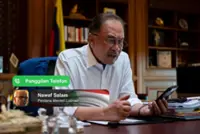
PETALING JAYA: Malaysia’s newly signed trade deal with the United States has sparked concern over possible sovereignty risks, as unlike Cambodia’s version of the same agreement, Malaysia’s pact contains no explicit clause protecting national sovereignty, says Datuk Seri Dr Wee Ka Siong (pic).
The MCA president said the omission raises serious questions about whether Malaysia could be pressured to align with Washington’s trade and security positions, including sanctions against key trading partners such as China, Iran and Russia.
“Why is it that Cambodia can, but Malaysia cannot?” Dr Wee asked in a video posted on his social media.
“The Cambodian deal clearly states that its commitments apply only if they do not affect national sovereignty. Ours, however, has no such safeguard,” he said.
Dr Wee warned that the absence of this clause could erode Malaysia’s long-standing policy of neutrality in global affairs.
He also expressed concern over provisions requiring Malaysia to consult the United States on prescribed security standards for technology suppliers, a move he said could jeopardise the country’s autonomy in telecommunications procurement.
“Given that Washington has banned Huawei and ZTE, will U Mobile be forced to cancel its plan to use their 5G technology, even though theirs is 20% to 40% cheaper than Western alternatives?” he said.
U Mobile has formalised a partnership with Huawei and ZTE to roll out Malaysia’s second 5G network.
On another concern, Dr Wee said the deal appeared to benefit the United States more than Malaysia, pointing out that while Malaysian exports worth around RM22bil could enjoy tariff relief, US goods valued at RM75bil would receive priority access here.
The real gain for Malaysia, he said, could be as little as RM1bil, only 0.2% of the country’s GDP.
He also criticised clauses restricting export limits on critical minerals, saying they could prevent Malaysia from developing its own value-added industries.
“This lets American firms buy our raw materials freely, without investing in local downstream sectors,” he said.
Dr Wee further questioned provisions requiring Malaysia to recognise US product certifications, including those issued by the US Food and Drug Administration, saying they could undermine local regulators such as the National Pharmaceutical Regulatory Agency and the Malaysia Islamic Development Department’s halal standards.
Another article, he said, compels government-linked companies (GLCs) such as PETRONAS, Khazanah Nasional and Tenaga Nasional Bhd to operate strictly as commercial entities rather than policy-driven institutions.
“If GLCs give preference to Malaysian companies or projects aimed at strengthening domestic industries, it could be interpreted as breaching the agreement,” he said.
“That limits our room to use GLCs as tools to empower local businesses.”
Dr Wee also questioned why the deal was signed without public consultation or parliamentary scrutiny.
“Has the entire government agreed to all these clauses? Why was it not tabled in Parliament for debate?” he asked.
“Malaysia must remain free, neutral and sovereign in charting its own economic future.”
The Malaysia-US Agreement on Reciprocal Trade was signed in Kuala Lumpur on Oct 26, the same day Washington inked a similar pact with Cambodia.
Framed as a market-opening deal, it aims to cut or cap tariffs, ease non-tariff barriers, speed up customs and digital trade, strengthen intellectual property and labour standards, and deepen cooperation on supply-chain security and sensitive technologies.
It also sets expectations on export-control and sanctions alignment, treatment of state-owned enterprises, and recognition of certain US certifications.