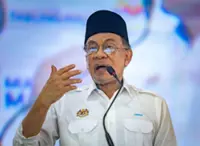
KUALA LUMPUR: Over the past two years, the government generated an income of RM15bil by confiscating assets and reclaiming funds lost to corruption and syndicates, says Datuk Seri Anwar Ibrahim.
The Prime Minister emphasised the need for justice and equality in economic development, adding that merely implementing Islamic financial instruments is insufficient if the underlying system is plagued by corruption.
Anwar, who is also the Finance Minister, said this at the Global Islamic Finance Forum 2025, which was attended by global Islamic finance experts on Monday (Oct 13).
Also present was Finance Minister II Datuk Seri Amir Hamzah Azizan, Bank Negara Malaysia Governor Datuk Seri Abdul Rasheed Ghaffour and Malaysia International Islamic Finance Centre (MIFC) Leadership Council (MLC) Chairman Tan Sri Azman Mokhtar.
Anwar argued that Islamic finance must address poverty and governance issues, rather than just Islamising financial instruments.
He cited the principles of Sharia, particularly Maqasid Sharia, as offering limitless opportunities to present a viable financial alternative.
"Timeless principles of Sharia (Islamic laws), particularly the understanding of Maqasid Sharia (objectives of Sharia), enabled boundless possibilities for us in the Islamic finance sector to focus on our ability and capacity and to showcase and present a viable alternative to finance,” he said.
He criticised the global trend of unbridled capitalism, including in Muslim countries, for neglecting values and humanity.
"Our understanding of economic development should be adjusted to encompass societal concerns related to human quality and justice. We tend to confine ourselves to unbridled capitalism, as do most countries, including Muslim countries,” he added.
Referring to Adam Smith's "The Theory of Moral Sentiments," Anwar noted the persistent issue of inequality and the challenges of post-colonial economic systems.
He advocated for reform by integrating Islamic principles into financial systems to enhance their effectiveness.
Anwar praised Caliph Umar Abdul Aziz's legacy of poverty eradication as a model of governance.
“The major concern in economic development is justice and equality. The legacy of Caliph Umar Abdul Aziz for example is that his major task during his tenure was the effective eradication of poverty from the Arab world to Azerbaijan as this has to do with the issue of governance.
"However effective an Islamic financial instrument is, if we operate the system in poor governance, endemic corruption, and abuse of power, it will not reach the desired needs of maqasid syariah.
He stressed the need for continued good governance to prevent financial losses due to corruption.
"We must start with good governance, and we must always remind leaders and civil servants that we must work together. While pursuing the higher aims of competitiveness and profits through financial instruments, we must not ignore the importance of value and good governance.
"Otherwise, these instruments will be working in systems that condone leakage and corruption," said Anwar.
The eighth edition of the Global Islamic Finance Forum, themed Bridging Tradition and Tomorrow: Advancing Business, Empowering Communities, was organised by Association of Islamic Banking and Financial Institutions Malaysia (AIBIM) with support from Bank Negara Malaysia.