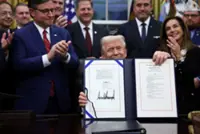
PETALING JAYA: The ongoing US government shutdown has generated uncertainty in global markets.
As one of Malaysia’s largest trade partners, the United States plays a crucial role in the local economy, particularly in sectors such as electrical machinery, semiconductors and optical instruments.
A prolonged shutdown could disrupt trade flows, delay customs clearance, and affect travel and logistics, with potential spillover effects on Malaysia’s exports and investor sentiment.
Economics professor Dr Yeah Kim Leng said the short-term impact on Malaysia’s trade and currency would likely be muted, as essential services such as customs and trade documentation in the United States remain operational.
However, he noted that the broader uncertainty triggered by the shutdown could weaken consumer and business confidence.
“A slowdown in the US economy poses a greater risk to Malaysia’s exports, especially semiconductors that are heavily influenced by US demand,” he said.
Malaysia’s largest export sector, the electronics and electrical (E&E) industry, would be the most exposed if US consumer demand weakens.
“Reduced orders from US tech firms would directly impact local semiconductor and component manufacturers,” said Prof Yeah.
On a brighter note, the situation could provide some relief for Malaysian importers.
“A stronger US dollar and weaker commodity prices could ease input costs. Given Malaysia’s high food import bill, lower commodity prices could benefit food processing companies and help stabilise domestic food inflation,” he said.
He recommends that Malaysia expand its network of free trade agreements, explore emerging markets in the Middle East, Central Asia and Africa, and attract “China+1” investments by positioning itself as a preferred destination for firms diversifying their supply chains.
“It could incentivise China+1 inflows by positioning Malaysia as the prime destination for companies, including US firms looking to implement a China +1 supply chain strategy,” he said.
Prof Yeah added that Malaysia, as the Asean Chair, will have a strong advantage in improving economic cooperation with other Asean countries.
“With Malaysia being the Asean Chair, we are strategically positioned to advance Asean regional deepening through greater economic cooperation and fostering trade and investment and business linkages with each other.
“In Budget 2026, the government has introduced the Asean Business Entity programme to facilitate trade and investment in the region.
“This could be promoted to Asean members to stimulate intra-regional trade and investment, which in turn will help to reduce Malaysia’s dependency on other markets,” he added.
Economist Geoffrey Williams shared a similarly calm outlook, noting that US government shutdowns are not new and that markets generally absorb them well.
“Federal government shutdowns are not that uncommon. There have been 11 since 1980.
“Markets mostly priced them in and there is relatively little effect unless they are prolonged,” he said.
He added that the current shutdown, now in its 11th day, would only begin to affect trade and tourism if it continues for several more weeks.
“The longest was 35 days under the previous Trump presidency. Most are short. Unless this one is prolonged, it will have no more effect than an extended holiday or a technology breakdown,” he said.
Williams said exporters could face slower customs clearance and travellers might encounter immigration delays if the situation persists, but he stressed that there was no cause for alarm.
“Nobody really benefits except companies offering work-around solutions and rerouting.
“There is no need for the Malaysian government to do anything. Businesses just have to solve it themselves,” he said.