
PETALING JAYA: The extension of childcare tax relief to cover children up to 12 years old is long overdue.
Welcoming the change as one of the more people-centric measures in this year’s Budget, tax expert Datin Christine Koh, managing partner of Owen KLCA PLT, said such good news would bring meaningful relief to working parents.
“It’s long overdue. Parents will really benefit from this,” she said when contacted in response to the government’s Budget 2026 announcement yesterday.
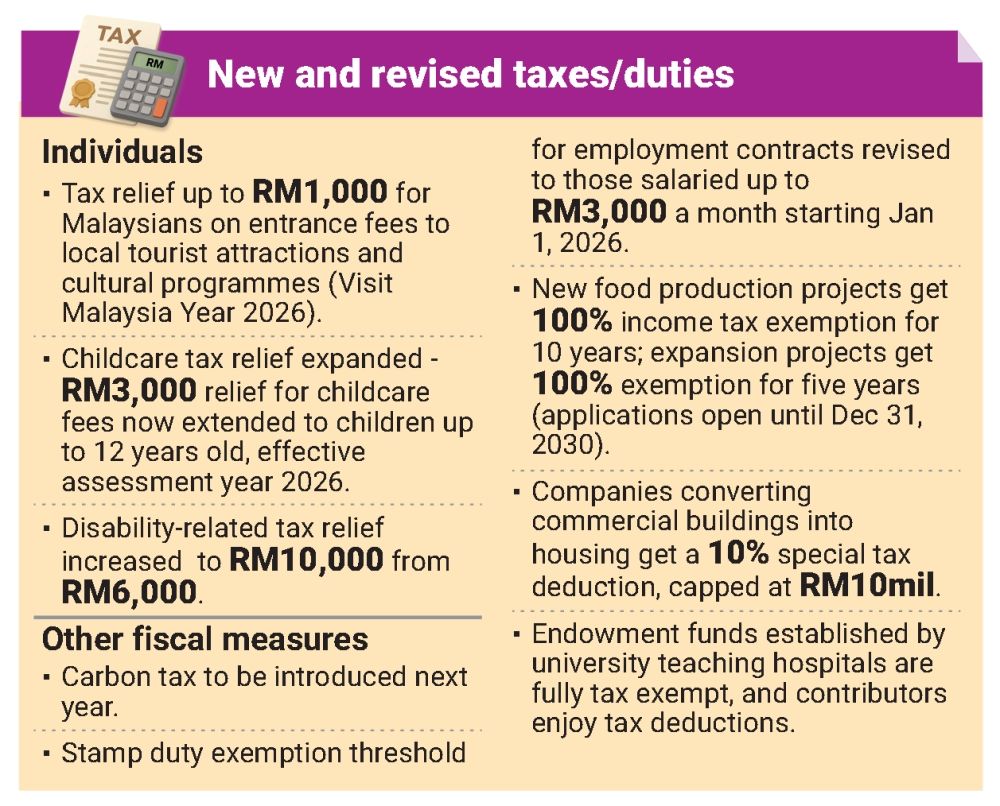
Under Budget 2026, the government has expanded the childcare fee relief from RM3,000 for children aged six and below to those aged up to 12, effective from the 2026 year of assessment.
Koh said this is a practical move reflecting modern family realities, where both parents often work and childcare costs continue to rise.
“It’s a small change on paper but will make a big difference for many households. Extending this relief recognises that childcare doesn’t end at pre-school – it’s a real financial burden for parents even in the early school years,” she said.
Koh also described the increase in excise duties on cigarettes and alcohol as expected but reasonable.
“The increase in sin tax is expected – it happens almost every year. It’s good for public health and helps the government raise funds,” she said.
The government had announced a two-sen increase per cigarette stick and a 10% rise in liquor and alcoholic beverage excise duty, effective next month.
Koh welcomed the absence of new broad-based taxes such as the goods and services tax (GST) or capital gains tax, saying it would help maintain public confidence and support domestic consumption amid global economic uncertainty.
“It shows that the government is being cautious and disciplined, focusing instead on efficiency and targeted incentives,” she noted.
On the tourism sector, Koh commended the government’s decision to offer generous incentives ahead of Visit Malaysia 2026, including tax deductions of up to RM500,000 for refurbishing tourism premises and full income tax exemptions on inbound tourism income.
“The tourism tax incentives are very attractive and should bring a strong positive impact to the tourism and hospitality industry,” she added.
However, she noted that the application process for tax incentives is often lengthy, typically taking between six months and a year for approval.
“The government should consider simplifying and speeding up the application and approval process. Perhaps those who already meet the qualifying criteria could be allowed to claim the incentive directly in their income tax return without having to submit a separate application,” she said.
Koh added that a faster and more streamlined process would encourage more tourism operators to invest, renovate and market their businesses in time to support the government’s tourism goals.
She further highlighted the extension of the Approved Food Production Tax Incentive (APFI) to 2030 as an important support mechanism for the agri sector.