
PETALING JAYA: From easing tuition costs to expanding scholarships, Budget 2026 puts education at the forefront of national priorities – with RM84.8bil dedicated to ensuring every Malaysian, regardless of income, has a fair chance at higher learning.
The sector will receive the largest allocation with RM66.2bil going to the Education Ministry and RM18.6bil to the Higher Education Ministry.
The amount marked an increase from last year’s allocation of RM82.1bil.
This year’s budget places strong emphasis on making education more affordable and accessible, particularly for students from underprivileged backgrounds, say stakeholders.
Malaysian Association of Private Colleges and Universities (Mapcu) president Datuk Parmjit Singh said Budget 2026 places greater focus on ensuring fair and inclusive access to higher education, particularly through initiatives targeting underprivileged students, as well as enhanced funding for scholarships, loans and tax relief for the private sector.
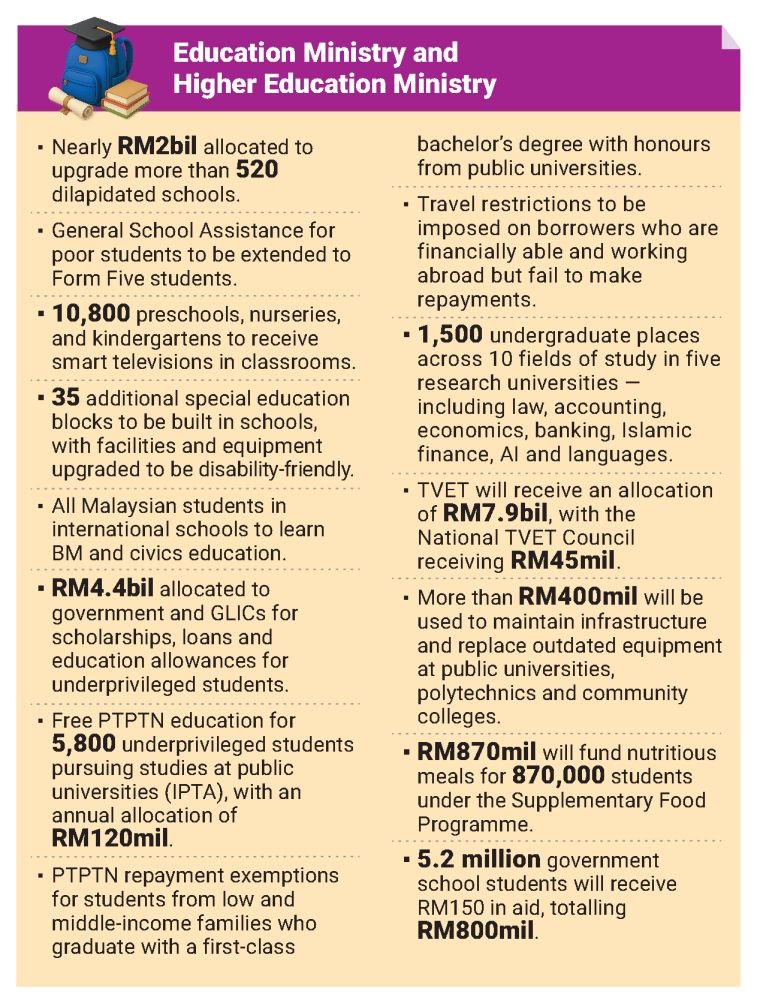
He also noted that the RM4.4bil allocation in scholarships, loans, and education allowances for underprivileged students should also cover those in private higher education institutions to ensure all students can pursue their studies and careers of choice.
He also welcomed the National Higher Education Fund Corporation (PTPTN) repayment exemption for students from low- and middle-income families who graduate with first-class honours bachelor’s degrees from public universities.
“This would ensure these students are able to transform the quality of their lives and that of their families as they embark on their careers without being burdened with loan repayments,” he said.
Parmjit added that the double tax deduction for private sector scholarship expenditures, including professional qualifications, will further encourage industry investment in human capital development.
“Budget 2026 clearly leans toward expanding access and fairness in higher education,” he added.
National Association of Private Educational Institutions (Napei) deputy president Dr Teh Choon Jin said the initiative will encourage more students from low-income backgrounds to pursue their studies at public universities.
“When students know that their tuition will be fully covered, it reduces a huge amount of stress and helps them focus on learning and completing their degree,” he said.
“At the same time, we hope that similar assistance can also be extended to deserving students studying in private higher education institutions.
“It’s also important to remember that many students who cannot secure places in public universities turn to private institutions to continue their studies,” he said, adding that there are students from B40 and M40 families in private institutions.
He urged universities to work closely with PTPTN and relevant agencies to ensure the aid goes to students who need it most.
Melaka Action Group for Parents in Education chairman Mak Chee Kin welcomed the government’s annual allocation of RM120mil to provide free PTPTN education for poorer students, but urged for clearer definitions and stronger safeguards.
“I hope there will be a proper mechanism to ensure the scheme is strictly targeted at those who truly need it,” he said, adding that eligible students should also meet minimum academic requirements to prevent a rise in dropout rates.
Mak also commended the provision of 1,500 undergraduate places, but suggested these be reserved for Sijil Tinggi Persekolahan Malaysia (STPM) high achievers who often face an uneven playing field in university admissions.
As for the Technical and Vocational Education and Training (TVET) sector, which received RM7.9bil, up from RM7.5bil, Universiti Tun Hussein Onn Malaysia Faculty of Technical and Vocational Education’s Prof Dr Razali Hassan said the increased allocation for TVET will enhance upskilling, reskilling, and talent development initiatives to meet future industry needs.
He, however, lamented the lack of specific provisions for vulnerable groups.
“The main purpose is to reduce the gap between high income and low income groups, besides encouraging more job creation through training and entrepreneurship.
“However, more focus is needed to include vulnerable and marginalised groups like the urban poor,” he said.