



Jamie Ling
Group chief executive officer
AmBank Group
BUDGET 2026 – the first budget under the 13th Malaysia Plan (13MP) – continues with the balanced approach in maintaining fiscal discipline, attracting and promoting new investments from both domestic and foreign investors and driving social upliftment.
Over the past three budget cycles, we have seen economic stability and policy certainty, which have benefited the economic sectors and increased investor confidence.
While policy clarity has continued to build confidence, external risks remain elevated. To cushion households, we are encouraged by continued government cash handouts, namely, Sumbangan Tunai Rahmah (STR) and Sumbangan Asas Rahmah (Sara), alongside targeted subsidies.
These automatic stabilisers will help sustain private consumption amid a challenging external environment.
We laud the Budget 2026’s allocations on High Growth High Value (HGHV) sectors, notably semiconductors, renewable energy, and AI-driven MSMEs, aiming to support the key Madani-related master plans priorities. These policies are paramount in positioning the economy to reach a RM2 trillion target by 2030.
Budget 2026’s emphasis on the services sector will benefit from higher digitalisation adoption through automation tax incentive, Islamic finance expansion, and tourism prospects.
Meanwhile, initiatives to support high-tech exports through the New Industrial Master Plan (NIMP) Industrial Development Fund, strategic investments by Khazanah and Kumpulan Wang Persaraan (KWAP) in the semiconductor system, alongside targeted financing for high-value activities, will drive the industry towards achieving a RM1 trillion export potential by 2030.
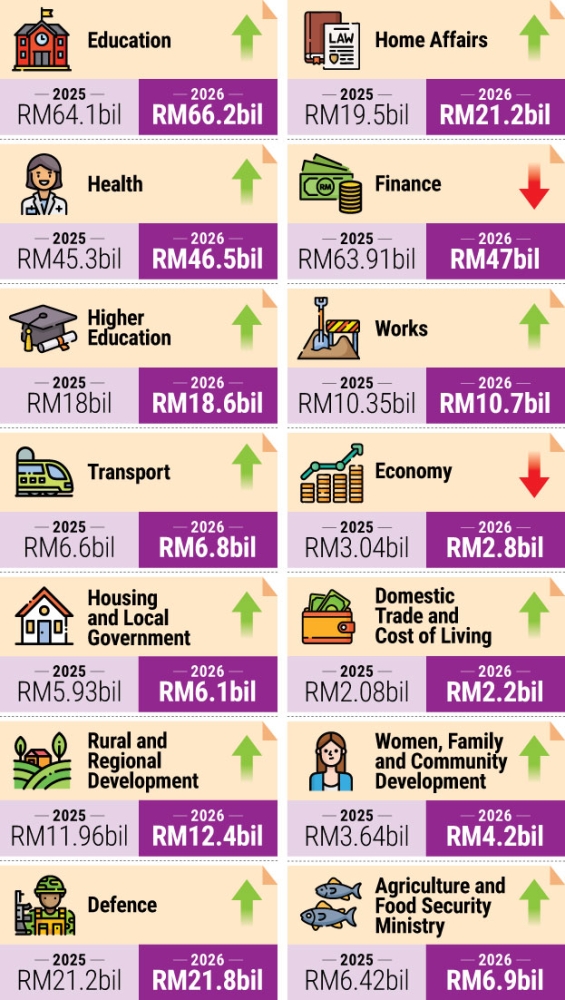
Budget 2026 allocates RM81bil for development expenditure, representing 18.8% of the RM430bil allocation under the 13MP.
We take it as a phased rollout strategy that prioritises fiscal discipline while laying the foundation for high-impact projects.
This also suggests a targeted approach to allow for mid-term recalibration amid a challenging external environment.
Corporate Malaysia, particularly large and SME firms, will benefit from Budget 2026’s emphasis on inclusive and green growth, as well as innovation-led development.
We at AmBank believe Budget 2026 strikes a commendable balance between securing Malaysia’s economic growth and maintaining fiscal discipline.

Amar Huzaimi Md Deris
Managing director/Group chief executive officer
Telekom Malaysia Bhd
WE are encouraged by the government’s strategic intent to advance the Sovereign AI Cloud and establish an AI Transformation Centre, which embodies Malaysia’s determination to lead in a digital-first world. We align closely with this direction through TM Cloud Alpha Edge, our platform built to safeguard national data sovereignty while enabling innovation across industries. We are also proud that Multimedia University (MMU), our education arm, has been recognised as part of this journey to develop future AI talent and research excellence.
Recognising the budget’s focus on people, TM is heartened to see continued support for MSMEs, TVET and capability building, alongside the expansion of Kampung Angkat Madani and Sekolah Angkat Madani.
These initiatives remind us that true progress happens when communities are empowered, opportunities are created, and every Malaysian is able to participate meaningfully in the nation’s progress and digital journey.
Nehchal Khanna
Chief executive officer/managing director
QSR Brands (M) Holdings Bhd
BUDGET 2026 presents a well-balanced framework for long-term economic reforms while maintaining the momentum of growth and safeguarding the resilience of the economy.
The budget focuses on returning benefits to the people through emphasis on governance, targeted subsidies for the rakyat, championing high-value economy, talent development, employment and wage empowerment, and social welfare and inclusion.
We commend the budget in driving economic growth and placing the rakyat first by highlighting the following initiatives: Sumbangan Tunai Rahmah (STR) and Sara Madani increases short-term disposable income, stimulating low and middle-income purchasing power and maintaining food retail demand amid inflation.
While Kos Sara Hidup Fund and Payung Rahmah support low-priced menu initiatives and reduces inflationary pressures on essentials.
The Tourism 2026 incentives and tax reliefs will drive higher footfall in tourist hotspots, boosting domestic consumption through tourism growth.
We welcome the government’s fiscal strategy, particularly its efforts to broaden the tax base and optimise expenditure through targeted subsidies.

Datuk Nik Amlizan Mohamed
Chief executive officer
KWAP
BUDGET 2026 continues to advance the Ekonomi Madani vision of building a more competitive, inclusive and sustainable Malaysia.
Through our GEAR-uP initiatives via Dana Pemacu and Dana Perintis, KWAP remains committed to mobilising capital that strengthens Malaysia’s investment ecosystem and catalyses the next engines of national growth.
To this end, RM1.2bil has been allocated under Dana Pemacu to build a vibrant domestic investment landscape, focusing on high-growth sectors such as energy transition and food security.
Complementing this, the combined investment under KWAP’s Dana Perintis and Khazanah’s Jelawang Capital will increase to RM750mil (from RM550mil) to accelerate the startup and innovation ecosystem, nurturing enterprises that contribute to technological advancement and job creation.
At the same time, KWAP and Khazanah Nasional Bhd will jointly invest RM550mil in the chip ecosystem, a strategic move to deepen collaboration between local firms and multinational players, strengthening Malaysia’s position as a global hub for high-value manufacturing and advanced technology.
Datuk Ho Hon Sang
President
Rehda Malaysia
WE laud the continued provisions made for first-time homebuyers, such as the stamp duty exemption for memorandum of transfers and loan agreements for homes priced up to RM500,000 that has benefited many buyers, for two more years until December 2027.
The expansion of the Housing Credit Guarantee Scheme (SJKP) to RM20bil, expected to benefit 80,000 future homeowners, will also continue to spur the housing market.
We also take note of the extension of the Youth Housing Financing Scheme under the Public Sector Home Financing Board (LPPSA), as well as the increase of financing to up to RM1mil.
The latter will ease the purchase of second homes, especially for those who are upgrading to a better home to meet their new needs.
Meanwhile, Rehda awaits clarification on the tax exemption for the modification and conversion of commercial buildings to residential, which will lift a significant financial pressure on the developers undertaking these tasks.
However, the association would like to express our trepidation pertaining the announcement to increase the stamp duty for foreign residential ownership, from the current 4% to 8%.
This seems to be contradictory to the government’s aspirations to bring in more foreign investments and may be seen as a deterrent for these investors to set up base in Malaysia.
