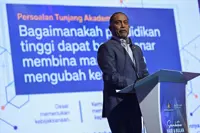

Prime Minister Datuk Seri Anwar Ibrahim said this is in line with the 13th Malaysia Plan, which lays the foundation for educational reform so that the learning system is more comprehensive and agile in responding to future demands.
A total of 38 new schools and two new special education secondary schools will be built to meet the needs of local communities while another RM100mil has been allocated to build additional classrooms in more than 100 high-density schools.
A total of 350 new preschool classes will be built within existing buildings, with an allocation of over RM100mil.
To ensure underserved children get an education, RM150mil will be allocated for the Federal Small Scholarship while RM870mil will be allocated to the Supplementary Food Programme.
The General School Assistance for poor Form Three students will also be extended to Form Five with a total allocation of RM180mil.
All 5.2 million students will also receive the RM150 Early School Aid next year, amounting to RM800mil, with the money being channelled to parents through the teachers.
In line with digital literacy demands, smart televisions will be supplied to 10,800 preschools, nurseries and kindergarten classrooms nationwide with an allocation of RM70mil.
There will be 35 additional blocks for special education built in existing schools at a cost of RM700mil while all 150,000 students with disabilities will receive an allowance of RM150 per month, with an allocation of RM270mil.
A total of RM115mil has been allocated to train teachers for the 2027 curriculum preparation and STEM pedagogy.
International schools must ensure the implementation of Bahasa Malaysia and civic education for all Malaysian students.
At the same time, proficiency in the English language within the national education system should be prioritised starting from the primary level.
Meanwhile the Higher Education Ministry has been allocated RM16.5bil with more than RM400mil going towards maintaining infrastructure and replacing outdated equipment at public universities, polytechnics and community colleges.
A total of RM4.4bil has also been allocated to the government and government-linked investment companies (GLICs) in the form of scholarships, loans and education allowances for underprivileged students to continue their education.
As for the private sector, they will be given double tax deductions on scholarship expenditures for eligible students, including undergraduate scholarships.
It also extends to professional qualifications, including those in ICT, engineering, accounting and finance.
Ikhtiar Dapur Madani, an initiative under the Higher Education Ministry with an allocation of RM26mil, will provide students with cooking equipment and raw ingredients.
It will also provide food assistance to needy students through CSR contributions from the private sector.
About 5,800 underprivileged students pursuing their studies at public universities will be provided free education via the National Higher Education Fund Corporation (PTPTN), with RM120mil allocated annually.
PTPTN repayments will also be exempted for all students from low and middle-income families who graduate with a first-class bachelor's degree with honours from public universities.
This will benefit around 6,000 borrowers with an annual allocation of RM90mil.
At the same time, borrowers who are financially able and working abroad will face travel restrictions if they fail to make repayments.
To increase access to education, the government will add 1,500 undergraduate places across 10 fields of study in five research universities – including law, accounting, economics, banking, Islamic finance, artificial intelligence (AI) and languages – for outstanding students, including STPM graduates, to pursue their studies.
To strengthen the medical field, the government has approved two public–private partnership projects – the Universiti Kebangsaan Malaysia Health Technopolis and the Universiti Malaya Health Metropolis. In addition to serving educational purposes, these projects will also expand access to modern healthcare facilities for residents around Petaling Jaya and Kuala Lumpur.
Public university lecturers who are founders of spin-off companies are allowed to take a one-year research or sabbatical leave for the purpose of R&D commercialisation.
As for technical, vocational education and training (TVET), RM7.9bil has been allocated, especially to support high-priority sectors.
The National TVET Council will receive RM45mil, among others, to incorporate digital technology and AI knowledge for 10,000 tahfiz and pondok students through the IPT@Komuniti Programme.
Institutions under the Ministry of Education will be provided with RM1.3bil to educate 79,000 TVET students.
The facilities of TVET institutions will be upgraded including a new hangar will be built at ADTEC Shah Alam for aircraft maintenance and a TVET Marine Teaching Shipyard Complex will be constructed at UMT for the maritime field to support blue economy development.