
PETALING JAYA: The battle against online child exploitation is going up a notch with the Malaysian Communications and Multimedia Commission (MCMC) working with national and global authorities to protect young people.
“We take the issue of offensive content against children very seriously. These include content deemed exploitative, harmful or inappropriate under Malaysian laws and platform community guidelines,” said MCMC.
It pledged to continue to strengthen collaboration with digital platforms and law enforcement agencies to ensure swift action is taken against harmful online content, particularly those that exploit or endanger children.
The commission acknowledged that the evolving digital landscape had led to parents facing increasing difficulties in safeguarding their children.
Criminals are using AI-generated deepfakes, end-to-end encryption, virtual private networks and the dark web to remain anonymous and evade law enforcement, it said.
Many operate on encrypted or private platforms, MCMC said, adding that the cross-border nature of certain services poses additional enforcement challenges.
“Unlawful or harmful content is also referred to the police for investigation under the Penal Code and other laws,” the MCMC told The Star in response to concerns about harmful online content involving children.
According to the MCMC, it will issue takedown requests to licensed platform providers when unlawful or harmful content is detected or reported.
“And where applicable, the Internet Service Providers (ISPs) would be required to restrict access, pursuant to statutory notice under the Communications and Multimedia Act.”
As for offences beyond the provisions of the Act, MCMC will refer the matter to the police.
“MCMC will provide the necessary technical expertise and coordination (if requested).”
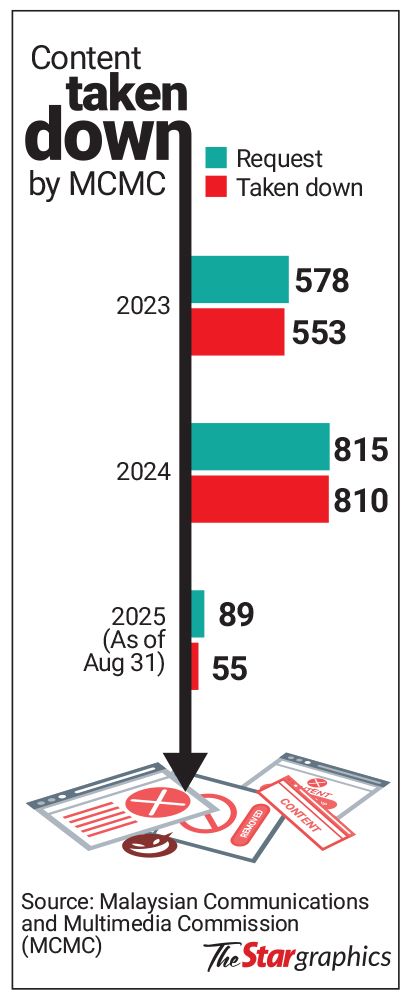
As of Aug 31, a total of 55 pieces of harmful content had been removed, in contrast to 810 in the previous year and 553 in 2023.
“Even though the cumulative figures appear reduced compared to previous years, this should be viewed in the context of ongoing actions still in progress,” MCMC said.
“For this year, there was no removal activity recorded between January and April. However, from May onwards, cases began to emerge, peaking in June with 21 removals. The number continued to increase gradually until August.
“This upward trend indicates stronger detection efforts and growing cooperation with platforms in the latter half of the year.”
The MCMC said platform providers should play a more active and accountable role in combating online sexual exploitation.
Beyond enforcement, the commission said it would provide long-term preventive strategies, such as nationwide digital literacy and advocacy programmes.
For example, the Communications Ministry launched the Safe Internet Campaign (KIS) through the MCMC in January.
This nationwide campaign focuses on providing digital safety education for children, parents and educators to address risks such as cyberbullying, online grooming, scams, misinformation and exploitation.
“KIS aims to reach over 10,000 schools and educational institutions, building resilience and awareness at every level of society,” it said.
The MCMC is also encouraging parents to take a more engaged role in their children’s digital lives and provide guidance to support them.
“By equipping families with practical tools and knowledge, MCMC supports a whole-of-society approach to online safety, where parental involvement remains one of the most effective lines of defence,” it said.