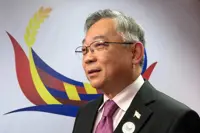
KUALA LUMPUR: The upcoming Regional Comprehensive Economic Partnership (RCEP) Summit in October will deliberate on the inception of new members, the importance of openness in trade and investments, and other issues, says Tengku Datuk Seri Zafrul Abdul Aziz (pic).
The Investment, Trade and Industry Minister said that after the fourth RCEP Ministers’ Meeting at the Asean Economic Ministers (AEM) meeting, it was agreed that all leaders under the trade bloc should meet.
Tengku Zafrul said the proposed RCEP Summit could take place on the sidelines of the 47th Asean Summit from Oct 26 to 28.
“The agenda is to talk about the importance of trade and investment within the 15 economies or RCEP.
“Second, about how we should continue to be open when it comes to trade and investment, even be open to new applications or to join RCEP,” he said.
Finally, said Tengku Zafrul, the RCEP summit next month will talk about how to operationalise RCEP better.
“We will talk about the dedicated RCEP secretariat focused on RCEP so that RCEP can be upgraded,” he added.
Tengku Zafrul also said four countries - Chile, Bangladesh, Hong Kong and Sri Lanka - have expressed interest in joining RCEP.
“Those are the four. We will wait for the announcement,” he said.
Japan’s Economy, Trade and Industry Minister Yoji Muto, who was the co-chair of the fourth RCEP Ministers’ Meeting, said there were some different views, but many members were “very positive.”
“There are different views and many of them were very positive, so we coordinated well with other members,” he said when met by reporters after the meeting.
He said seeing an increase in member countries was a good direction.
“I am sure that officials will do a good coordination job going ahead. It was a wonderful meeting today,” he said.
Observers have said Malaysia and Asean could leverage the world’s largest free trade agreement amid challenging and uncertain economic conditions with tariffs and growing protectionist policies in the US.
RCEP is a gateway to a market of more than two billion people, and the 15 participating countries account for about 30% of the world’s GDP.
Hong Kong, Sri Lanka, Chile and Bangladesh have expressed interest in joining RCEP.
RCEP involves all 10 Asean members and five key partners, namely China, Japan, South Korea, Australia and New Zealand.
It came into force in 2022 and aims to lower tariffs, boost investment, and allow for freer movement of goods within the region.