Malaysia Day is a reminder of the sounds that made us. Modernisation and globalisation bring progress, but they can also push the “old stuff” to the edges – among them the traditional instruments that give Malaysia its distinctive heartbeat.
Heritage doesn’t just preserve diversity; it helps us understand one another. In a nation of many cultures, each with its own musical lineage, that harmony matters.
That’s why mainstream artiste Noraniza Idris sees traditional music as a powerful tool – one that helps the young discover their roots.
For years, the Dikir Puteri singer has conducted classes to revitalise the Irama Malaysia genre and ensure the next generation stays connected to its distinctive sounds and dance style.
“Not many people are willing to teach the proper techniques of the Irama Malaysia style, which is why I conduct weekend classes at schools – to ensure this unique sound isn’t forgotten,” she said.
“There’s so much potential for Irama Malaysia, especially in tourism and cultural sectors.
“My aim is to equip anyone who’s interested – even those starting with no knowledge of the genre – so they can carry it further than what I’ve taught them,” she added.
Broadening the horizon
Inspiring curiosity in traditional sounds is also something Sarawak-born musician Anderson Kalang is passionate about.
A sape player from the Orang Ulu community, the 45-year-old is encouraged to see growing interest in the instrument not only in Peninsular Malaysia but also abroad.
Still, he admitted there are challenges, especially in terms of funding, resources and manpower.
“The idea is not just about promoting the sape but about building a self-sustaining industry for traditional instruments,” he said.
One approach he is exploring with sape is to conduct lessons in schools.
While he has faced roadblocks with public schools, Kalang says he has found interest among international schools in the Klang Valley.
If the paid sape lessons materialise in more schools, he hopes there will be a need for both trained sape players and tutors.
Furthermore, this would develop new players and ultimately contribute to Malaysia’s entertainment industry.
Another challenge lies in supply.
“The surge of interest in 2017 and 2018 was something I didn’t expect. It was very encouraging, but we simply weren’t prepared,” said Kalang.
That surge traces back to efforts that began in 2015, when he and fellow sape artistes from Sarawak, including Alena Murang and the late Saufi Aiman, formed the Kuala Lumpur Sape’ Collective with Seremban-based sape player Abishegam Thiyaga Dass.
“Our capacity to provide instruments in Peninsular Malaysia is limited because there are hardly any good sape makers here.
“Most instruments are still imported from Sarawak or Borneo, and they are not able to meet the demands,” said Kalang, who learned the instrument from his first cousin, Hezekiah Asim.
However, he added that these are good problems to have.
“A friend once joked, ‘You should stop teaching, because if too many people learn to play, you’ll be out of a job.’
“But I don’t see it that way. The more people I teach, it means the more good students I’ve helped nurture.”
One way he draws interest is by fusing sape with popular hits.
Last year, he accompanied British singer Calum Scott on You Are The Reason, creating a special “sape version”.
For him, blending the sape into contemporary genres is not about replacing tradition but extending it.
He compares it to the fern, a motif often found in Orang Ulu art. Its fronds curl and hold onto one another as they grow – symbolising wisdom, humility and mutual support.
“In the same way, cultural heritage binds communities together, allowing us to grow while staying rooted,” Kalang explained.
“When it comes to contemporary music, I can play almost every genre. I’ve explored rock, blues, a little bit of jazz, and even EDM effects. But whatever the style, it is always about highlighting the sape.”
Building bridges
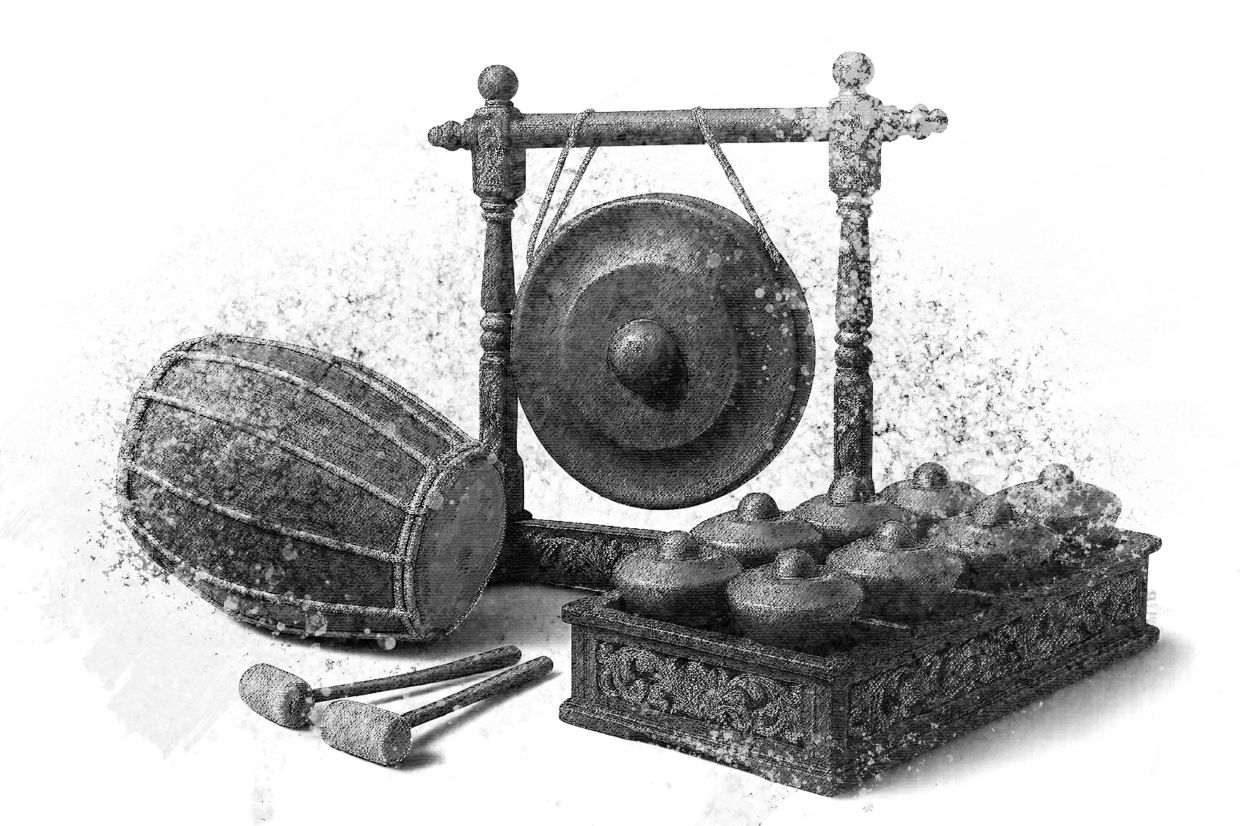
Similarly, gu zheng player Lum Yi Mann believes traditional instruments thrive when reimagined for today’s audiences.
Together with her husband Alex Tan, who plays the ukulele and ruan, they run Rockstars Production, covering popular songs with a unique twist.
“At Rockstars Production, Alex and I use the gu zheng and ukulele to show that traditional instruments aren’t just about heritage – they can be fun, versatile and a bridge that connects people across cultures and generations,” she said.
Lum, who began learning the traditional Chinese musical instrument at the age of five, remembers how difficult it once was to find a teacher or instrument.
“My dad had to ask a friend to bring one in from China.
“But the funny part is – his friend didn’t know the difference between nylon-string and steel-string gu zheng.
“He ended up choosing a nylon-string gu zheng, while the music centre I was enrolled in taught steel-string technique.”
These days, things are much easier, she said.
“There are many teachers and music centres now.
“Plus, with the Internet and social media, resources are more accessible for anyone who wants to start learning,” added the national gu zheng champion, who represented Malaysia in Hong Kong at the 2012 international gu zheng competition where she won the silver prize.
Lum said that staying connected with traditional instruments is “a way of remembering who we are and where we come from”.
“For me, the gu zheng grounded me in my roots. Playing a traditional instrument doesn’t mean being stuck in the past – it means carrying our heritage forward and giving it new life.
“That balance of tradition and modernity is what makes our identity unique,” she explained.
Beyond their work as a duo, the husband-and-wife team also formed Naungan, a group comprising Malaysians of other races who perform with traditional instruments.
Their shared goal is to unite people through music.
Alongside Lum on gu zheng and Tan on ruan, the group features Vickneswaran Ramakrishnan (tabla), Asri Sharizan (jidur and rebana), Yong How Yean (seruling and dizi) and Pravinraj Premkumar (sitar).
“We believe the responsibility of preserving and sharing traditional music doesn’t belong to just one community – it lies in all of our hands,” Lum said.
“Through Naungan, we bring our different instruments, traditions and stories together, showing that culture becomes even more powerful when it’s celebrated collectively.”
For National Day and Malaysia Day this year, the group offers its own rendition of Ella’s classic Standing In The Eyes Of The World, now available on YouTube.
The couple also believes that keeping traditional instruments alive must begin at home.
“That’s why we begin with our kids – not only teaching them the gu zheng, but also introducing them to instruments like tabla, seruling and many more,” said Lum, a mother of two.
“Children should grow up not only knowing their roots but also appreciating as well as respecting the music of others.”
Her hope is that small steps of appreciation, support and sharing will ensure these instruments remain relevant.
“Alex and I want people to see that traditional instruments aren’t relics of the past – they’re living voices that can inspire, connect and carry our culture forward together into the future.”
Click here to read more StarSpecial stories.