
PETALING JAYA: The voluntary Progressive Wage Policy (PWP) saw an overall 12% increase in median wages, the Human Resources Ministry revealed..
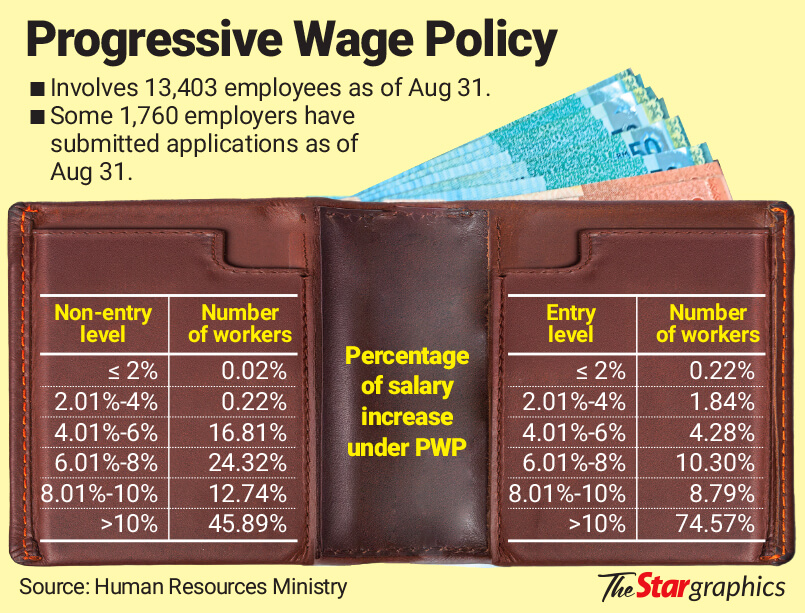
As of Aug 31, 13,403 employees from 1,760 firms joined the PWP.
For instance, entry-level workers who earned RM2,000, saw their median wage rise by 22% to RM2,440 under the PWP. The median wage for a non-entry level worker earning RM2,000 rose by 10% to RM2,200, the ministry told The Star.
The most employer applications was in Selangor with 600 (34.1%), followed by Kuala Lumpur at 245 (13.9%), Johor with 163 (9.26%), Sarawak with 117 (6.65%), and Perak with 105 (5.97%).
The ministry said these outcomes underscored the effectiveness of the PWP in driving equitable wage growth across different categories of workers, particularly in uplifting the earnings of those at the entry level.
It said this contributed to the government’s broader objective of enhancing living standards and reducing wage disparities in the labour market.
At the non-entry level, 45.89% of workers who joined the programme received a salary increase of more than 10%. At entry-level, 74.57% received a salary increase of more than 10%.
“Data shows that 80% of entry-level and 91% of non-entry level workers received the maximum incentive amounts of RM200 and RM300 respectively,” it said.
The ministry said the PWP was to ensure fairness between bosses and workers through a win-win formula, with training having a crucial role in boosting individual and company productivity.
Training enabled workers to effectively enhance their skills, knowledge and efficiency, it said.
“This concept is designed at addressing a key concern of employers, that an increase in wages should be aligned with improvements in a worker’s skill and productivity.
“For workers, training is vital for personal and professional development. By adopting a culture of lifelong learning, workers can acquire new skills and prepare themselves to face changes in the labour market,” the ministry said.
For companies, it said investing in training programmes could positively impact organisational competitiveness and productivity.
“By aligning training programmes with strategic business objectives, companies can enhance the capabilities of their workforce and adapt their business to changing industry trends,” it pointed out.
Collectively, the ministry said these outcomes reflect on the core aspirations of Malaysia Madani by promoting inclusive growth, strengthening human capital and advancing a sustainable and equitable labour market.
The ministry held 20 engagement sessions in all states with 3,763 participants.
The roadshows were not only aimed at seeking employer participation but also to provide an explanation of the concept and necessity of the PWP within the context of the national economy.
It also increased awareness among bosses and workers on the importance and benefits of the PWP, conveyed information about the PWP and allowed the ministry to obtain direct feedback from employers regarding the implementation and improvement of the policy.